
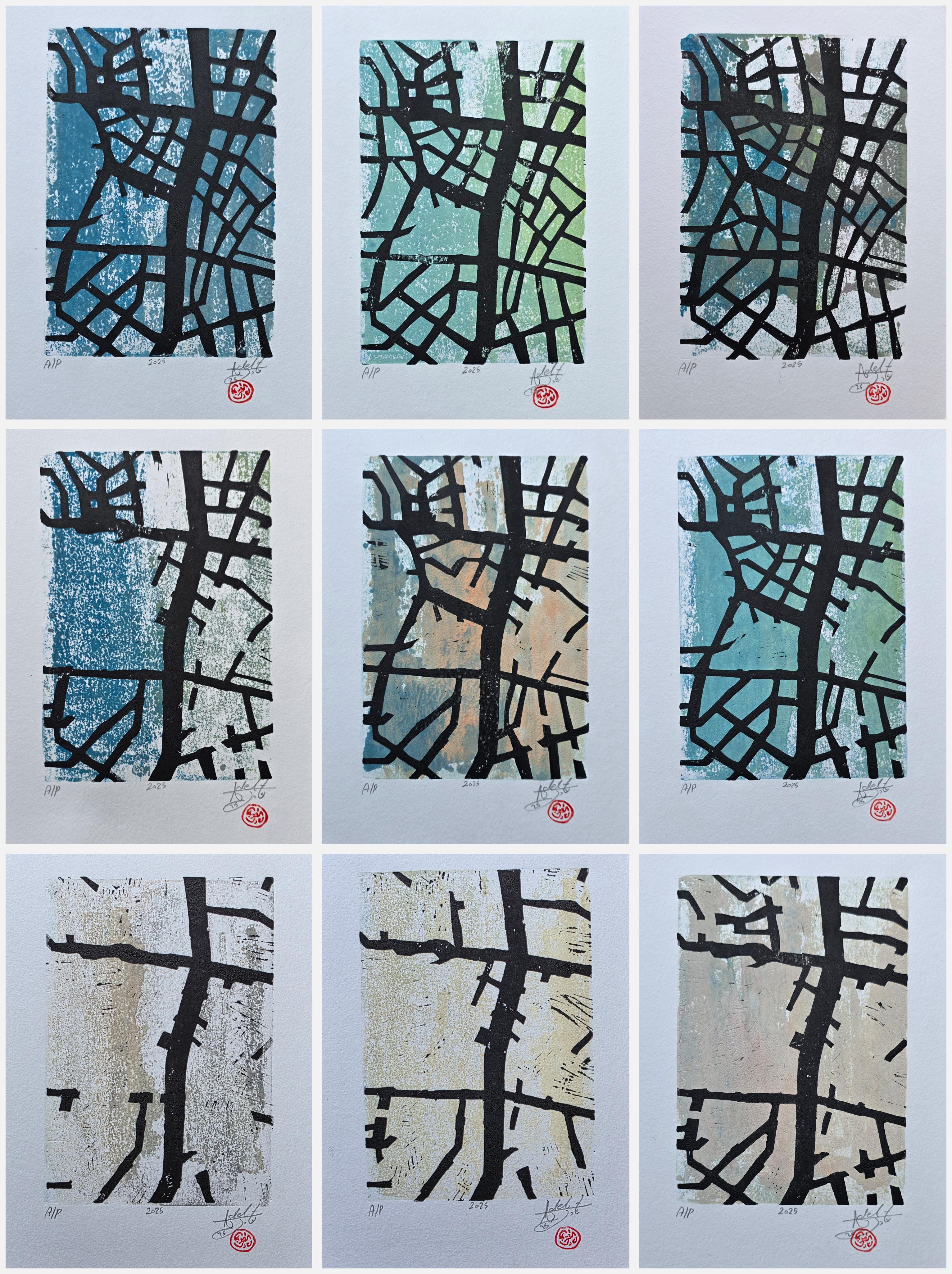
In the time of digital maps, Gaza has become featureless.1 I once knew the finest wrinkles of its narrowest streets, like a person staring at their own reflection, mapping every detail, which has now become unrecognizable.
The street that once passed from north of the camp to its south has been executed… yes, executed. In Gaza, roads are put to death. In Gaza, even buildings are executed.
This is work that does not ask, it mocks... it doesn’t ignore, it is deliberately ignorant...
I'm an “Arab” who coldly asks, “What have your maps become?”
They ask from a room equipped with water and electricity, with free time, a keyboard, and Internet… It's like they don’t know that an entire city’s been liquidated, length and breadth, streets and everything they contain... as though it were the result of an update on a map, in an application.
These paintings are not just lines and color, but proof of erasure.
They start with a palette of green, the color of life, the color of Gaza’s mornings, its beginnings.
They fade to gray, then to brown, then to the earthiness of human origins.
With every painting, the colors blend, steadfast against this erasure (genocide). The streets disappear,
Turning familiar maps into empty spaces, now only featuring a street or two.
From urban fabric to a void in geography
Maps fade, just as a missing person’s name fades among the lists of survivors.
This is not a visual representation.
It's a question, mocking and addressing those who naively ask, “What have your maps become?”
And I answer:
“……”
-
The project is funded by the “Cloud Museum” as part of the 2025 emergency grant program and by SAHAB Museum through the 2025 Urgent Grant Program. ↩