
It’s 3:00 am. My daughter is fast asleep next to me; I’ve been insomniac for weeks. On Instagram, I blearily type into my echo chamber: YOU DON’T HATE BORDER PATROL ENOUGH.
The caption accompanies a screen grab of masked, heavily armed Customs and Border Patrol agents (CBP) closing in on construction machinery. Mid-frame, a silver foil emergency blanket is visible, shoddily taped to the backside of a cement truck. There’s a person locked on to the equipment. The agents are attempting to suffocate them with built-up diesel fumes.1
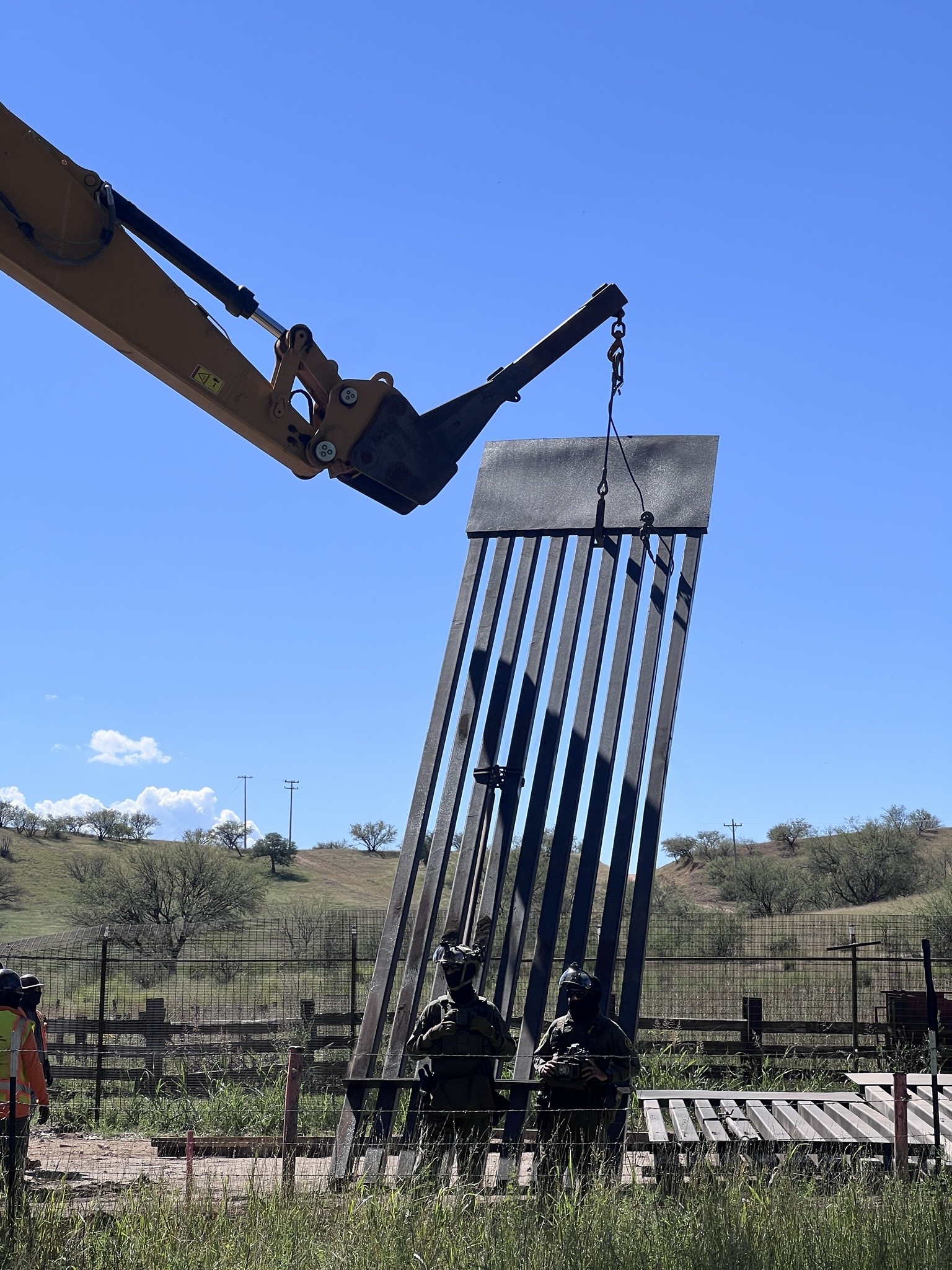
You don’t hate Border Patrol enough, because they are building a second wall alongside the already very much built first wall, which is already woven into the hypersurveillance dragnet of the very much physical “virtual wall” that runs along the US-Mexico border. You don’t hate them enough, because in the early hours of October 5, 2026, in the San Rafael Valley in Arizona, CBP agents—including the militarized tactical unit, BORTAC—raided land defenders’ nonviolent encampment in a 200-plus-year-old cottonwood tree in Lochiel, surrounding and arresting the activists during their sunrise prayer ceremony.2 CBP hacked down the tree shortly thereafter, a defender still clinging to its branches.
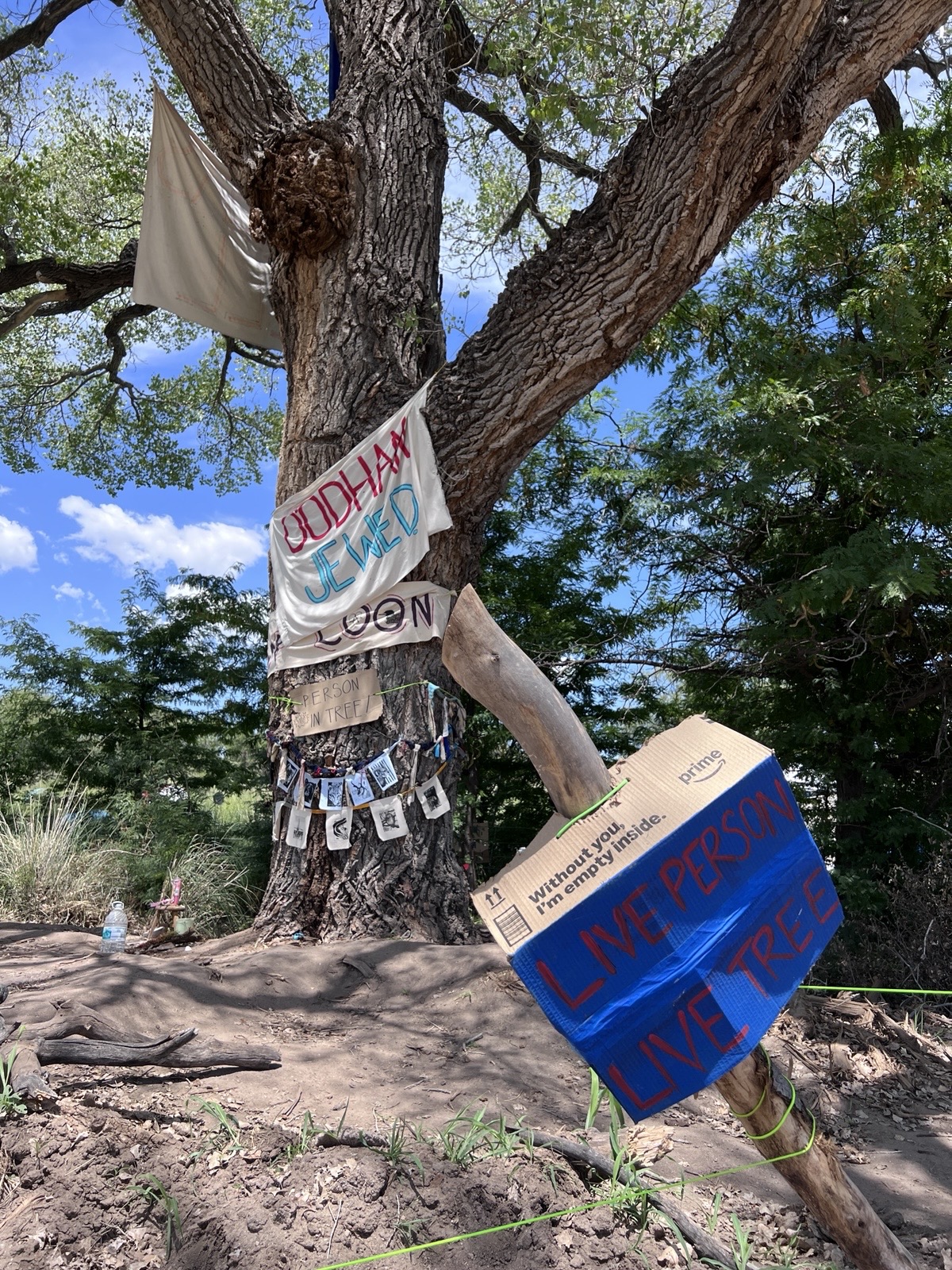
Every time I view this clip, my stomach twists into ever-tightening knots. Every time, the defenders’ guttural screams are drowned out by the tree’s cracking limbs, and then by the sound of its trunk thudding into drought-compacted caliche soil. This tree, this being, was decades older than the state of Arizona itself and about a century older than the so-called International Boundary. It was likely also much older than the Treaty of Guadalupe Hidalgo and the Desert Lands Act.
31°19'59.3”N 110°37'12.0”W—where the direct action campaign had endured since July 29, 2026—is occupied Indigenous Tohono O’odham land.
Populus fremontii trees, also called Frémont's cottonwood, are named for Major-General John Charles Frémont. The son of a French-Canadian immigrant, he led five Manifest Destiny–driven expeditions in the 1840s and served as a major in the Mexican-American War. Dubbed “The Pathfinder,” he directed massacres of Indigenous communities across present-day California and Oregon, including the Sacramento River massacre of the Wintu people, the Klamath Lake massacre, and the “preemptive” attack known as the Sutter Buttes massacre. All were part of the genocide of Indigenous peoples in California. He profited immensely from the pillage of the Gold Rush, and became one of the first US senators elected from the newly formed state in 1850. That same year, Frémont was awarded the Patron’s Medal by the Royal Geographic Society for his accomplishments—the society’s most prestigious honor.
Settler-colonial expansionism is fueled by the cannibalism of the people and lands that sustain its stakeholders; we needn’t explicate the histories of plunder in this territory to wholly grasp that the spoils of “exploration” and “discovery” by Frémont and his colluders are foundational to that of today’s fear- and warmongers, all of whom profit from an ever “untamable” West—a shape-shifting frontier they demand be fortressed ever tighter. Frémont was tasked by the Department of War to survey “the West,” just as CBP is emboldened by the Department of War to surveil these same Indigenous landscapes. Theirs is a continuum of marauding.
Frémont’s Report of the Exploring Expedition to the Rocky Mountains in the Year 1842, and to California in the Years 1843–44, is heralded as one of the most influential US government publications of the nineteenth century.3 His reconnaissance-cum-pilfering laid the foundations for the institutionalization of the War Department’s thievery and/as annihilatory legislation. Never mind the Native American Graves Protection and Repatriation Act (NAGPRA), or the ceaseless violation of sacred sites across a landscape stewarded since time immemorial.4 In the centuries of Manifest Destiny-like plunder since, the architectures of “The Wall” and the supply chains that bolster its unrelenting construction have proved fatal to human and more-than-human life. Beyond any single spool of concertina or surveillance tower’s footprint; beyond the mining and mineral extraction, tailings mismanagement, aquifer and water table poisoning and depletion; beyond the trenching and clear-cutting, “The Wall” amounts to an ecocidal terraforming project premised on the razing of all who might dare challenge it.
On January 20, 2025, the Trump administration invoked5 the National Emergencies Act (50 U.S.C. 1601 et seq.) section 12302 of Title 10 United States Code to “support the Federal Government’s response to the emergency at the southern border”:
I hereby declare that this emergency requires use of the Armed Forces and, in accordance with section 301 of the National Emergencies Act (50 U.S.C. 1631), that the construction authority provided in section 2808 of title 10, United States Code, is invoked and made available, according to its terms, to the Secretary of Defense and, at the discretion of the Secretary of Defense, to the Secretaries of the military departments.6
Tucked into this decree is the authorization to deploy “personnel and resources” (including the provision of “appropriate detention space”); construct additional physical barriers; waive all applicable Federal Aviation Administration and Federal Communications Commission regulations pertaining to the operation of unmanned aerial systems; and impede and deny unauthorized entry across the United States’ southern border.
IN WITNESS WHEREOF, I have hereunto set my hand this twentieth day of January, in the year of our Lord two thousand twenty-five, and of the Independence of the United States of America the two hundred and forty-ninth.7
In these years of our Lord, more drones to the border—to the Forever Frontier. It must be underscored that when CBP invaded Camp O:ṣhad (O’odham for jaguar) in Lochiel, the agents—as elsewhere—ignored demands to present warrants, covered their badges, and brutally assaulted land defenders who were actively engaged in a prayer ceremony. With more than 1,500 active-duty servicemembers deployed to the region on behalf of this “Operation Ardent Vanguard,” War Secretary Pete Hegseth boasted:
Mission accomplishment means 100% operational control of the border… Right now, that means a surge of manpower… We’ve seen thousands of active-duty and National Guard troops come to the border with additional assets and systems that allow us to surveil.8
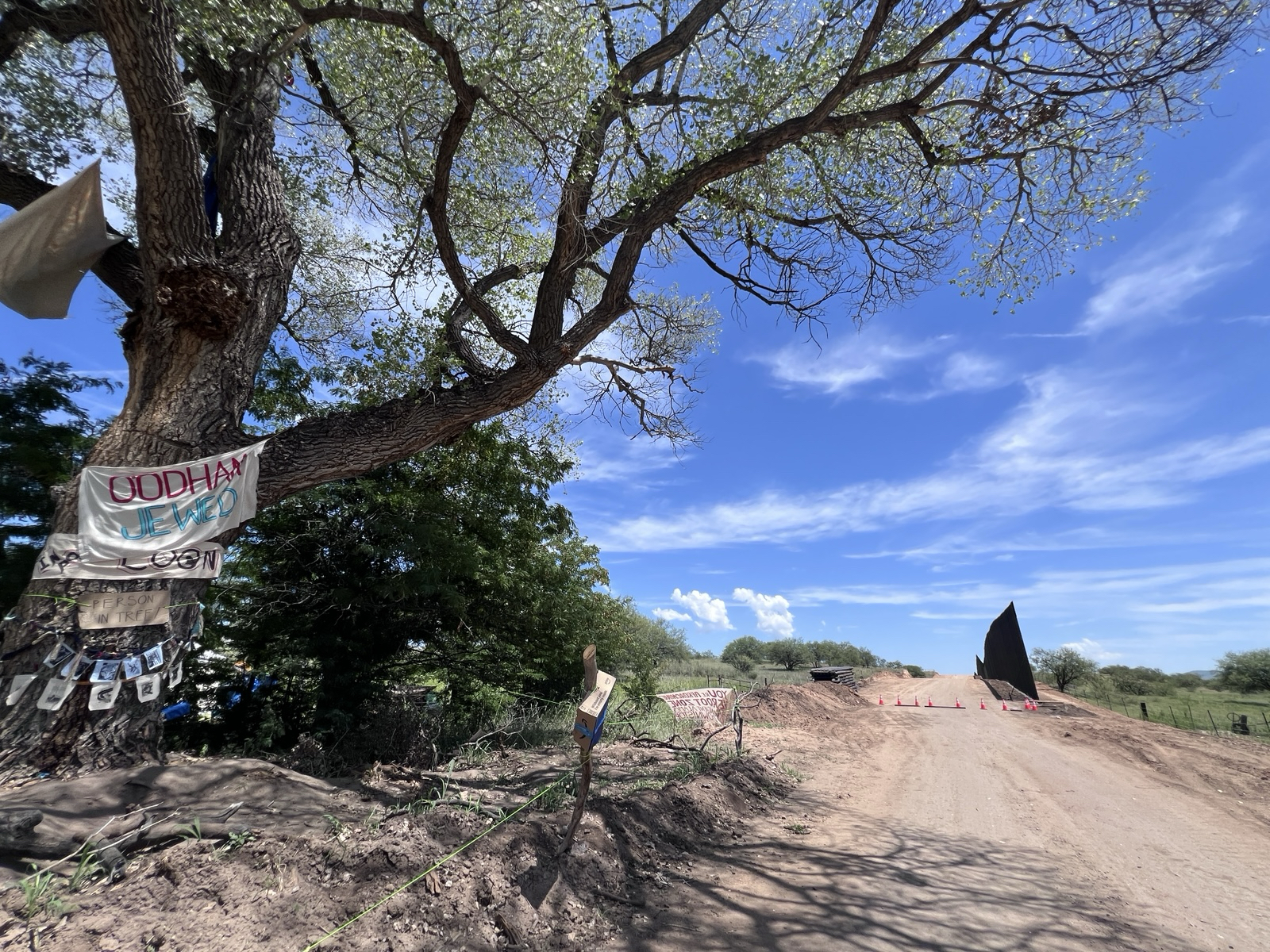
To expedite this “mission accomplishment,” the Department of Homeland Security awarded Tempe, Arizona-based Fisher Sand & Gravel Co. (hereafter Fisher) a $352.4 million contract:
(July 2025): NEW VERTICAL BARRIER BORDER WALL BORDER WITHIN THE TUCSON, ARIZONA SECTOR (TCA), THESE INCLUDE TCA 10-4, SONOITA AND TCA 10-6.9
I scour the Department of War’s contracts daily—a yearslong habit to assuage my anxiety (doesn’t help) and sharpen my qualitative pattern recognition (or rather, trace where billions in tax dollars hemorrhage). The multimillion-dollar sum is, at this point, no shock, and neither is the bombast of the recipient.10 Fisher, a privately held third-generation company established in Dickinson, North Dakota, specializes in gravel and sand and is thus far the largest beneficiary of the immigration spending frenzy of the Trump administration, landing almost one-fifth of the Department of Homeland Security’s “One Big Beautiful Bill” awards and counting.11
Prior to their overt involvement with Trump’s “Build the Wall” gimmick-as-policy, Fisher, whose labor and environmental controversies have already been covered at length, had long reaped profits from drilling, blasting, and excavating.12 Founded in 1952, the family
[turned the company] into one of the largest sand and gravel companies in the country. It has built bridges, levees, dams and freeways across the West, and sold mining and other heavy equipment to the construction industry. Tommy Fisher first became interested in barrier-building when Trump ran for office a decade ago, envisioning a completed wall along the nearly 2,000-mile-long southern border. “We started working on it almost two years ago when he first made some of his campaign pledges,” Fisher told Fox News in 2018 shortly after the company was selected along with three others to build concrete prototypes of the wall. “All the employees of Fisher Industries were very, very excited.”
This is your evergreen reminder that war—and its constellation of walls, biometrics, bullets, and bombs—is about what your neighbor does for a living.13 Still, to pin the cruelties of the ongoing wall construction entirely on Fisher would, of course, miss the bigger picture: matrices of bloodthirstiness-as-architecture, as “progress” relies not only on transnational so-called defense firms like Elbit, Anduril, Lockheed Martin, Raytheon, and Palantir, but also on thousands of their subsidiaries—many operating in the strip mall right up the road from you. For example, Barnard Construction Company, Inc., headquartered in Bozeman, Montana, has recently raked in upward of $7 billion in federal border-barrier and prime contract obligations for projects in New Mexico and Texas. Kiewit Infrastructure West and its subsidiary Southwest Valley Constructors are receiving billions from DHS and the US Army Corps of Engineers (USACE) for border-barrier and security infrastructure construction. The same goes for Cochrane USA, Inc., Spencer Construction LLC, BCCG Joint Venture, and SLSCO LTD. Assuming that the “borderlands” struggle is limited to the Sonora and Chihuahua Deserts is myopic; the task, rather, is to grasp and act on the research, development, manufacture, and testing of weapons and walls rearing their fangs on every continent and, increasingly, on every sea.14
I’m on the phone with a dear compa. Panicked, I blurt: It’s too late for all this. The trees are razed. They’re walling the walls and slaughtering our elders.
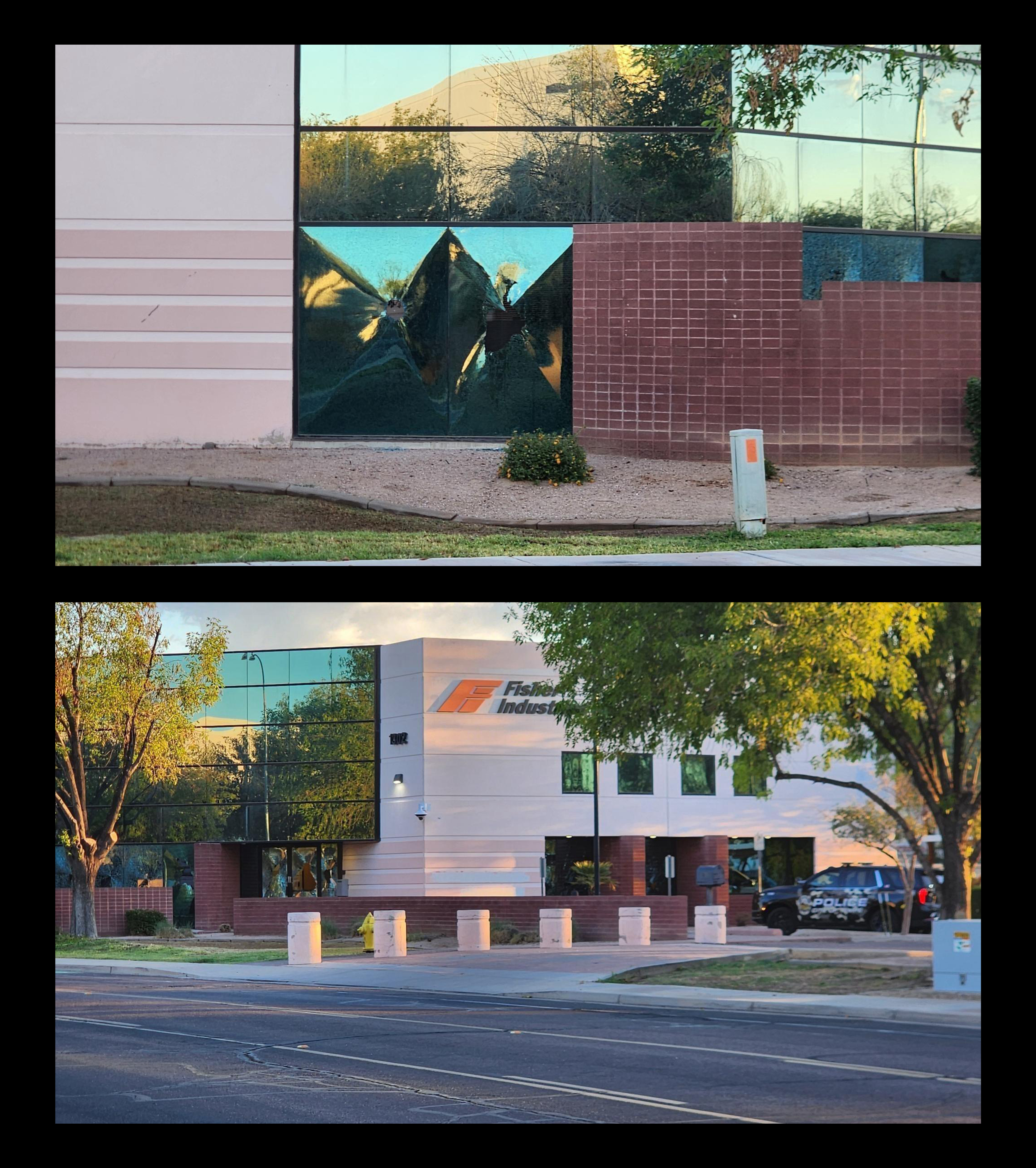
Later that night, my hollow gaze at the dark bedroom ceiling becomes a projector: Visions of Lochiel and our slain cottonwood flash before my eyes, and then so does Fisher headquarters in Tempe, Arizona. But then I think of how, on October 9, 2026, actionists smashed out the building’s windows. And so I also hear shouts of joy from the Filton 24, smashing up Elbit’s Aztec West, and I’m then pulsing with the assured rush of breaking into RAF Brize Norton, into Leonardo S.p.A., into Teledyne…15
I dream I held the sledgehammer. I dream you were holding the sledgehammer. Tierra libre.16 And I’m thinking that a way out from all this is resistance by any means necessary. I believe the trees agree.
-
I’ve seen several accounts of this story circulate, including Lookout’s October 9, 2026, coverage: “Person who locked themselves to a gravel haul truck to halt border wall construction in Lochiel, Arizona, says a Border Patrol agent threatened to take them to ‘a place where nobody can hear you scream,’ according to multiple witnesses. The person, who has not been publicly named, was locked to the truck for more than seven hours on the evening of Oct. 7. They used a ‘sleeping dragon,’ a protest device in which a person’s wrists are locked together inside a metal or PVC tube, making it much harder to cut them free. Alex Chabbott, who was previously arrested near Lochiel while protesting in a jaguar costume, recorded much of the standoff. Chabbott said agents used pain-compliance methods on the person. Chabbott and other activists said agents partly enclosed them with silver emergency blankets, subjecting them to exhaust and heat. Kate Scott, an organizer, said it looked like agents were ‘trying to suffocate them.’ ” See John Washington, “‘A Place Where Nobody Can Hear You Scream’: Witnesses Describe Border Patrol Crackdown at Lochiel,” Lookout, October 9, 2026, link. The reporter has since updated in a related post: “Statements attributable to BP spokesperson, ‘U.S. Border Patrol personnel conducted enforcement operations in the Lochiel, Arizona area in support of authorized border infrastructure activities on federally managed land. The operation was conducted in coordination with partner agencies to maintain public safety, protect personnel, and ensure compliance with applicable federal laws and land-use restrictions. While most activity remained peaceful, agents took appropriate enforcement action in response to alleged violations and an alleged assault on a federal officer. U.S. Border Patrol respects the public’s right to lawfully express their views. Individuals are expected to comply with lawful orders and avoid conduct that endangers others or interferes with authorized federal operations.’” See: j.bwashington and lookoutnews, Instagram, October 7, 2026, link. My plea is that you read this essay, and also the Border Chronicle’s coverage of this atrocity: Erin Patrick O’Connor, “Before the Wall: The Last Stand at Lochiel,” Border Chronicle, October 20, 2026, link. My other ask is that we slot this saga into a much longer history of environmental direct action spanning the globe. See Mayday Rooms, “MDRxCrab Museum: TREES ARE GOOD: Archives of Environmental Direct Action and Eco-Defence,” October 16, 2026, link. ↩
-
Max Granger, “Border Patrol Raids Camp O:ṣhad, Cuts Down ‘Grandmother’ Tree,” Writing on the Wall (Substack), October 5, 2026, link. ↩
-
Too vast to fully cover here, the report’s reach included its issuance to trade publishers and would-be settlers in New York, London, and across Germany—lauding the potential riches up for the taking across the “West”—and later to aspiring forty-niners. Additionally, copies were printed for the 27th Concress, Third Session, as Senate Document 243, Serial 416. Maps prepared by Charles Preuss accompanied Frémont’s report; while the “American West” had been “discovered” prior to Frémont’s 1842 expedition, this was a landmark document connecting/visualizing such reconnaissance for mass circulation (and, in lockstep, for thievery and destruction). ↩
-
Ryan Devereaux, “As Trump’s Wall Closes In, DHS Intimidates a Border Tribe with Surveillance, Masked Agents and Drones,” ProPublica, October 10, 2026, link; Ryan Devereaux, “Tribal Leaders Warned Border Wall Construction Would Disturb Native American Remains. They Were Right,” ProPublica, November 2, 2026, link. While too voluminous to cite here, I urge you to explore the scholarship, documentation, and voices from the ground interrogating treaty violations and infringements on Indigenous sovereignty, decimation of wildlife and waterways (such as A’al Vaipia—Quitobaquito Spring), and the expediting of migrant torture/extortion/disappearance/death in these borderlands—particularly in this era since the inauguration of CBP’s 1994 “Prevention Through Deterrence” policy. Moreover, the 2005 REAL ID Act authorized the Secretary of Homeland Security (presently Markwayne Mullin) to waive any and all legal requirements deemed necessary to “ensure expeditious construction of barriers and roads” along US borders. In April 2008, Secretary Michael Chertoff exercised his waiver authority to “waive in their entirety” the Endangered Species Act, the Migratory Bird Treaty Act, the National Environmental Policy Act, the Coastal Zone Management Act, the Clean Water Act, the Clean Air Act, and the National Historic Preservation Act to extend triple fencing through the Tijuana River National Estuarine Research Reserve near San Diego. ↩
-
The National Emergency Concerning the Southern Border of the United States (Proclamation 9844) was declared on February 15, 2019, in Trump’s first term. Steeped in on-brand controversy throughout the year related to the declaration, Trump extended Proclamation 9844 in February 2020 for an additional year; then repeated the one-year extension on January 20, 2021, the day he left office. ↩
-
The White House, “Declaring a National Emergency at the Southern Border of the United States,” January 20, 2025, link. ↩
-
The White House, “Declaring a National Emergency at the Southern Border of the United States.” ↩
-
US Department of War, “Defense Secretary Says Full Control of Southern Border Equals ‘Mission Accomplishment,’” February 3, 2025, link. ↩
-
USA Spending, “Contract Summary,” link. See also US Department of Defense [now US Department of War], “Contracts,” December 2, 2019, link). ↩
-
Sophie Alexander and Dylan Sloan, “Trump’s Border Wall Spending Creates a Billionaire Family,” Bloomberg, March 18, 2026, link. ↩
-
The “One Big Beautiful Bill,” which allocated $46.5 billion to “complete” construction of the US-Mexico border wall, is more than 1,100 pages long before Senate amendments and final reconciliation; to spare us from combing it in its entirety, key border-related fiscal astonishments include “SEC. 20011. IMPROVING DEPARTMENT OF DEFENSE BORDER SUPPORT AND COUNTER-DRUG MISSIONS. In addition to amounts otherwise available, there are appropriated to the Secretary of Defense for fiscal year 2025, out of any money in the Treasury not otherwise appropriated, to remain available until September 30, 2029, $1,000,000,000 for the deployment of military personnel in support of border operations, operations and maintenance activities in support of border operations, counter-narcotics and counter-transnational criminal organization mission support, the operation of national defense areas and construction in national defense areas, and the temporary detention of migrants on Department of Defense installations, in accordance with chapter 15 of title 10, United States Code.” See: H.R. 1 – An Act to Provide for Reconciliation Pursuant to Title II of H. Con. Res. 14, Congress.gov, link. ↩
-
See Perla Trevizo and Jeremy Schwartz, “DOJ Tried to Hide Report Warning That Private Border Wall in Texas Could Collapse,” ProPublica, December 2, 2022, link; Barnini Chakraborty, “Contractor Hopes for a Piece of Trump’s Border Wall—No Matter Who Pays for It,” Fox News, January 5, 2018, link); Washington Post, “How a CEO’s Repeated Appearances in Conservative Media Might Get Him the Border Wall Contract,” May 24, 2019, link; Alicia Inez Guzmán, “A New Section of the Billion-Dollar Border Wall in Arizona Is Bent Out of Shape,” High Country News, July 21, 2026, link. ↩
-
Max Porter, “Wild West,” Palestine Festival of London, December 2023, link. ↩
-
See, for example, Anduril’s latest “family” of autonomous underwater vehicles (AUVs) link, presently utilized by the US Navy (such as in the Strait of Hormuz) and the Royal Australian Navy. Also see NATO’s Arctic Sentry activity link. ↩
-
We wait on the the UK court’s final verdict regarding the de-proscription of Palestine Action (see Section 13 of the Terrorism Act 2000, and, more elusively, US Executive Order 13224 under the Department of the Treasury’s Office of Foreign Assets Control (OFAC)); meanwhile, Palestinian infants continue to freeze to death in Gaza. Meanwhile, the US-UK-Israel coalition continues to slaughter—such as the November 12, 2026, attack on the surgical building of the Nasser Medical Complex in Khan Younis. The GBU-39/B aerial bomb utilized was manufactured by Boeing in the United States. What comforts are you thus far unwilling to give up to end this? What will move you to act? ↩
-
Resistance in this land is deeply rooted; the grief and rage we hold will propagate new fierce and tender life: “Pieces of the cottonwood trees gathered by Southern Arizona environmental advocates now live on at Tohono Chul Sonoran Botanic Garden, where Jack Dash, gardens and facilities manager, has been tending to their propagation. In late October, the grandmother tree cuttings stood at about barely four inches… [Actionist Maxie Alder] sees the cottonwood cuttings for the first time since she dropped them off in July. ‘Wow, they’ve grown so much,’ she says, smiling down at the 32 sprouts in front of her, all lined on a shelf in an outdoor propagation garden. ‘This is that first round. We figured, until it gets cold, leave them out and let them get some real sunshine,’ Jack tells her. ‘And they’ve been growing really, really quickly, just starting to put roots out.’” See Stephanie Casanova, “ ‘Hope Is an Action’: Lochiel Cottonwoods Razed for Border Wall Live On in Cuttings and Ofrenda,” Arizona Luminaria, November 6, 2026, link. A line in this piece I want you to hold is, Grief is a way back into the world. ↩
Taylor Miller is a writer and researcher based between the Sonoran and Chihuahuan Deserts. She earned her Ph.D. in political geography from the University of Arizona. Taylor is a Contributing Editor and writer for Columbia University’s Avery Review. Other recent works are featured with Social Text, Disjunctions, The Contrapuntal, Kohl Journal, Al Mayadeen, Weird Economies, Shadow World Investigations, The New Inquiry, and Protean. She’s motivated by border abolition and cactus propagation.