
The idea for this text came from thinking about debates. Mostly about inane debates. The ridiculous debates. The ludicrous debates. The red-herring debates. The debates that debate that which is undebatable. It stems from the insistence that “room” must be created for debate, as if genocide is a matter of opinion and that conversations on whether to condemn it or not deserve space to take up. As if Palestinians must endure the indignity of debating those who think [their] only life choices should be to leave [their] homeland, submit to [Zionist] supremacy, or die quietly and politely.1 As if genocide necessitates that a room full of academics agree or disagree with the reality we see with our own eyes.
I offer a poem instead.
I offer a poem because my thinking about this more-than-past year—as I write, we’re more than 600 days into the genocide of Palestine—has been inspired by the poetry I’ve read. Poetry that defies the bureaucratic formality of diplomatic reports and evasive headlines; poetry that confronts the senseless condemnations of the Palestinians’ right to life. A poem for stones, a poem for paint. A poem for geodes hewn from the Earth. For the colorful rivers that erode prisons. A poem for seeds.2 A poem for cloth / and some strings.3 For thirsty roots, /… tunneling deep, deep, into the land!4 A poem for [teaching] life.5 For women chanting, drumming / on pots and pans / with goddamns and hasbiyallahs.6 A poem for that which makes life worth living.7 For necks. For steel. A poem for poems:
In September 2021, six Palestinian prisoners escaped from Gilboa Prison by tunneling out with a spoon. Among them was Zakaria Zubeidi of the Freedom Theater, further reminding us that the cultural revolt is inseparable from the material one. One of the other escapees, Mohammed al-Ardah, said they did it to show “the occupation is a mere illusion made of dust.” This illusion of dust coating our bodies, drowning us in cruelty. We move with Intifada to shatter the illusion.89
I write this poem and transform this page, this weapon, beyond the preconceptions I myself once held. Beyond a notion of poetry as something that merely rhymes nicely, or stanzas and prose that craft beautiful sentences, beautiful words, beautiful somethings or others. Beyond poetry that is not unlike those reports and headlines, and those calls to accept the oppressor’s “peace.”
I wonder if this poem could become a well from which to draw—as boundless and uncontrollable as the falling rain.
This poem will grow across our cities, across entire landscapes, unfolding into times that run alongside, rather than over each other. I imagine it growing until every encampment—from across our campuses to those of the houseless, from the in-progress ruins of cop cities and detention centers—and the various uptowns and midtowns and downtowns will blend into each other, dissolving our many Omelases, bright-towered by the sea.10
Omelas: an archetypal city of fabricated joy where the utopic bliss of many is enjoyed at the expense of a single, miserable child condemned to squalor. Omelas: guiltless and happy: with its avenues of trees and settlements of houses with red roofs and painted walls.11 Omelas with its magnificent fields and meadows, with its many old moss-grown gardens, and the cheerful faint sweetness of [its] air. Omelas and its free, happy people, but also: Omelas and its lone, cobwebbed cellar; Omelas and the child suffering in abominable misery within.
Ursula K. Le Guin wrote to us some time ago of Omelas, of the many inane debates and justifications given to rationalize this lone child’s pain, of those who keep it locked away in its windowless room. Never mind the cost of their happiness, the people of Omelas. Never mind how fragile that freedom really is that even the mere threat of guilt is enough to shatter their walls of illusions. Never mind the many hidden basements of our many Omelases; how damning the terms are; never mind all that is stowed away behind our finely crafted facades.
And yet, of those who choose to stay and make a life among injustice, there are always those who choose to walk away, reminds Le Guin.
Omelas is not our city by choice, per se, but it is what we have indeed made for ourselves. In this, our world, I ask: Who dares walk away with me? Who walks alone? Do we walk away together, toward a place even less imaginable to most of us than the city of happiness?12 Will we walk away from this sham of a utopia toward something real, something gritty and painful? Toward healing… imperfect, but capable of growth? When will we walk out of these damning cellars of ours and away from the gilded walls and gates? With purpose? With promise?
Empathy is selective in these Omelas cities, dissolving the pursuit of justice into muddled middle grounds where some farce of “understanding” is ushered in with crafted characters sharpened into words that slash through sense and solidarity.
Death to pity! And death to despair! It is time to act.
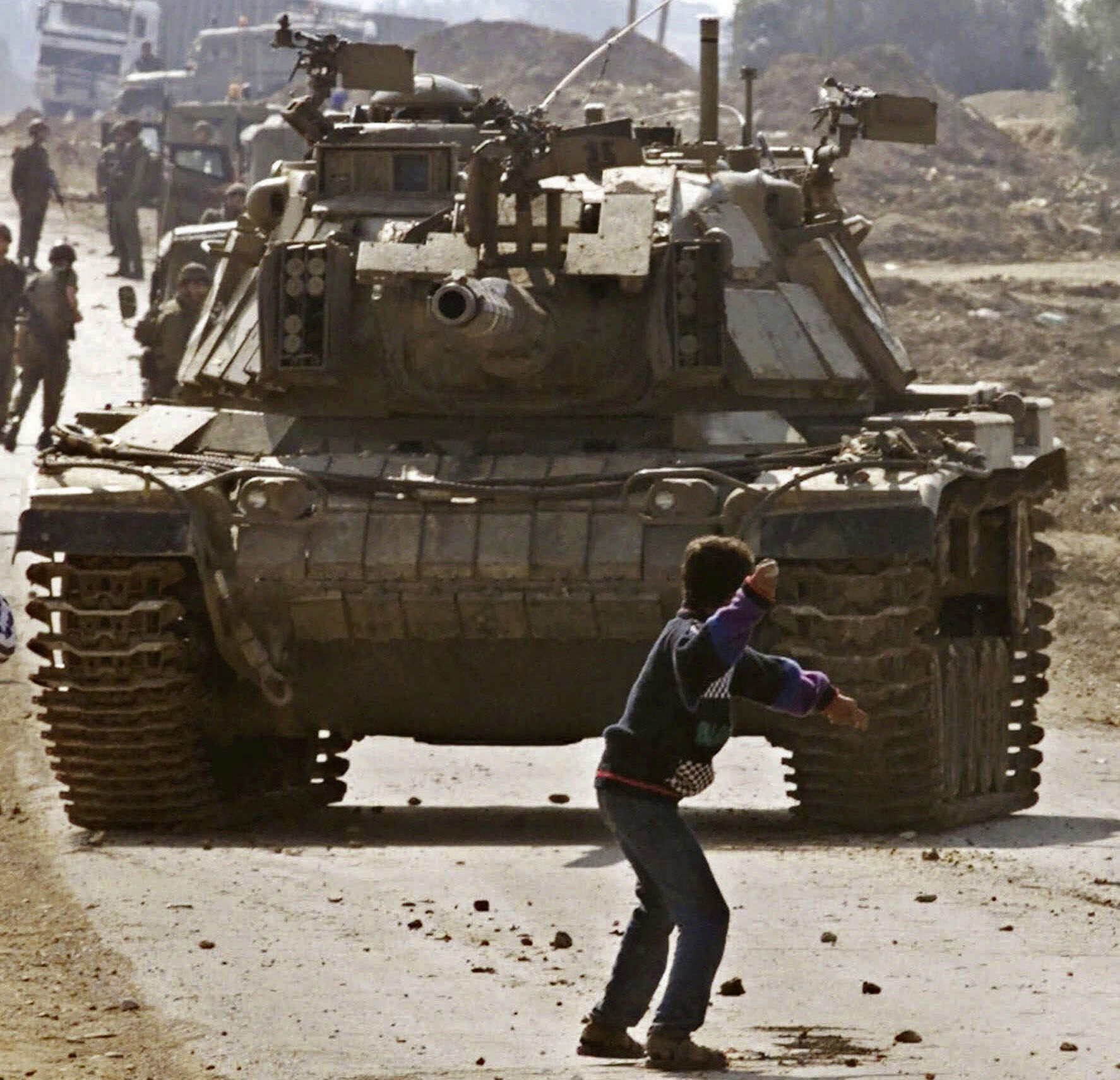
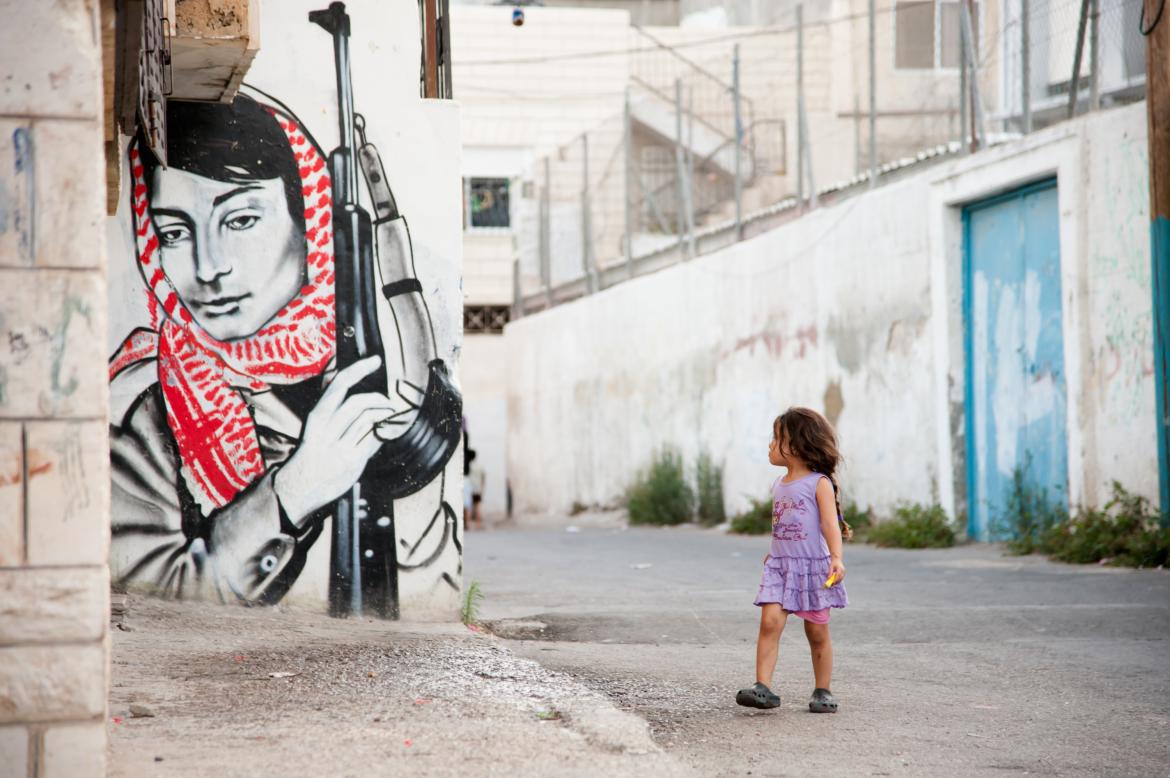
We maintained these middle grounds—grounds bombarded by 2,000-pound bombs; grounds desecrated by bulldozers carving Stars of David into Palestinian land;13 grounds grafted with invasive forests planted atop cavities where the roots of olive trees once tunneled;14 grounds, precious earth, poisoned by white phosphorus;151617 grounds seized by Zionist capitalist interests across Lebanon, Yemen, and Syria in defiance of their sovereignties—simply to keep the asinine tradition of debate alive. As if middle grounds can be found between a child clutching a stone and a tank. Middle grounds—these debates of ours—are arbitrarily placed in the somewhereness of the “middle” and on the distant, abstract elsewhere of “grounds,” together ripe with the neutral rationality required of deathmaking.
But middle grounds do not exist in genocide. I refuse to enable or entertain any notion of “neutrality.” Grow your encampments, reject the selective empathy these grounds require of you, and defy the apoliticality this genocide demands.
One thing I know there is none of in Omelas is guilt.
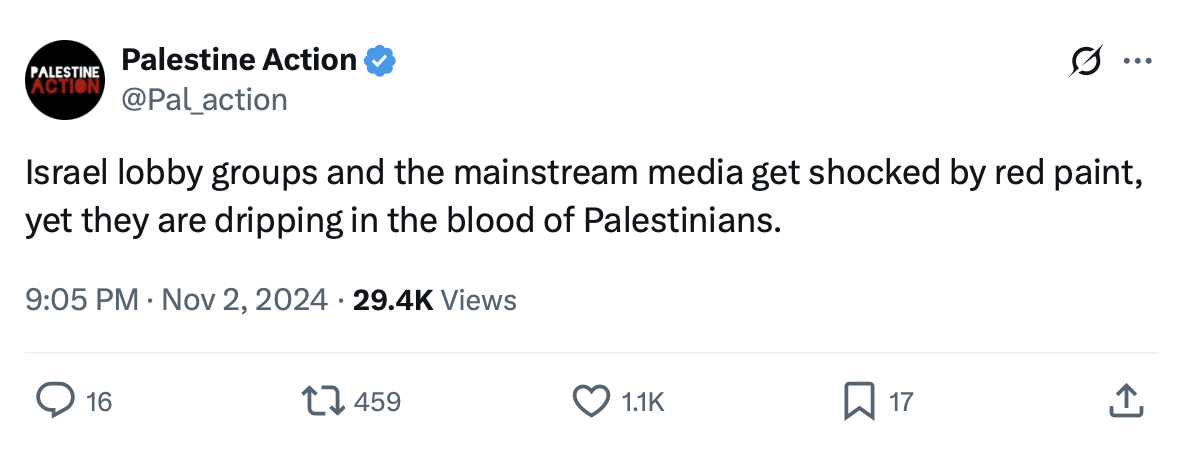
In these cities of ours, death seems to be the only option that our democracies dare dream of. The Western fetish for death, the sadism it inflicts, sans consent, upon the world, shatters with every action crafted to remind them of their fragility. Their cities of death die with them, and life makes its way through every warehouse window shattered, through every drop of red acrylic paint splashed across weapons depots by activists. It breathes through every stone thrown from tiny hands, and through bodies that are also earths, airs, waters, olives, and sunbirds. Red stains their hands, their eyes, and their ears. Death may be the only option available to these manufacturers—the Raytheons, Lockheed Martins, Elbit Systems, and Boeings of the world, gorging themselves on the profits from besieged bodies and lands—but the right to dignified life is the only reality, in truth.
To them, a message: Your world is a fiction. We exist on real land, upon real stories, among flesh—there is no more time and no more space for your fabrications; those who pass between fleeting words, it is time for you to be gone.18
Liberation is fact. Resistance is fact. Emancipation is fact. Reparations are fact.
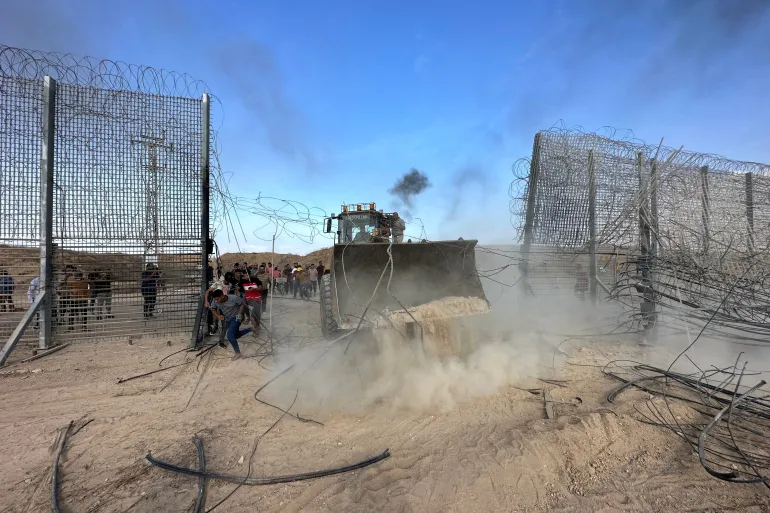
So, what then becomes of resistance? Circle saw becomes praxis19—as it cuts through “impenetrable” border walls. Paint becomes praxis20—as it stains the facades of weapons manufacturers and complicit universities. Markers, chalk, stones—all become praxis. As do spoons, shoes, and sticks. The chain-linked fences of neutrality and deathmaking, backed as they are by earth-burning AI networks,21 mines of artillery,2223 and pages of vague-as-ever text242526 are undone by the simplest of things. In their so-called complexity they are weak and inferior—after all, that “smart wall” was taken down by a lone bulldozer, was it not? The instruments of deathmaking become tools of resistance. Metal and machinery forged from the earth and forced into aesthetics of so-called power are co-opted. Power bends and breaks via its very own rigidity.
The stone shatters the tank (and the tank becomes a clothesline).
The paint melts away the glass (and the glass becomes sand that fills the beaches again).
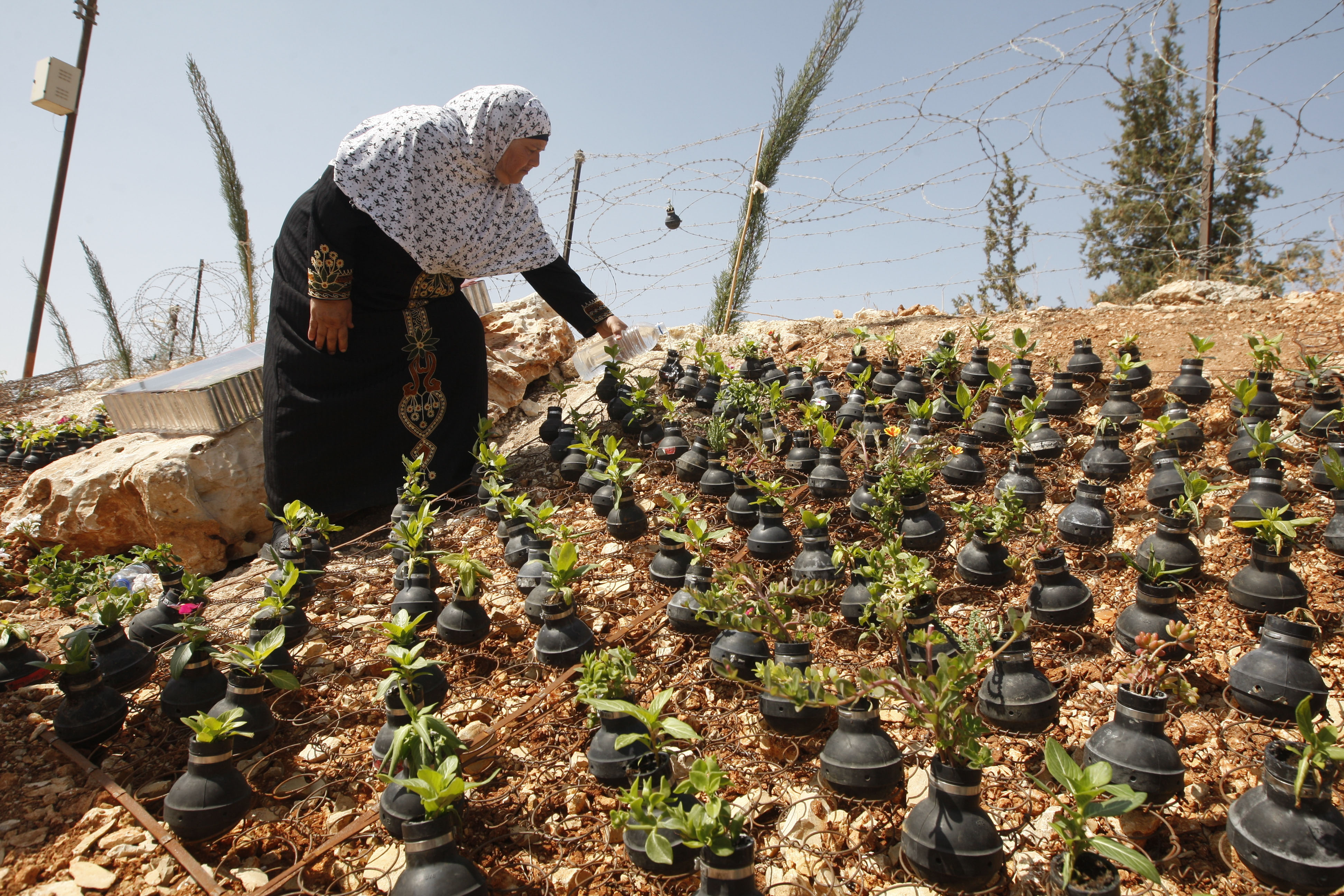
The circle saw cuts down the fence (and the fence becomes a grape trellis).
I belong there. I have many memories. I was born as everyone is born.
I have a mother, a house with many windows, brothers, friends, and a prison cell
with a chilly window! I have a wave snatched by seagulls, a panorama of my own.
I have a saturated meadow. In the deep horizon of my word, I have a moon,
a bird’s sustenance, and an immortal olive tree.
I have lived on the land long before swords turned man into prey.
I belong there. When heaven mourns for her mother, I return heaven to her mother.
And I cry so that a returning cloud might carry my tears.
To break the rules, I have learned all the words needed for a trial by blood.
I have learned and dismantled all the words in order to draw from them a
single word: Home.27
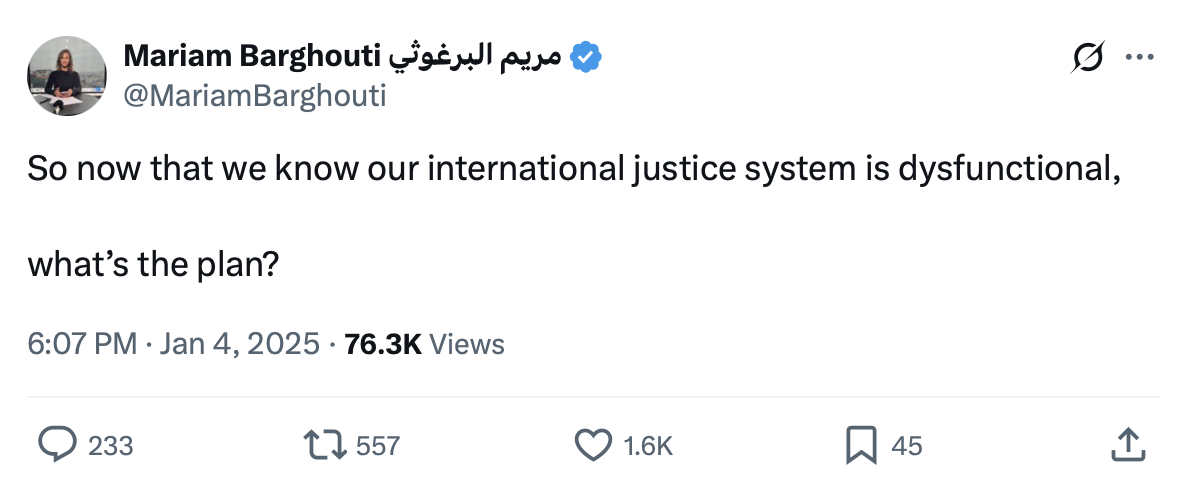
What is required here is not only the dismantling of this oppression but the dismantling of the language that props it up as well. If everything is spatial, then there is no more space for the occupiers’ words—or the permanence they supposedly impose. Ceasefires, the “right to defend,” demands of condemnations, antisemitism, the privatized public sidewalk—fleeting words in bureaucratic conversations, and fleeting worlds denying their own fragility—brittle.
We must begin by loosening our own tongues. We must begin by freeing them for those who can’t, for those burdened and besieged for the audacity to bring poetry into this world that exists beyond pretty rhymes and pretty craft. We must speak our ugly truths, be irritatingly loud and respond in the extreme. What new vocabulary rings true with stones and paint in hand? What lingua franca is manifested when we abandon neutral mouths and create new, radical glossaries with our whole bodies? A landscape woven of laughing and crying and Sunbird and Bulbul and sea and fisherman’s net and nasheed and and and and and and and?
With these new languages, we build toward new dimensions, and reconnect with those obscured and severed from us. In sifting through semantics, we bring in new desks and do away with the old ones. We might, you could argue, even get rid of the desks completely, along with the old words dipped from their inkpots. After all, the master’s tools will never dismantle the master’s house. Still, perhaps, the desk could be thrown through the front windows drenched in red paint, to let more new language (and breath) in. The new language is, I’m sure, of mesmerizing composition, painting the city red in broad, literal strokes, beating to the lovely rhythm of stones crashing upon hardened panes of sand imprisoned within architecture’s cheap curtain-walled warehouses of complicity.
Look where they tell you not to look and see everything. Speak where they tell you not to speak and say everything. Hear it all, drown out the trite, the polished, the sanitized (neutralized). Feel what they tell you not to feel and sit with it, move with it. The moment we refuse to look, to speak, to hear, to feel is at once too our complicity with their linguistic machinations, their manipulations.
We must reject that.
Words create space—they become the point of reference for how we move about these lands and understand from what and whence we came.
The value of an individual life a credo they taught us
to instil fear, and inaction, “you only live once”
a fog in our eyes, we are
endless as the sea, not separate, we die
a million times a day, we are born
a million times, each breath life and death:
get up, put on your shoes, get
started, someone will finish.28
And with this we will create the new radical,29 a root city—a non-Omelas—that is designed to break and fall apart. Become the “legitimate target” and paint bullseyes onto the storefronts and sidewalks and campuses so that the arrow finds its mark.
Become a legitimate target: Be Palestinian. Be Lebanese. Be Syrian. Be Yemeni. Be Congolese. Be Sudanese. Be someone. Be a mosque or a church30 standing for thousands of years on land being blown apart by the greed for oil, for coal, for lithium, for copper, for metals precious enough to kill that which actually is real and true and precious.31 Be a poet32—be someone whose words move millions and live on through every mouth who remembers your name and remembers the words that came from your heart. Be a garden of flowers or of vegetables. Be an olive tree—be someone/thing that sustains life, something that feeds, something that provides shelter, something that provides shade.33 Be a doctor34353637— be someone who risks their life to ensure that others might live and impart comfort in the final moments of a child martyr. Be a journalist383940—be they whose truth, words, reporting, photographs are incessantly censored and scrutinized. Be steadfast. Be resistant. Be someone who loves life more than the death craved on your behalf. Be human despite their attempts to degrade your character with their perversions and propaganda.
If it isn’t obvious now, then let it be known that this new radical is a form of love, the roots to which our humanity tethers itself. That love is spatial—embodied in signs and stones and marches and screams and anger and happiness and tears and laughs and cries—encompassed, as it is, in everything that makes us human. A boundless type of love can be held in anger and rage. Because your anger is not like theirs. Their anger is a soulless thing incapable of discerning right from wrong, good from bad. Theirs is a rage invested in reproducing, prolonging, the hostility to keep their utopias alive by instilling indifference and defeat within us. Keeping us from each other.
No.
This anger of ours is an olive tree, rooted and steadfast. This rage is life, defiant.41
Their anger comes after us all, along with their borders and their walls and their nations and their surveillance, locating themselves by dislocating others. And so, we will throw stones at it and drench it with paint. We will saw through it, will throw markers42 and sticks at it. Chip away at it with spoons. Overwrite it with poetry written in chalk. We will throw our shoes, and our sandals too. Vibrate the air with the clanking of pots and pans and the steady rhythms of knives upon a chopping board. Hold out our hands and form Dabke circles and lines that trace paths from street to street. They come after you with bordering logics that you refuse to accept.
You cease the border, and it ceases to exist. Begin the poem this way.
There is a saying my parents taught me, Qatra qatra, mil ke darya banta hai, or: Drop by drop, they meet to become a river.43 This river doesn’t just suddenly appear, I’ve learned; it is an amalgamation of raindrops that have come down together, one by one, over time, seeping into the cracks and fissures, making their ways into the ever-growing stream that will eventually come to the surface Earthside. Along these lines, Adam HajYahia writes, “The event of return does not take place after the fact, in a ‘post’-temporality where the Zionist regime no longer exists. Instead, the act springs from within the time of its reign, cracking its walls and fracturing its frame.”44
Grab them by their deceitful forelocks!45 Based on this Qu’ranic verse, my dad shares an Urdu saying—Jab kisi qaum ko Allah ne saza dehni hoti hai, to uskay peshani (matha) se khanch ta hai, or: When Allah wants to punish a people/nation/tribe, He pulls/grabs them by their forehead. By this my dad means grabbing them by their economy and structures of power, for these deathmakers’ hearts don’t exist—they can only think with the greed in them, so that is where you grab them by, and pull hard.
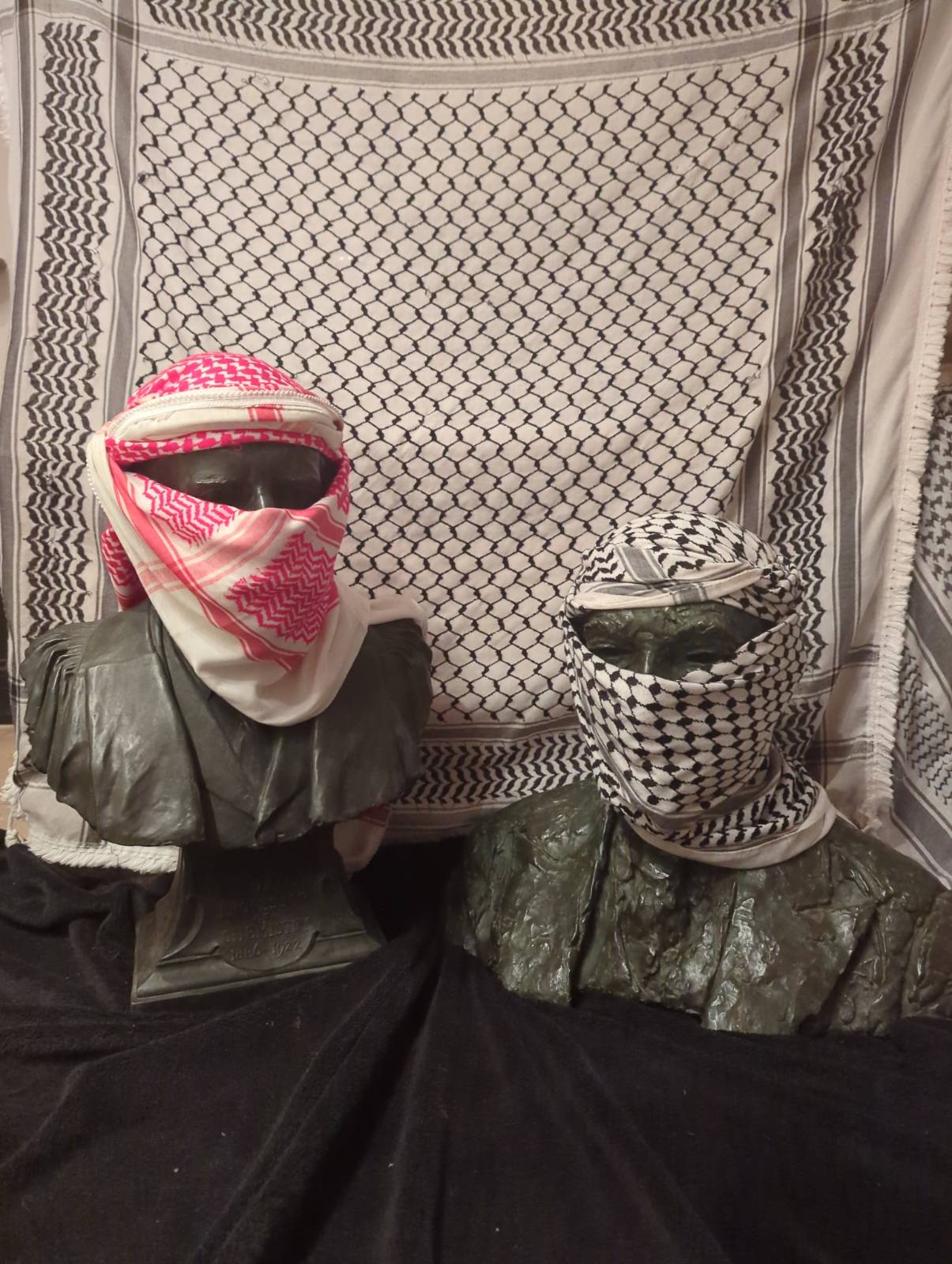
From destroying the carefully crafted head-busts of dead men whose terms and rules continue to plague us, defying their preserved death masks and wrapping them up in keffiyehs to further obfuscate them into oblivion—we continue to grab the Zionist entity by the ficklest of things that they continue to attribute their legacies and identities to. With every university renamed in the solidarity encampments, every statue toppled, and every move toward divestment, our pull grows ever more taut, their lies more exposed, more damning in the ever-growing charge for Palestinian liberation.
Let’s build our Madhafas46 on their ruins, rip open the roofs and let the rain pour in. Let’s rearrange these rooms—and exhume their cellars—with stones and paint becoming our medium of choice for a people [grown] tired.47
This space, I imagine, will quickly begin to renew. Land back, it will say, with the understanding that it does not mean dispossession—but rather land that is once again stewarded—cared for. Caregiving (not taking). The room, this space, no longer has permission over memory—and history no longer begins at the moment of the flood.
Mahmoud Darwish writes:
O those who pass between fleeting words
Carry your names, and be gone
Rid our time of your hours, and be gone
Steal what you will from the blueness of the sea and the sand of memory
Take what pictures you will, so that you understand
That which you never will:
How a stone from our land builds the ceiling of our sky.
To the stones and the paint, I write this poem to you—
something unwavering,
emboldening you to build Darwish’s skies:
Hands hold out your tools of praxis in wait
To begin that boundless creation
Of raining clouds and shimmering moonbeams
That sky could be painted in watercolors and shower down drops
That fall gently onto the stones and wash away the glass shards dusting it.
Shards created by the collective hands of many
Fingertips stained with acrylic holding stones awaiting, in solidarity,
For the moment we begin to un-make and re-build
The shards shift in the sand and become enveloped by the sea,
As the ebbs and flows erode its sharpness and leave you with crystals of sea glass
Capable of lying together with the stones
As drops continue to fall out of that watercolor sky
The sky is re-made with stars and sunset hues and midnight tones
The shining city no longer occupying its vastness
And the moon shines to welcome you to another tomorrow
And
The stones and the paint
No longer left to interpretation
Can simply
Be.
-
Susan Abulhawa, “Susan Abulhawa: This House Believes Israel Is an Apartheid State Responsible for Genocide,” Oxford Union, November 28, 2024, posted December 13, 2024, by Oxford Union, YouTube, 19 min., 22 sec., link. ↩
-
“It is not international law that will save Palestinians. We will all save ourselves together because like any people, like you, Palestinians want life, not only the right to it. Resistance to your own annihilation is a deep reflex; it grows effortlessly. We know that the stone is a weapon and we know that the stone is also a seed.” See Mira Mattar, “Stone and Seed,” Vittles, August 19, 2024, link. ↩
-
Refaat Alareer, “If I Must Die,” This Is Gaza (blog), November 27, 2011, link. ↩
-
Fadwa Tuqan, The Deluge and the Tree, trans. Naomi Shihab Nye and Salma Khadra Jayyusi, New York War Crimes, December 5, 2024, link. ↩
-
Rafeef Ziadah, “Rafeef Ziadah – ‘We teach life, sir,’ London, 12.11.11,” Sternchen Productions, November 13, 2011, YouTube, 4 min., 38 sec., link. ↩
-
Mohammed El-Kurd, “This Is Why We Dance,” in The Unprecedented Times (blog), October 16, 2023, link. ↩
-
Mahmoud Darwish, “On This Land,” Palestinian History Tapestry, link. ↩
-
Fargo Tbakhi, “Notes on Craft: Writing in the Hour of Genocide,” Protean Magazine, December 8, 2023, link. ↩
-
As part of the first phase of the then “ceasefire,” Zakaria Zubeidi and over a hundred other Palestinian prisoners were liberated from Zionist detainment. ↩
-
Ursula K. Le Guin, “The Ones Who Walk Away from Omelas,” in The Wind’s Twelve Quarters (New York: Harper and Row, 1975), 4, link. ↩
-
Red roofs are settler homes, with a cage built around the Gharibs’ house in Beit Ijza, west of Jerusalem. See Middle East Monitor, “Israel Settlements Turn Palestinian House into Cage,” Middle East Monitor, April 4, 2020, link. ↩
-
Le Guin, “The Ones Who Walk Away from Omelas,” 8. ↩
-
“Branding the Land” and “Symbol of Hate”: Satellite Images Reveal Star of David Carved into Gaza,” Quds News Network, January 29, 2025, link. ↩
-
“Zionists destroyed over 800 Palestinian villages during the Nakba of 1948, uprooting an entire people and civilization. Many remnants of Palestinian villages remain today and have been covered up by millions of European pine trees as a way to erase Palestinian existence in its entirety.” See Mohammed Ahmad, “The Price of ‘Green Zionism’: Climate Justice and the Colonization of Palestine,” The Forge, January 23, 2025, link. ↩
-
“Israel: White Phosphorus Used in Gaza, Lebanon,” Human Rights Watch, October 12, 2023, link. ↩
-
“Lebanon: Israel’s White Phosphorous Use Risks Civilian Harm,” Human Rights Watch, June 5, 2024, link. ↩
-
Mahmoud Darwish, “Those Who Pass Between Fleeting Words,” Middle East Report 154, September/October 1988, link. ↩
-
Dr. Taylor Miller gave a lecture regarding the saguaros of the desert. This is a quote from her discussion of the US-Mexico border wall and how a circle saw was used to destroy it to help free a man stuck within it. ↩
-
Palestine Action (@Pal_action), “Don’t like paint? Don’t fund the genocide of Palestinians and the destruction of their homeland,” Twitter (now X), March 6, 2025, link. ↩
-
Yuval Abraham, “‘Lavender’: The AI Machine Directing Israel’s Bombing Spree in Gaza,” +972 Magazine, April 3, 2024, link. ↩
-
“German Arms Exports to Israel,” Forensis, April 2, 2024, link. ↩
-
Kelsey Gallagher, “Canada Under Contract to Supply the IDF with Artillery Propellant,” Ploughshares, March 26, 2025, link. ↩
-
For every person—world leader, journalist, faculty member, opportunistic politician, and others—for those who spew statements of peace and outrage for the genocide carried out with their unbridled support, statements always followed by but. “We condemn, we are outraged, we reject… but Hamas, but student protestors, but antisemitism, but October 7th, but co-existence.” See “Statement by the Prime Minister on the Ceasefire Agreement in Gaza,” Prime minister of Canada, January 15, 2025,link. ↩
-
Israelis are “massacred” and Palestinians “lost their lives.” See Keir Starmer (@Keir_Starmer), “My statement on the Israel-Hamas ceasefire,” Twitter (now X), January 15, 2025, link. ↩
-
Akela Lacy, “A Bomb Threat Targeted Student Protesters. So Why Did They Get Blamed for It?” The Intercept, April 24, 2025, link. ↩
-
Mahmoud Darwish, “I Belong There,” Academy of American Poets, link. ↩
-
Diane di Prima, Revolutionary Letters, May 1968–December 1971, link. ↩
-
“‘Radical’ comes from a Latin word meaning ‘root,’ and in its earliest uses it referred to roots of various kinds, first literal and then figurative. Because roots are the deepest part of a plant, radical came to describe things understood as fundamental or essential.” See “The Roots of ‘Radical,’ ” Merriam-Webster, link. ↩
-
Indlieb Farazi Saber, “A ‘Cultural Genocide’: Which of Gaza’s Heritage Sites Have Been Destroyed?,” Al Jazeera, January 14, 2024, link. ↩
-
Walid Abuhelal, “The War on Gaza Is Also an Israeli Drive to Seize Palestinian Gas Reserves,” Middle East Eye, February 20, 2024, link. ↩
-
Tamara Nassar, “Refaat Alareer Was Assassinated by Israel,” Electronic Intifada, December 9, 2023, link. ↩
-
“‘No Traces of Life’: Israel’s Ecocide in Gaza 2023–2024,” Forensic Architecture, March 29, 2024, link. ↩
-
“Dr. Mahmoud Abu Nujaila was killed in a strike on Al-Awda Hospital in northern Gaza on November 21, along with MSF’s Dr. Ahmad Al Sahar and another doctor, Dr. Ziad Al-Tarari. Before his death, Dr. Abu Nujaila wrote a message on a whiteboard in the hospital normally used for planning surgeries: ‘Whoever stays until the end will tell the story. We did what we could. Remember us.’” See: “Remembering Our Colleagues Killed in Gaza,” Medecins Sans Frontieres/Doctors Without Borders, March 21, 2024, link. ↩
-
“Palestinian paediatrician, [Dr Alaa al-Najjar], received the charred bodies of seven of her children while on duty after an Israeli strike hit her home in Khan Younis, in the southern Gaza Strip.” The children’s names were Yahya, Rakan, Ruslan, Jubran, Eve, Revan, Sayden, Luqman, and Sidra. Her husband, Dr. Hamdi al-Najjar, was also injured and succumbed to his injuries a week later. Only one of her ten children, Adam, survived with serious injuries. See Maha Hussaini, “Gaza Doctor Grieves Her Nine Children Killed in Israeli Strike,” Middle East Eye, May 24, 2025, link. ↩
-
“The Gaza Red Crescent Paramedics Israel Attacked,” Al Jazeera, April 9, 2025, link. ↩
-
“This Message Must Reach the World,” New York War Crimes, December 5, 2024, link. ↩
-
“Shireen Abu Akleh: The Extrajudicial Killing of a Journalist,” Forensic Architecture, November 3, 2022, link. ↩
-
“Ismail al-Ghoul’s Killing: Targeted and Discredited, Palestinian Journalists Suffer Double Punishment in Gaza,” Reporters Without Borders, August 30, 2024, link. ↩
-
“All this time I told myself we were born from war—but I was wrong, ma. We were born from beauty. Let no one mistake us for the fruit of violence—but that violence, having passed through the fruit, failed to spoil it.” I read this quote over a year ago, and over a year since we have all borne witness to all the ways these institutions deemed humanity ugly for caring. From the encampments to the protests—all turned into something monstrous by deathmakers who cannot see that all these actions are the beauty of love un-afraid. See Ocean Vuong, On Earth We’re Briefly Gorgeous (New York: Penguin Press, 2019), 205, link. ↩
-
From Refaat Alareer: “I am an academic, probably the toughest thing I have at home is an Expo marker. But if the Israelis invade, if they charge at us, open door to door to massacre us, I’m going to use that marker, throw it at the Israeli soldiers, even if that is the last thing I will be able to do. And this is the feeling of everybody. We are helpless and we have nothing to lose.” See Refaat Alareer, “Breaking News and Analysis on Day 3 of Gaza’s Al-Aqsa Flood: The Electronic Intifada Podcast,” interview by Ali Abunimah, Jon Elmer, Asa Winstanley, and Nora Barrows-Friedman, YouTube, The Electronic Intifada, October 9, 2023, Video, 1:38:42, link. ↩
-
This is in Urdu, and means, “Drop by drop, they meet to become a river.” I unfortunately don’t know how to write in Urdu script, but I can at least transform this language I write in into the tongue I speak in. I can at least do that. ↩
-
Adam HajYahia, “The Principle of Return,” Parapraxis, April 7, 2024, link. ↩
-
From the Holy Quran, Surah Al-Alaq “The Clot.” ↩
-
Sandi Hilal and Alessandro Petti’s project, “Al-Madafeh/ The Living Room (VAM),” Decolonizing Architecture Art Research, link. ↩
-
“Earlier this week a group of people sabotaged Gastops’ factory in Ottawa, the only place in the world where engine sensors are produced for Lockheed’s F-35 combat jets—including the ones dropping 2,000 pound bombs on Gaza. We cut the wiring inside all of the heat pumps on the Gastops roof, locked them out with official Ministry of Health and Safety lock-out tags, shut off the gas, broke the handles for their systems, and cut the lines to their backup communication system on the way out... People growing tired of politicians continuing to support the slaughter of civilians in Palestine and Lebanon will continue to escalate actions seeking peace and an end to these war crimes.” See “Sabotage of Ottawa Factory Producing Parts for Israel’s F-35 Warplanes,” North Shore Counter-Info, link. ↩
Syeda Khadeeja is a Pakistani woman currently residing on the unceded Traditional Lands of the Coast Salish Peoples. She is a recent graduate of the Carleton University School of Architecture’s M.Arch program. For her thesis project, “Tomorrow and Tomorrow and Tomorow: Foreign Lands on Stolen Lands,” she imagines a possible world and architecture of a free Palestine. This was explored via the dismantling of nation-states and bureaucracies, and countering the structures of the embassy through the design of a Musafir Khana (Urdu: Traveller’s Room), on unceded and never-surrendered Algonquin land along the Kìchì Sìbì (Ottawa River), in so-called Ottawa, in so-called Canada. I would like to extend my sincerest thanks to the editors who helped me with this piece and to my thesis advisor, Ozayr Saloojee, for all the support he’s given me through this journey. May more stones and paint and sticks be thrown, may more poems be written as praxis, and may resistance come like a flood to topple all the walls and cease all the borders Inshallah Ameen.