
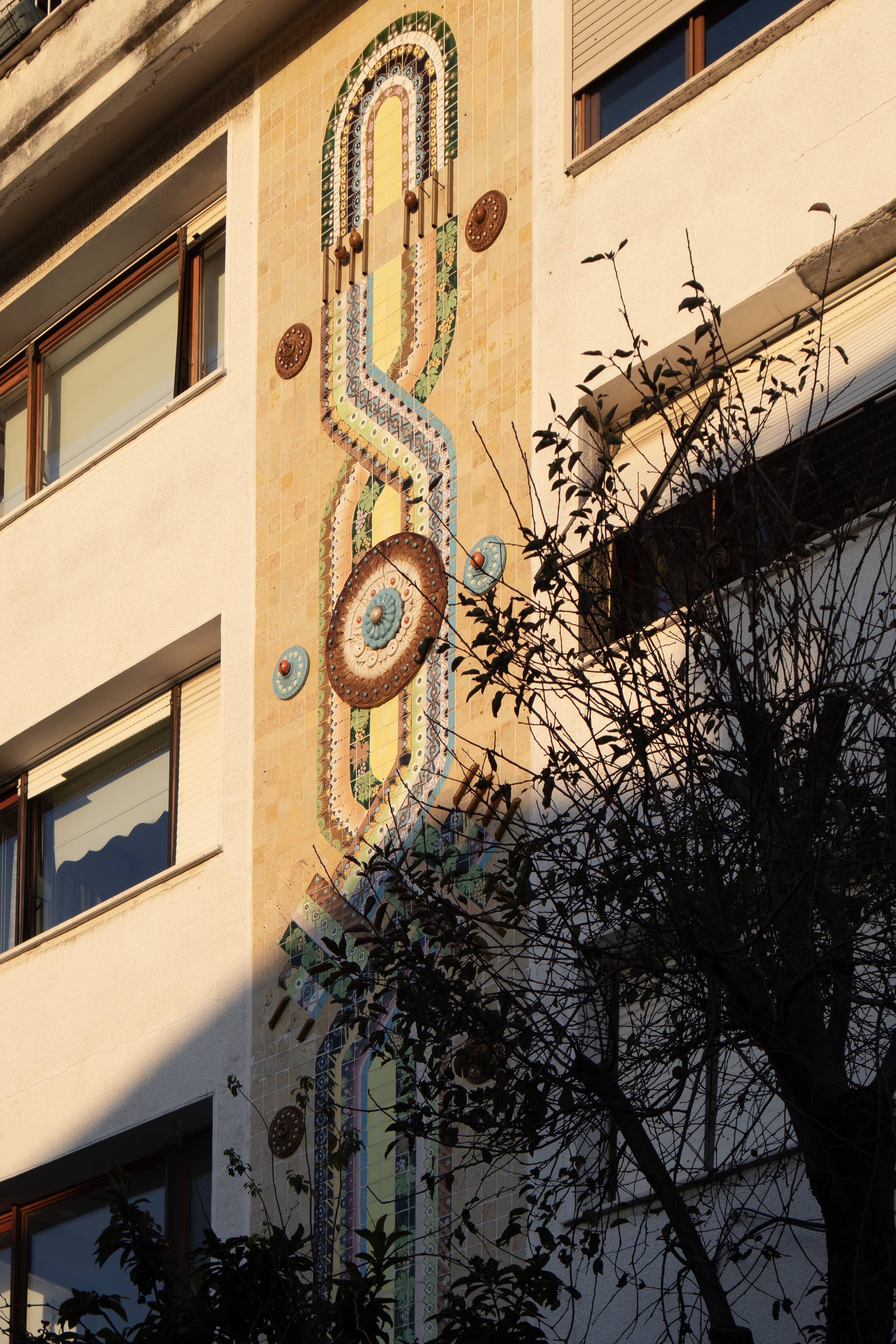
In winter 2023, I found my favorite building in Salacak bordered with corrugated steel panels.1 Corrugated steel is the first symptom of destruction. It is the local news breaker, simultaneously an obituary and a tombstone. In this coastal neighborhood of Istanbul, constant transformation and development are expected, given the high value of the Bosphorus view. Here, within a ten-minute stroll, there is one demolition site for every five cats encountered. And there are many cats in Istanbul. My favorite building, architecturally speaking, wasn’t particularly significant: a typical concrete apartment block from 1989, with waist-high windows and a dull, light brown plasterwork on its façade. Still, in contrast to contemporary design in Turkey, this building—like others, constructed at the same time, no matter how small, illegible, or haphazard—carried a certain aspiration for nuance. In some modest, gaudy, or experimental way, and with a sort of dignity, these buildings sought distinction. What made this apartment block meaningful to me were the two ceramic panels covering the length of its two façades. On these panels, kilim motifs, grapevine icons, and a variety of circular nodes were arranged in festive colors, with a quasi-futuristic undertone. Perched on one of Salacak’s many hilly streets, the building would glimmer in the evenings, when the sunset hit the glazed tiles. In the months following its demolition, I often took long detours to avoid the site.
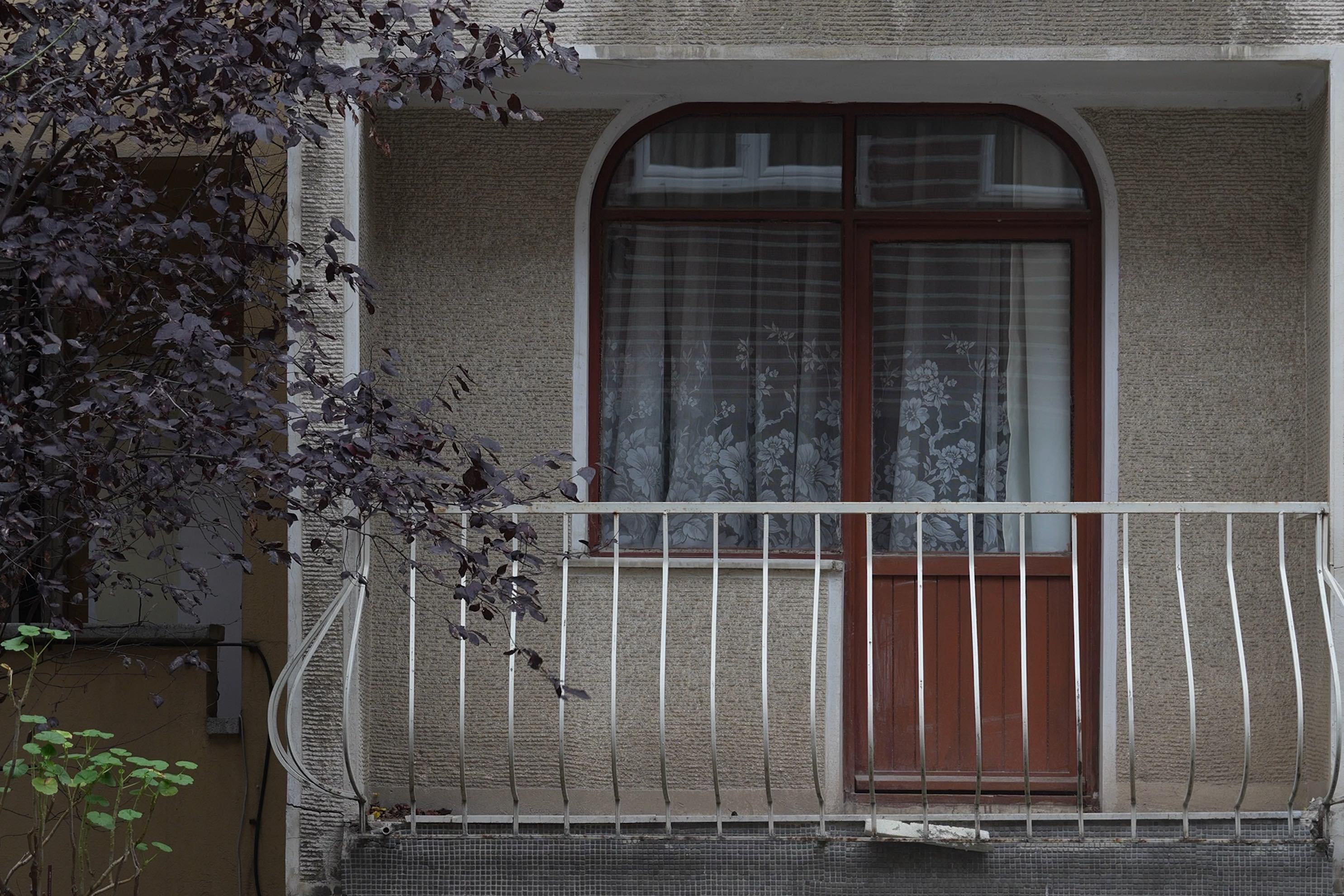
In Istanbul, seemingly individual and outwardly abrupt demolitions indicate a broader process of urban transformation carried out in preparation for the imminent 7.5 magnitude Istanbul earthquake. Seismic data confirms that an earthquake of this scale can be expected, with a 65 percent probability, within the next thirty years.2 Istanbul’s housing stock largely consists of mid-rise, single-block reinforced concrete buildings, around 194,000 of which face moderate to severe risk of collapse in the event of an earthquake.3 The structural impact of the earthquake is primarily influenced by ground conditions and when a building was constructed. Yet the faults embodied in Istanbul’s housing stock are wide-ranging, and can be broadly categorized into three types: faults through design, in which buildings were originally constructed with limited regard for seismic design principles (such as discontinuities in vertical load-bearing walls that create a “soft-story effect”); faults through corruption, where material quality and/or quantity was knowingly reduced; and faults through legislation, where legal frameworks are either absent or poorly enforced—allowing buildings to lack original construction documentation or undergo precarious structural modifications without recorded inspection or regulatory oversight.
To address this condition, in 2012, the Turkish Parliament enacted Law No. 6306, on the “Transformation of Areas Under Disaster Risk”—marking the first legislative attempt at risk mitigation, thirteen years after the last major earthquake struck the Marmara region.4 This disaster law introduced multiscalar mechanisms of urban transformation, delivering not only risk-related goals but also broader sociopolitical and financial agendas. In Istanbul, these mechanisms have manifested in various forms: real estate developments on treasury-owned land, contested restorations in historic neighborhoods, the gentrification of informal settlements, and the widespread transformation of apartment blocks that face the risk of collapse.5 In investigating the transformations brought by the latter case, this essay disentangles the earthquake risk from the disaster law—offering a comparative tracing of their impressions. The law’s silent and pervasive influence on the midrise housing of Istanbul is interrogated through a recalled history of recent earthquakes followed by an analysis of the risk factor and by a thorough reading of the law, its definitions and authorizations, and the procedural frameworks set up in the context of these individual transformations.
Fault Lines
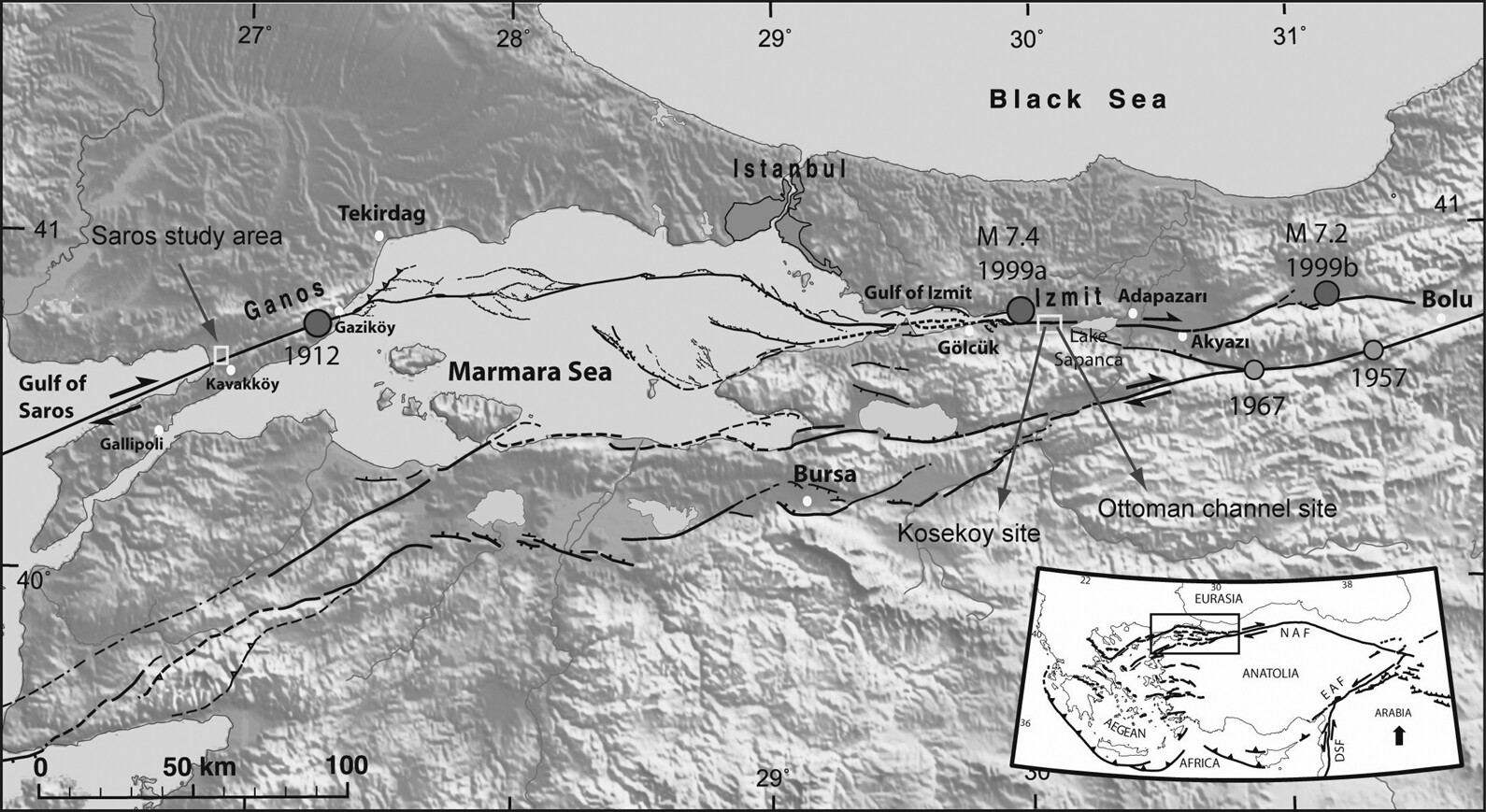
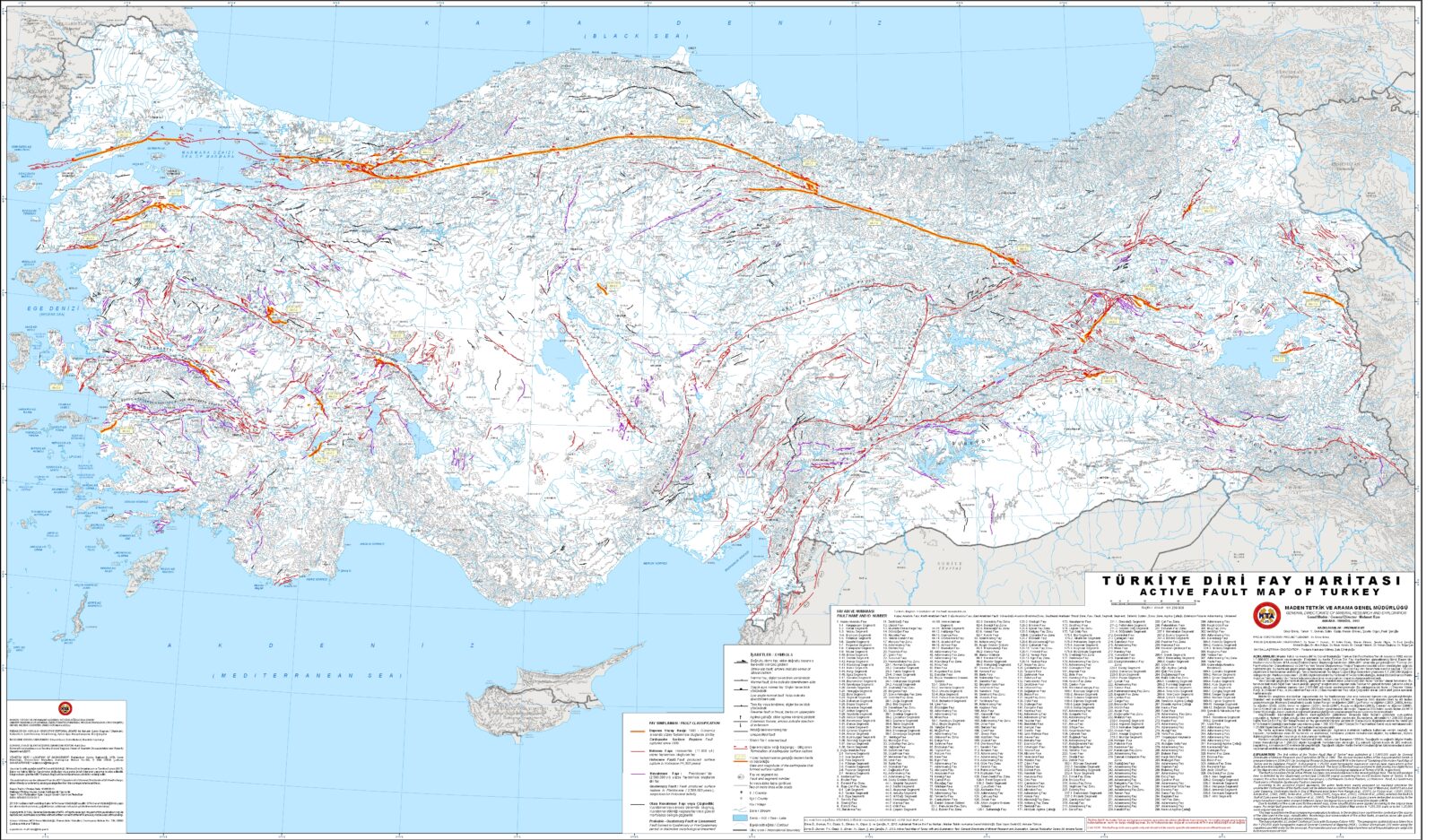
Along the edges of Turkey run the North, East, and West Anatolian fault lines that geologically position the country in a seismic hazard zone. Beginning at the Karlıova Triple Junction, where the Arabian, Eurasian, and African plates converge, the North Anatolian Fault line stretches toward the Black Sea region and ends at the Gulf of Saros, where it meets the Aegean Sea. Its bow-shaped western tip lies just twenty kilometers south of Istanbul. Within this zone, earthquakes form a special kind of history, through which immense loss and dislocation become reference points in time, unresolved and lingering. Different cities at different times carry this recurring memory.
Forming my first memory of earthquakes, the Van earthquake occurred in 2011 at the intersection of the North and East Anatolian fault lines. I watched, for the first time, news channels broadcast search and rescue operations. My second memory must have been about a year later, when people whose homes had collapsed in Van were handed the keys to their new flats in a celebratory ceremony. A key was tangible, it was visible. It was on a hand, then put on another.
The Izmir earthquake struck in 2020. News channels broadcast the search and rescue operations. The debris covered the pale faces of those being pulled out from the collapsed buildings. Each earthquake was followed by its own epic narratives. In Izmir, the rescue of a three-year-old took place ninety-one hours after the earthquake occurred. The mother she lost was commemorated with her name given to a children’s playground.
When Mehmet Özhaseki, the minister of urbanism, was defending the 2018 zoning amnesty law that exempted corrupt or unpermitted constructions from sanctions, he used a number. The law would generate “forty–fifty billion Turkish liras”6 from the tax collections and land sales facilitated through newly registered buildings. This target was, however, missed terribly.7
Turkey experienced the most lethal earthquake of its history only two years ago. It happened on a winter’s night. The news channels could not broadcast search and rescue operations. With thirteen cities of the Southern Region being affected, for days, rescue teams could not arrive, search could not happen. Ambulances set off from 1,100 kilometers away, from Istanbul. In the Kahramanmaraş earthquake, the numbers provided fail to capture the level of catastrophe. But if one were to attempt it, the 53,537 people who were lost in the earthquake could fill the Turkish Parliament Hall to the brink seven times over.8
Risk
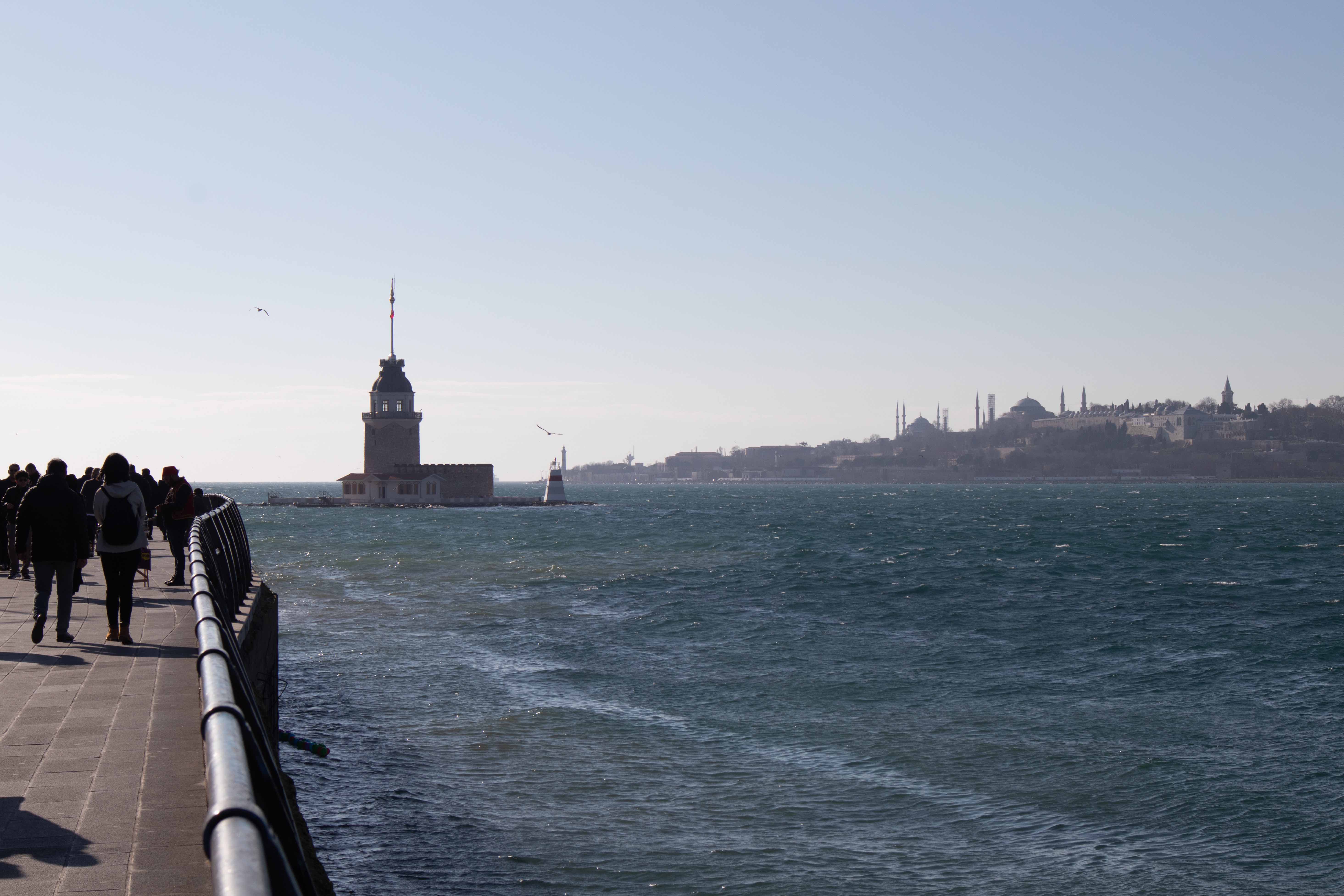
Istanbul is wide, messy, and unequivocally beautiful. And when telling of it, I am biased with an impervious kind of love. There is a silhouette etched into my retention of the city. The silhouette lets one locate themselves within it and experience the city through its totality. This perception offered by Istanbul’s matchless geographic setting is in part formed by the Bosphorus Strait and the hilly landscape that tactfully frames it. Despite its appearance as an obvious separation, the Bosphorus geologically works more like a bridge. It holds two currents: One travels on the surface of the water, and takes the Black Sea into the Mediterranean. The countercurrent goes deep under and brings the Mediterranean into the Black Sea. Istanbul truly exists with water. Its shape is a direct result of its interaction with the matter. And it is this water—rising and receding, shaking and creaking—that adds an ephemeral definition to the city. And Istanbul is, in the truest sense, defined by this ephemerality.
In his 1986 book Risk Society, Ulrich Beck positions an “emerging future, against a predominant past,”9 in demonstrating how risks bear a new modernity. When describing the nature of risks, Beck writes about how they are evidenced to exist both in present and future time: “On the one hand, many hazards and damages are already real today… On the other hand, the actual social impetus of risks lies in the projected danger of the future.”10 In contemporary Turkey, the presently destructive reflection of the earthquake risk is to be found within the systemic and recurring operative failures. These failures are exemplified not only by policy around disaster mitigation that substitutes urgency for neoliberal technocracy but also through other risks—such as the recent Kartalkaya Hotel fire that took the lives of seventy-eight people, and the deadly elevator accidents in government-run student housing—that materialize through lack of regulation and inspection.
Although commonly referred to as the “earthquake risk,” the contingent element in the anticipated Istanbul earthquake is solely defined by the uncertain timing of its occurrence and the varying levels of structural threat that each apartment block faces. In assigning the uncertain aspect of time and subject to the earthquake, these two contingent elements immanently individualize the loss and damage expected for Istanbul. Individualizing risk cultivates the perfect environment for trivializing risk. The earthquake risk in Istanbul fades through a false sense of mitigation and by the built-in ignorance posed by the current policies. And risk, by its nature, materializes and proves existence precisely through that ignorance. It ceases to be a functional territory, becoming a state where one knows and disowns concurrently. When renounced, risk permeates all aspects and all times of the urban condition.
Within the contingencies of the Istanbul earthquake, risk does carry a certain level of immanent singularity that at times allows it to be relegated to the past, through personal experiences of safety. Yet, still, earthquake risk is a weight carried collectively. It is held within the present time that retains it. In the urban condition of Istanbul, risk is a persistent feeling of nostalgia in a city that is lived not in its presence but through its anteriority. Risk anchors through its ties to the inevitable continuity of time, a continuity whose end point—what it may soon extinguish—remains unknown. Beneath the Sea of Marmara, the western segment of the North Anatolian fault line becomes both the natural source associated with antecedent disasters and an apparatus for potentially lucrative earthquake mitigation. Underwater and above time, the line is a crack and a hammer.
The Disaster Law
The initial policies around disaster risk mitigation were introduced during the accelerating urban transformations of the early 2000s. An amendment to the Municipality Law in 2005 allowed municipal councils to take measures against earthquakes exclusively. In the same year, Law No. 5366 took precautions that enabled the reconstruction and restoration of historic and cultural sites.11 These were the first legislative instances that both directly and indirectly aimed to address earthquake risk.
The year following the Van earthquake, the Parliament enacted the law titled “Transformation of Areas Under Disaster Risk” (Afet Riski Altındaki Alanların Dönüştürülmesi Hakkında Kanun) to establish the process of “improvement, liquidation, and renewal” in areas and/or structures that would qualify as “risky.”12 This was the first law in the country’s history to make disaster risk mitigation its sole objective. In the disaster law, article one, paragraph five gives a generous definition of “risky structures”: “Any building—whether located within a designated risk area or not—that has either reached the end of its economic lifespan or has been determined, based on scientific and technical data, to be at risk of collapse or sustaining major damage.”13 The law gave authorization to the Ministry of Environment, Urbanization, and Climate Change,14 and its housing subagency TOKI, to determine “reserve areas” where new housing developments could accommodate the residents displaced by the urban transformations taking place in the inner quarters of Istanbul. By allowing the ministry’s urban transformation department “to carry out any investigation that would bring profit,” the law sets out the tool kit of its proprietary operations targeted at the success of its economic growth predominantly attained by neoliberal urbanism and construction-led development.15
The Procedure
The transformation of apartment blocks starts with an application for a structural assessment report, known as the risk report. Only the property owners can officially initiate an investigation of the building’s structural condition, which at this stage can be undertaken individually. The assessment inspects the building’s age, structural alterations, ground conditions, and the layout of its load-bearing elements—columns, beams, and foundations. A special consideration is given to the corrosion levels on rebars and the compressive strength of concrete. The risk report provides no gray areas—a building can only be risky or not. If the structure is determined to be “not risky,” the owner(s) do not have the right, and are not required, to perform transformations under Law No. 6306. Otherwise, risk is flagged in the registry documents and the legal process accelerates, demanding the building’s immediate demolition.
The law provides sixty days, and if needed, a thirty-day extension, for a two-thirds majority of owners in the building to agree on and carry out its demolition. Later, an agreement will be signed between the council of owners and the contracting firm to settle on the new building’s technical, proprietary, and architectural attributes. This will lay out the costs and portion-of-profit of the contractors. If the owners fail to undertake action in this given time frame, the building will become subject to water, gas, and electricity cuts. The administration will be at the door to enforce demolition, by their own handling, and will make the owners pay for it.
Structural strengthening is a technically and legally viable alternative to reconstructing risky buildings. In such cases, the agreement must be reached by the owners with a four-fifths majority, rather than the two-thirds required for reconstructions. Depending on the individual case of each risky building, strengthening can offer varying levels of logistical, social, and economic benefits. While new-builds may take one to two years due to lengthy construction schedules, most strengthening applications can be completed within five months. Strengthening can stabilize rent increases caused by new constructions, avoid infills caused by demolition wastes, and keep the buildings, their value, and their habits.
The main determinant of the cost and technical feasibility of strengthening application is the building’s Seismic Safety Rate (SSR)—which is calculated based on the building’s age and the earthquake code it complied with; its interstory drift ratio (IDR); concrete and rebar quality (for example, concrete and corroded rebars); and the natural vibration period and its performance level (for example, immediate occupancy, IO, life safety, LS or collapse prevention, CP), among others. The disparity between the strengthening and reconstruction costs widens as buildings have better structural qualities. Yet there is a threshold in which these benefits are most efficiently utilized. In preliminary research published in 2022, academics Cem Demir, Mustafa Cömert, Hasan Aydoğdu, and Alper İlki determined that at a 20 to 50 percent seismic safety rate, strengthening offers better affordability and a technically feasible alternative to demolition and reconstruction. The research also provides a cost comparison of the two scenarios in a longer time frame that factors in both the preparation before the earthquake and the likely damage after. In the long term, strengthening all residential buildings in Istanbul with a 50 percent seismic safety rate would cost three times less than reconstruction and demolition.16 For every reconstruction encouraged by the disaster law, three buildings could be strengthened. However, the seismic safety rate is not a product of the risk reports under law 6306. The results are binary. This, in turn, prevents site-specific solutions for each building’s structural necessity.
The ubiquity of new-builds across Istanbul despite the lower cost of strengthening is due to zoning increases. In Istanbul, zoning increases are incentives that allow a higher number of floors in new constructions, providing two extra flats through which the new constructions can fund their own demolition and reconstruction. While zoning increases ensure economic feasibility for residents and profit for contracting firms, strengthening applications are naturally disfavored as they fail to generate revenue. The construction agreements arranged with a “payment of new flats” are a common approach in urban transformation across Istanbul, where available. This practice alleviates a lot of the economical and bureaucratic burdens put on the shoulders of residents. Yet zoning increase through redevelopment is not only a form of unsustainable reliance upon perpetual construction in dealing with the risk but also a mechanism through which the government avoids accountability for addressing that risk altogether.
Then there is a double act: On the one hand, disaster law introduces centralized provisions that enable the government and municipalities to take quick action. On the other hand, the same provisions ensure the survival of the industry at the expense of quicker and more affordable solutions. The two-sided choice presented in the risk reports, of being risky or not, avoids a transparent structural analysis. It makes it difficult to argue for strengthening and argue against complete demolition. Reconstructions have become the primary mode of operation for addressing the hazardous apartment blocks in Istanbul. These transformations have triggered rent increases and subsequent shifts in demographics. Each new build has displaced tenants who could not afford to live in the reconstructed block and irrevocably altered the architectural character of once-familiar streets. Definitions and inventions that seemed diligent on paper have proven to be most beneficial for the profitability of the construction industry. Earthquake risk became enmeshed in the surplus ensured by the disaster law.
The Informal Government
However intimately choreographed, the procedures of the law fail to forecast how demolitions are practiced on-site. The timeline for evacuation, set in motion once the building is declared risky, proves too tight and unforgiving. Before any risk report is even officially initiated, the government encourages residents to work with a contractor to alleviate the bureaucratic and technical intricacies of the reconstruction process. This is evidenced in a text message sent by the ministry, outlining loan eligibility and financial evacuation aid:
In this context [of your application], after reaching an agreement with a contractor, chosen by the unanimous decision of all shareholders in the parcel where your building is located, you can complete the necessary procedures, including the contract, risky building assessment, project design, and building permit application… According to the initial information received, applications will be processed through the relevant district municipality after an agreement is made with the contractor firm.17
This, in turn, raises skepticism over the integrity of the assessment reports, given that owners may have already committed to signing an agreement with a contractor before learning about their building’s structural condition. In this way, both the law and its on-site reflection position the contractor as the imperative actor who conducts the transformation processes. Contracting businesses infiltrate into most tasks that risky buildings require, in which they are authorized to perform structural assessments, carry out demolitions, and collaborate with their choice of an architect (who in turn complies with the industry-standard lists of building materials, brands of fitted appliances, or “aesthetics” before any design work begins). The private sector’s scope of influence over the redeveloped residentials of Istanbul becomes the preeminent implication of the disaster law.
This core role appointed to contractors bears an indication of post-politics, a term extensively present in philosopher Jacques Rancière’s work in referring to depoliticization in societies.18 In the post-political condition, “disagreement and debate”19 as the products of proper politics are replaced with imposed and managed consensus.20 In his article on the topic, Erik Swyngedouw writes, “The implementation of such new urban policy rests crucially on the formation of a set of new formal and informal institutional and governance arrangements that engage in the act of governing outside and Beyond-the-State. In sum, a new police order of governing and organizing social relations accompanies the emergence of new urban landscapes.”21 Later in the article, Swyngedouw further establishes his argument through sociologist Thomas Lemke, who draws on Foucauldian governmentality:
Foucault’s discussion of neoliberal governmentality shows that the so-called retreat of the state is in fact a prolongation of government: neoliberalism is not the end but a transformation of politics that restructures the power relations in society. What we observe today is not a diminishment or reduction of state sovereignty and planning capacities but a displacement from formal to informal techniques of government that indicate fundamental transformations in statehood and a new relation between state and civil society actors.22
As a by-product of post-politics, the technocratic element within the current earthquake policies in Istanbul is found within the disaster law’s appointment of risk reduction responsibilities to private actors that in essence exists through profit-driven redevelopment. As the new informal technicians of the government, the contracting firms’ “reflexive risk-calculation (self-assessment), accountancy rules and accountancy-based disciplining, quantification and benchmarking of performance”23 leave them subsisting on a socially exclusionary model of safety. The governmental tools, structures, and powers that are accountable for an extenuation of risk—building by building, door by door—are replaced by contracting firms’ market-led replacement of the contingent fatalities.
By its part in an informal government, the disaster law fails to invite the actors who advocate for social and architectural gains in the timeline leading to the Istanbul earthquake. How earthquake-resilient cities should be thought, designed and lived, and what opportunities a city possesses in the urgent necessity of its redefinition, is a discussion perpetually delayed. The governance of earthquake preparation goes only as far as the economic framework allows, through which urban transformation carries itself out with turbulent autonomy. The single-handed mode of operation appointed to contractors proves infertile in discussions on the needs of citizens, while sidelining architects and urbanists from the discourse of urban transformation.
Construction-Led Development
Contracting firms’ mode of operation in Istanbul differs from other professions of the built environment. Contractors function as half developer, half tradesman—and with a construction strategy of building cheap and fast. The brakes must be pulled just before arriving at a point where architectural quality becomes economically redundant. In contrast to urbanists, engineers, or architects, the contracting practice depends on the invention of projects, cultivating communication, and delivering guidance to owners for the duration of the urban transformation. As a seductive offer and a project-cultivating force, firms can offer full rent coverage for displaced residents during transformations. In such cases, minimizing construction time becomes an economically critical priority. Off-the-record agreements with local municipalities and constabulary often allow constructions to continue past legal hours.
Within the agency the disaster law bestows, the contractor’s decisions shape an entire urban scenography imagined by their individual enterprises. What one encounters on the streets are outcomes not only of revenue-driven architectural calculations but also of personal taste, habit, and power practiced through design decisions. The choice between two materials with a contrasting economic value might be a default decision imposed by the neoliberal condition. But what psychological contents come into play when the decision involves two material options of similar quality and price range? Then, the economically safe margin of yearned pseudo-modernity reinvents Istanbul, and PVdf panels24 overwrite the city.
Through the visual dominance of contractor occidentalism, “architecture” becomes a vague concept without certainty of why and how it really exists. Is it a luxury that is only attainable in certain types of projects with a certain amount of budget, or a necessity reduced to a signature and nothing more? What is the architect accountable for? If the new gray-varnished parquet floor can out-modernize the old-fashioned ones of oak (that used to be arranged in a herringbone pattern) and for the façades one gets to choose between the dark and bright side of the moon, the kitchen will be Miele and taps will be Vitra, what more is there to ask for in the name of architecture? Contractors cannot answer, and the question is never asked. A scene: The advertisement plaques of contracting firms’ take hold over the architect’s signature engrained at building entrances (out of pride and out of love), turn it into ink, and montage it onto the bottom right corner of redevelopment documents. Finding the profession’s agency, or its authors, becomes a quest so naive and quixotic. The construction industry remains vigilant. It blooms before the earthquake; it blooms after it as well.
Of Emancipation
Through the resident-initiated timeline of transformations, the law emancipates the government from the accountability of ensuring the safety of Istanbul’s housing, formed through its own history of economic modes and sociopolitical motivations. Beck writes, “Politicians and politics release pressure by holding individuals and not systems responsible for the accidents and damage. On the other hand, the viewers of risk definition take over and expand their market opportunities.”25 By the fixed price, the assessment reports and rent endowments26 appear to be within hand’s reach of the owners. Many financial incentives offered to them, too, provide loans, or even grants,27 for redeveloping risky buildings.28 Yet, who holds the resources to reconstruct or strengthen? By what means is the risk mitigated for the alarmingly increasing numbers of Istanbul’s tenant population? And what is an earthquake if one can’t see it?
“As with wealth, the history of risk distribution shows that risks too adhere to the class pattern, only inversely: wealth accumulates at the top, risks at the bottom.”29 Similarly, the risk of earthquake damage accumulates and peaks among those who cannot afford to pay for an assessment report or rent a flat in a reconstructed block elsewhere. While the causes of risk materialize by salvational reconstruction, the disaster law is willing to omit the very population that needs protection most.
The class divide that is already embedded in the earthquake risk in Istanbul is further deepened by the aspired-to figures and calculative predictions. Rent endowments that the ministry monthly provides to owners are cut down to onetime stipends for tenants. With each apartment block transformed, flats rise in value. A new construction, ensuring the safety of its inhabitants, causes the displacement and redistribution of the ones who cannot afford such safety. And yet, the housing market does not offer a competing level of financial comfort for the property owner either. Displacement due to reconstruction often lands the owners in rental crises exacerbated by the country’s economic downfall. The monthly rent endowments supported by the disaster law are not sufficient to alleviate this burden. And for both parties, remaining in the vicinities of home becomes an increasingly impossible task. From the scale of its neighborhoods to Istanbul itself, the disregard of the economically vulnerable results in the rewriting of decades-long relations within local communities. Through this interruption of time and place, urban memory gradually dissipates.
The maintenance of the class divide inherent in the disaster is also traceable in its introduction of the debt opportunity. In Maurizio Lazzarato’s terms, the law establishes an “indebted man” by way of the state-initiated interest-rate reductions for financing urban transformation projects. In partnership with banks, what is provided is a credit line with a reduction of the interest rate to 0.79 percent.
What is credit? A promise to pay a debt, a promise to repay in a more or less distant and unpredictable future, since it is subject to the radical uncertainty of time… The system of debt must therefore neutralize time, that is, the risk inherent to it. It must anticipate and ward off every potential “deviation” in the behavior of the debtor the future might hold.30
Lazzarato argues that the debt economy is “an economy of time and subjectivation.”31 Freed from the hold of the earthquake risk’s spatial confinement, the resident is aided with an economic one of the disaster law. Here, a financial assurance replaces the contingencies arising from the North Anatolian fault line and eradicates the resources of its debtor undertaken in the confidence that they will survive.
The disaster law, then, attempts at neutralizing two risks for the Turkish government: first, the risk of its own culpability from the imminent earthquake; second, the risk of its financial uncertainty. Through the introduced bureaucratic procedures and forged alliances of the construction industry, the disaster law ensures the demolish-ability of Istanbul in the name of earthquake preparedness. Risk returns to its etymological origins, and is remade into rızık:a sustenance provided for one’s perseverance.32 Seismic risk delivers the perfect objectivity of fear that enables a lucrative harvest—spoiled but still a harvest. The imminence of the earthquake is realized in causal form. It is not the tectonic plates that grind into each other that evidence the possibility of disaster, but the concrete rubble and the bent rebars in clumps, appearing here and there, occasionally but consistently. The earthquake dissolves itself through time and rains over the city.
I would like to thank Dr. Eleni Axioti, whose support has been an anchor from early on in my architectural education, and without whose seminars my view of the profession would be fundamentally lacking today. I would like to thank Arzu Kuşaslan for her affectionate guidance and the generous time spared for our conversations, which I indulged in too often in writing this essay. To the editors Melis Uğurlu, Joanna Joseph, and Jess Myers for the thought, trust, and care they put into my words, I am deeply grateful.
-
Salacak is located at the shore of the Bosphorus. From the Anatolian side, it looks over the historic peninsula, the Golden Horn, and Beyoglu. Salacak is known for the Maiden’s Tower held within its borders. It covers an area of 0.5 km² and has a population of 10,000 people. ↩
-
Thomas Parsons et al., “Heightened Odds of Large Earthquakes near Istanbul: An Interaction-Based Probability Calculation,” Science 288, no. 5466 (May 5, 2000): 661–665, link. ↩
-
İstanbul Büyükşehir Belediyesi Deprem ve Zemin İnceleme Müdürlüğü ve Boğaziçi Üniversitesi Kandilli Rasathanesi ve Deprem Araştırma Enstitüsü, İstanbul İli Olası Deprem Kayıp Tahminlerinin Güncellenmesi Projesi, 2019, link. ↩
-
The 1999 Gölcük earthquake had a magnitude of 7.6 M_(w), and caused 18,373 deaths. ↩
-
Ayşe Çavdar and Pelin Tan, İstanbul: Müstesna Şehrin İstisna Hali (Istanbul: Sel Yayıncılık, 2013); Senem Zeybekoğlu Sadri, Mustafa Ökmen, and Kıvılcım Akkoyunlu Ertan, Kentsel Dönüşüm ve İnsan Hakları (Istanbul: Istanbul Bilgi Üniversitesi Yayınları, 2013), 1–16. ↩
-
Mehmet Özhaseki, “Bakan Özhaseki İmar Barışını Basın Toplantısında Anlattı,” Çevre ve Şehircilik Bakanlığı, link. ↩
-
Zoning amnesty generated 23.5 billion Turkish liras. Murat Kurum, “İmar Barışından Elde Edilen Toplam Gelir 23.5 Milyar Lira,” Yapı, October 21, 2019, link. ↩
-
The 53,537 was the number officially announced; 107,204 more were injured. ↩
-
Ulrich Beck, Risk Society: Towards a New Modernity, trans. Mark Ritter (London: Sage Publications, 1992), 32–46. ↩
-
Beck, Risk Society. ↩
-
Uğur Sadioğlu and Eser Ergönül, “The Meaning, Actors, and Objectives of Urban Transformation in Turkey [Türkiye’de Kentsel Dönüşümün Anlamı, Aktörleri ve Amaçları],” Yıldız Social Sciences Institute Journal 3, no. 1 (2020): 55–76, link. ↩
-
Law No. 6306, “The Transformation of Areas Under Disaster Risk,” enacted on May 16, 2012, published in the Official Gazette, No. 28309, on May 31, 2012. ↩
-
”The Transformation of Areas Under Disaster Risk.” ↩
-
Ministry of Environment, Urbanization, and Climate Change, link. ↩
-
Law No. 6306, “The Transformation of Areas Under Disaster Risk.” ↩
-
Cem Demir, Mustafa Cömert, Hasan Hüseyin Aydoğdu, and Alper Ilki, “Seismic Risk Assessment and Preliminary Intervention Cost-Benefit Analysis for the Building Stock of Istanbul,” conference paper in Progresses in European Earthquake Engineering and Seismology (August 2022), link. ↩
-
Anıl İnşaat, “Kentsel Dönüşüm Yarışı Bizden Kampanyası Detayları 2024,” Anıl İnşaat, 2024, link, translated by ChatGPT. ↩
-
Jacques Rancière, The Politics of Aesthetics: The Distribution of the Sensible, trans. Gabriel Rockhill (New York: Continuum, 2004). ↩
-
Erik Swyngedouw, “Post-Political City,” in Urban Politics Now: Re-Imagining Democracy in the Neoliberal City, edited by BAVO (Rotterdam: NAi Publishers, 2007), 58–78, link. ↩
-
Swyngedouw, “Post-Political City.” ↩
-
Swyngedouw, ”Post-Political City.” ↩
-
Emphasis added. Thomas Lemke, “Foucault, Governmentality, and Critique,” Rethinking Marxism 14, no. 3 (September 2002): 49–64, link. ↩
-
Swyngedouw, “Post-Political City.” ↩
-
Commonly used aluminum façade claddings treated with a fluoropolymer-based resin. ↩
-
Emphasis added. Beck, Risk Society, 32–46. ↩
-
Considering the economic instability Turkey has been experiencing in the last decade, even fixing this price fails as a futile incentive. Republic of Turkey Ministry of Environment, Urbanization and Climate Change, “2025 Rent Assistance Increase Work,” Ministry of Environment, Urbanization and Climate Change, January 2, 2025, link. ↩
-
These grants are advertised in the offical website of the ministry as part of an initiative that translates as “The Half Is on Us.” The support provided through the campaign has been accelerated in the last couple of months before this essay’s publication, as prompted by the 6.2 magnitude earthquake in Istanbul in April 2025. How many buildings have been aided with the claimed ₺875,000 grant and ₺875,000 credit line is a number not yet stated. In the past few years, the predominant incentives of the ministry have been provided in the form of reduced-interest loans of ₺1,250,000 per owner. ↩
-
Republic of Turkey Ministry of Environment, Urbanization and Climate Change, “Frequently Asked Questions and Answers Regarding Ministry Activities,” Ministry of Environment, Urbanization and Climate Change, link. ↩
-
Beck, Risk Society, 32–46. ↩
-
Maurizio Lazzarato, The Making of the Indebted Man: An Essay on the Neoliberal Condition (Los Angeles: Semiotext(e), 2012), 45–46. ↩
-
Lazzarato, The Making of the Indebted Man. ↩
-
The etymology of the word risk is traced down to two possible roots, both of which closely relate to the Mediterranean Sea. The Latin risicum is first found in maritime documents. In Arabic, rızq belongs to Islamic tradition that signifies a trust in Allah’s provisions encompassing both material and immaterial sustenance, initially used in the context of long voyages through deserts and seas with their uncertainties and dangers. In today’s Turkey, an everyday usage of the word rızık would signify a belief, or a desire, in a materially abundant future. See Gaspar Mairal, “A Mediterranean Origin of Risk,” in A Pre-Modern Cultural History of Risk: Imagining the Future (London: Taylor & Francis, 2020), 1–21. ↩
Tugra Agrikli is a diploma student at the Architectural Association. Her current work introduces a midscale strategy that allows for affordable reinforcements in Istanbul. She is drawn to an architecture aware of its systemic definers.