
Cleaning, Cleaning
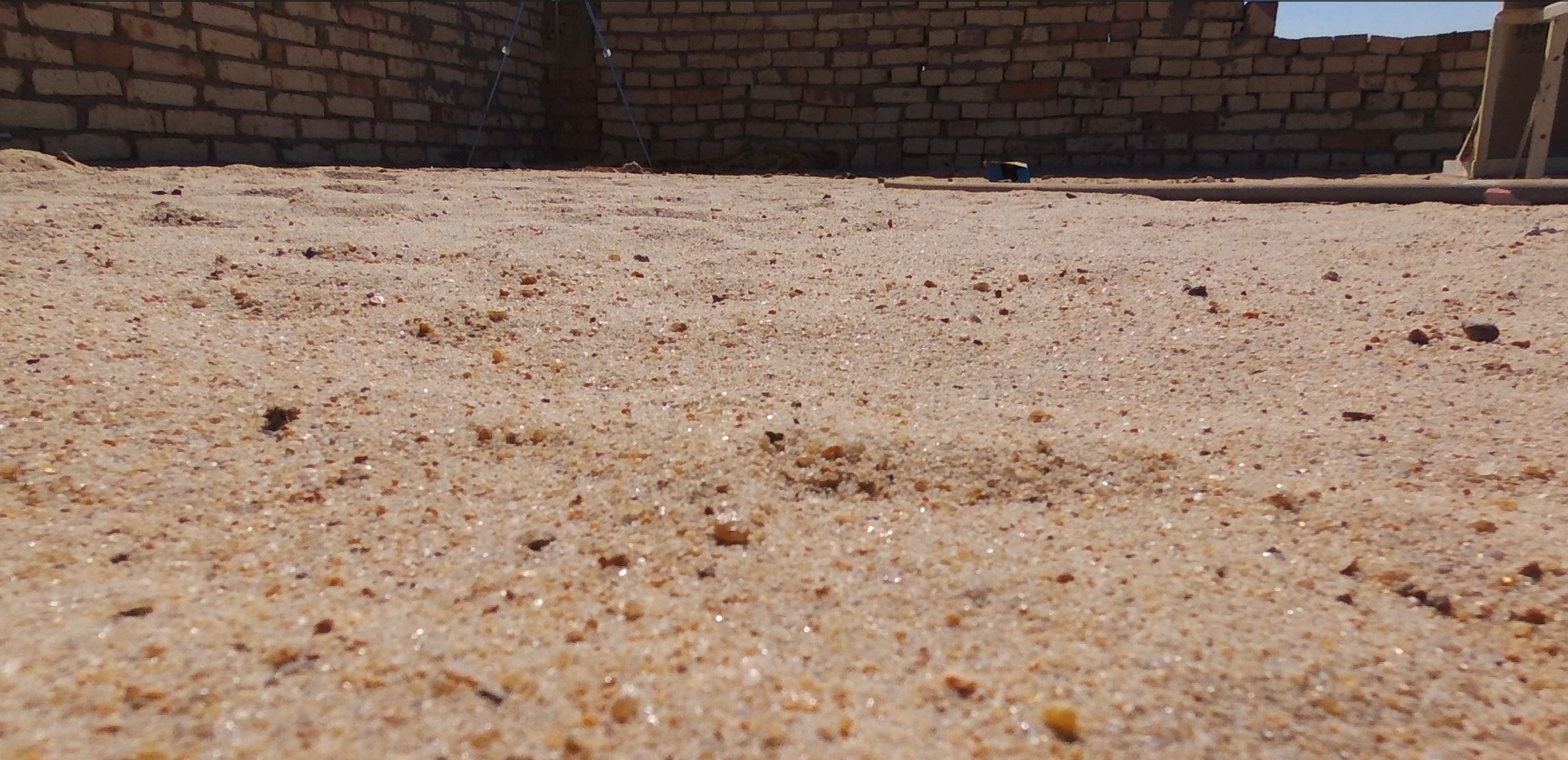
At the crack of dawn, my maternal grandmother, Fawzia Kabbara, began to clean. She cleaned her face, made Wudu’, cleaned under the water container, and then swept the entire 15-square-meter sand-filled courtyard. Wielding her corn-fiber broom in a backward squat to ensure her own footprints would not mark the sand, she would leave behind a pristine, legible page. This surface was destined for me and my sisters, the cat, and the pigeons to stomp all over the moment we woke up. My grandmother’s courtyard in the center of her Kom-Ombo Valley government-built dwelling unit—a 10-hour train ride upriver from Cairo—was perhaps one-fifth the size of traditional Nubian yards. Yet, like them, it was filled with sand and endlessly swept by Nubian women in that same backward squat so as not to leave their footprints. They did this with an athletic agility that makes me question my own life and health choices. Her broom was kin to those used by her African sisters across the continent and the diaspora. It was an epistemic vehicle Black women carried across the Atlantic.
Anna Moza would re-sweep the courtyard as often as we managed to stomp across it—as often as the neighbor’s cats, the pigeons, the chickens, and any other being did the same. Every day, unfailingly, whenever needed, she swept as if it were both marker and sign of life. We were never scolded for running through the courtyard. We were never told to stop making a mess or to leave the sand flat. No one asked us to behave or to spare our grandmother the burden of sweeping again and again, which she did diligently. I always thought this special treatment was a privilege for her precious grandchildren who were visiting from the city. Later, I learned that no child was ever told to stay out of the courtyard; they were encouraged to make their marks of joy as the courtyard was the heart of life in the Nubian house.
I never understood why the sand had to be so flat until I grew up and took on cleaning tasks as well. I learned that a flat sand surface served as a screen for all signs of life. My grandmother read her courtyard like a book. Chickens, crows, the cat, children, pigeons, and, every so often, a snake or a scorpion left their traces. She knew the difference between the movement of a harmless snake and that of the horned viper, whose imprint warranted a scream and the swift evacuation of the house. This keen literacy carried on a mandate of multispecies justice within Nubian peoplehood, one that recognized the ability of all creatures sharing this courtyard to negotiate life on a daily basis. Her labor was thus life-affirming and generative of a relational order.
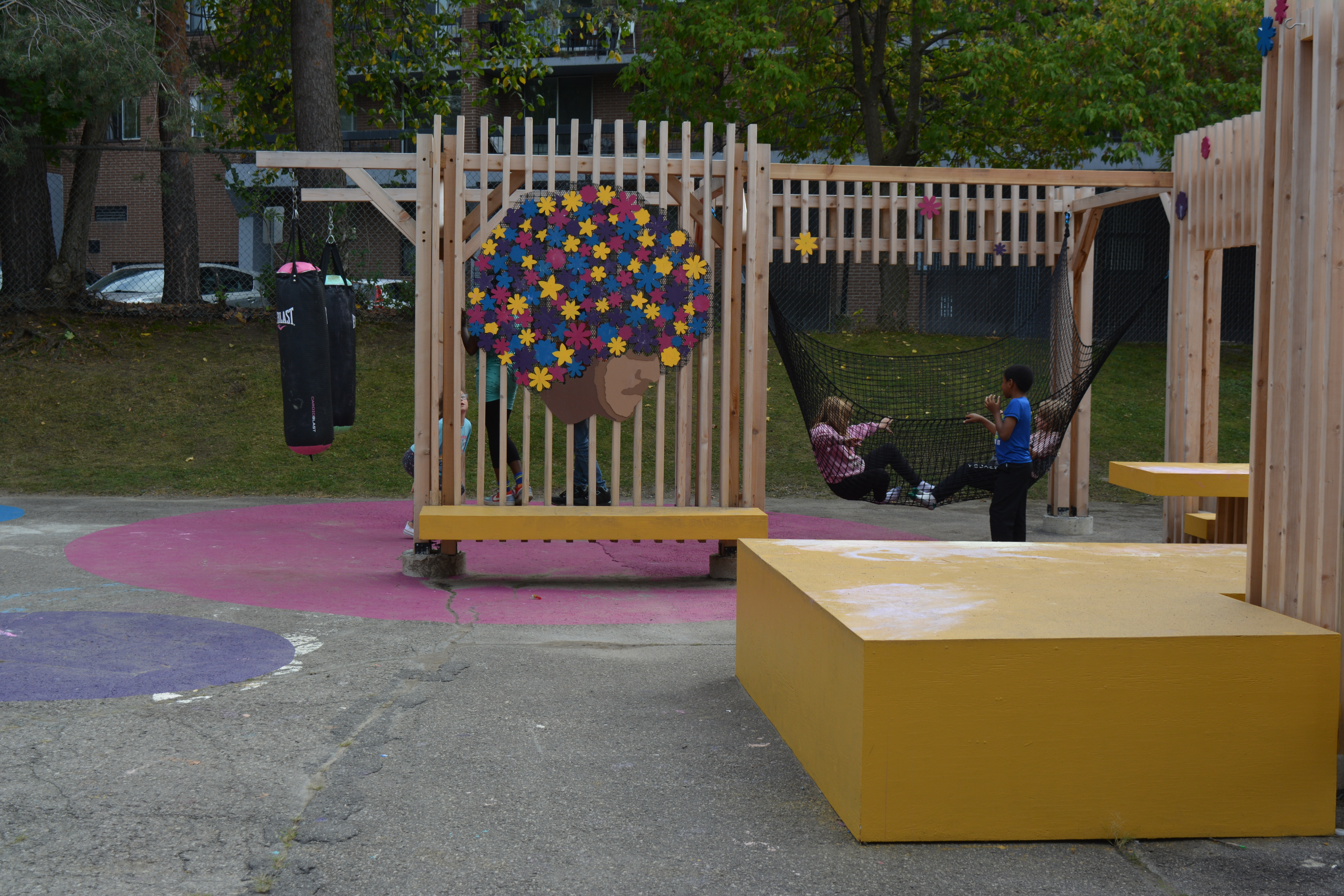
We woke up on the weekend of Canada Day in 2024 to text messages from our community and friends in Russell Heights, a predominantly Black community on the east side of Ottawa. The texts alerted my students and me to stop our design-build project for their new community space, because Yousef had been shot and killed in the early hours of the day. It was the second fatal shooting that summer in the Russell Heights community—a neighborhood owned and operated by Ottawa Community Housing, Canada’s second-largest affordable-housing provider. Like many of their neighborhoods, the precarity of the built environment, the disinvestment, and the marginalization reflect a textbook case of racialization in urban space. Yousef was nineteen. The news of his death was reported in the Ottawa Citizen as “19-year-old man killed in Friday night shooting on Russell Road.”1 But he was not a man; he was our boy, and every boy and girl in the neighborhood felt closer to death every time we lost one of our own.
Meanwhile, the Ottawa police were extremely dismayed and inconvenienced by the idea of having to work on Canada Day. They refused to clean the site of the incident, a convenient alleyway between buildings used daily by kids on their way to the playground and the basketball court. The mothers, mostly immigrant women of East African descent, had to divert the movement of children and swiftly clean the gore out of the way to save their youngsters from more trauma. At that moment, the question of regulations about site contamination was rendered obsolete within a frantic race to eliminate every spatter before the first wave of kids moved through the space. The cleaning process was fast and quiet. The mothers brought their own cleaning supplies, and many of these tools were discarded and disappeared immediately after the cleaning was done. This corner of the neighborhood will forever be associated with trauma, but those youngsters, who were asleep and never saw the evidence of death, were spared the visual. In that act of cleaning, we disappeared the signs of death as a means of fighting for and maintaining our young and old lives.
The Ottawa Police’s refusal to clean the scene is a perfect illustration of the order of race in space. The state, through its agents, regulates death by marking the space with its sovereign power but then abdicates all responsibility for the material and emotional consequences of that death. Here, cleaning is the most urgent form of architectural work. It is an immediate, community-led spatial practice aimed at repairing a profound social and psychological fracture. By eliminating the traces of blood, these mothers are not just cleaning an alley; they are actively maintaining a relational order.
With these two stories, I reckon that cleaning is an inseparable, indissoluble condition of our material existence. Cleaning fills the space between life and death. And in these two stories, I touch the edges of this proposition in the archaeology of my memory. I see the epitome of life perpetuated by my grandmother, and I see the refusal of death asserted by the women in Russell Heights. These stories also straddle the edges of agency, between generation and abnegation, for and around relations and relationality.
My grandmother’s cleaning was generative. It produced knowledge as she read the sand like a book. It produced a relation as she intentionally hosted chickens, cats, pigeons, and grandchildren. It produced a persistence of a livelihood; the endless sweeping was itself a confirmation of life. But this generation sat inside abnegation. By sweeping in a backward squat, she erased her own self to make the surface legible. The labor was endless—we stomped, she swept, we stomped again, she swept—and it was gendered, expected, uncredited. Generation through abnegation.
The mothers of Russell Heights and their cleaning worked at the other edge of the generation-abnegation agency. Their cleaning was abnegation. They cleared the evidence of state violence and intentionally disappeared their own labor and silenced their trauma to spare their kids. Yet this abnegation was also generative. It created a path for children without exposing them to visual traces of violence. It produced collective action. It produced continuance and a refusal to let the space become a monument to death. Their agency was in choosing abnegation.
I am reminded of the words of James Baldwin in his 1980 essay “Notes from the House of Bondage.” He wrote, “The children are always ours, every single one of them, all over the globe; and I am beginning to suspect that whoever is incapable of recognizing this may be incapable of morality.”2
Between both cleanings lies the relational. Between them, also, lies architecture’s blind spot. The discipline sees only the object and intentionally dismisses the relational work that makes spaces livable. To see this is to recognize that cleaning is a relation forged in the disappearance of self.
Through these acts of cleaning, I argue for an emotional practice of architecture as a framework that “registers the emotional as a potent factor in placemaking,” crediting “another kind of placemaker, thus expanding our understanding of the architect,” by positing the agency and the practice of cleaning as an explicit condition of livable/living architectures.3 I also veer away from narratives of care, not for a deficiency in their reliability as an analytical lens but as a counter to the contemporary use of the term in our field. Thus, I protest the overuse and underutilization of the word “care” in its current position as a generic, charitable, low-stakes, rhetorical, and anemic term. Care work is backbreaking work that operates in a material collective logic.
Cleaning, as an embodied and ritualistic practice, is political, with everyday constitutive policies at the intersection of architecture, labor, and emotion. It disrupts colonial narratives that devalue everyday acts of living. This essay calls for the abolition of an architecture that requires death-worlds, necroeconomics,4 and survival by extraction. It proposes instead an abolitionist practice of place-making that must be entangled in cleaning. Taking on cleaning as both labor and knowledge production is to refuse the dehumanizing logic that renders it invisible. Here, cleaning becomes a path through the epistemic revolt against the master architect. It requires different modes of practice and a new social contract for space—one that requires a new economy. From Hobbes to Locke to Rousseau, the term “social contract” carries a great deal of baggage. It has meant an agreement among so-called free individuals to surrender certain freedoms in exchange for some form of order, while those excluded from the contract became its subjects. Architecture inherited this arrangement. However, cleaning brings creative, reparative action to the center of that contract. It is a form of what Kyle Powys Whyte might call “collective continuance.”5 This reframing positions cleaning as a core spatial practice. It is not a side note to the “real work” of architecture; it is architecture. It physically reshapes spaces, redefines our relationship to the environment, and repairs social and ecological fractures.
A Matter of Life and Death
In my search for stories and tales about architecture’s relationship with its cleaners, the exhibition PHANTOM. Mies as Rendered Society (2012)6 by Andrés Jaque at the Barcelona Pavilion caught my attention. I visited the pavilion about eight years ago when I was in Barcelona. I felt obligated as “a person in architecture” to take the long bus ride to see this building that made its way into my third-year history of architecture curriculum at a small university on the outskirts of Cairo. We were taught about some brilliant ghostly walls, the pristine marble, a dignified spatiality, and the architect’s genius. In all honesty, this visit left me with a deep sense of emptiness, one I navigated by convincing myself there was something I did not understand. I only felt at ease when I caught the familiar sight of pigeon droppings.
How the pavilion managed to make those little traces of excrement, the confetti of open spaces in many European cities, disappear is a mystery to me. However, Jaque may have partly unraveled this secret in his exhibition by “making visible” what modernist monumentalization systematically conceals: the marble-buffing machines, chemical cleansers, broken tiles, ladders, dog bowls, and worn curtains that keep the pavilion legible as “timeless” architecture. But that did not explain exactly why this pavilion appears like a corpse—mummified, and in need of an occasional freshening up to avoid imminent decay. Even in its recognition of such an intensive cleaning operation, Rendered Society still perpetuates the lifeless silence of the pavilion itself. It is silence upon silence, death upon death, without addressing architecture’s problem with the momentum of living—living people, living organisms, living spaces, and living practices.
Rendered Society is one example of architecture’s fetishization of maintenance and care in the last decade. From Hilary Sample’s Maintenance Architecture to a slew of well-meaning exhibitions on repair, this new interest performs a critical sleight of hand that makes maintenance visible only to more efficiently re-contain it as a form of building performance art. By framing repair as technical or managerial problems of “reproduction,” these works sidestep the political stakes of existence as sites of racialized and gendered expropriation. They put forward a palliative effort that soothes the discipline’s conscience, allowing it to feign self-critique while leaving the necropolitical foundations of the Architect-as-Sovereign and the Building-as-Capital intact. This framing of care allows architecture to instrumentalize the life-giving force of care by rendering it an endless, invisible service owed to the building-object. The order of architecture is sustained by a specific, sacrificial figure, what Joy James theorizes as the “Captive Maternal.”7 She describes this character as people identified by their function and deemed a necessary sacrifice to maintain order. They themselves have no individuality yet they are necessary for maintaining the individuality of those whose humanity is deemed more valuable. The Captive Maternal describes those who are coerced into nurturing life within systems engineered for the consumption of others. They are “feminised into caretaking” regardless of their gender, and their life-sustaining labour is extracted by the very structures that consume and dispose of them.
Here, cleaning, as performed with the extraction of captive maternals, is not the same as that we see in the Kom-Ombo valley or in Russell Heights; it is severed from spatial agency and coerced through the economic precarity of those who do the maintenance and cleaning.
Centering cleaning as an architectural action that interweaves social, emotional, and spatial relations exposes the emptiness of the contemporary discourse on “maintenance” and “repair” in architecture. When figures like Hilary Sample advocate for Maintenance, they perform an act of naming, typical of design research, which catalogues phenomena but stops short of taking a position on them. Yet, too often, this discourse stays within the bounds of what Fred Moten and Stefano Harney would call “governance.”8 It seeks to make maintenance more efficient, more visible, and more “integrated” into the design process. It wants to give maintenance better credit. It seeks to repair the machine, not to ask why the machine is designed to break in ways that require racialized and feminized labor to constantly fix it. This is why the concept of the “irreparable,” as theorized by Joachim Ben Yakoub, doesn’t make its way into this discourse.9 The irreparable is that which is broken and “should not be repaired” because the structure itself is the violence. The plantation is irreparable. The prison is irreparable. And the necropolis, which externalizes its life-sustaining functions onto a captive underclass, is also irreparable. It cannot be fixed. It must be abolished.
Achille Mbembe’s theorization of necropolitics exposes the darker mechanisms of sovereignty, wherein death itself becomes a tool of governance and exclusion. For Mbembe, necropolitics is profoundly spatial: The production and organization of space operate as technologies through which colonial and postcolonial powers regulate the distribution of death. Within architectural practice, cleaners function as one such device, sustaining the necropolitical project of architecture by preserving its appearance of purity, cleanliness, and a sense of being uncontaminated. The necropolitical order that Mbembe theorizes, in which sovereignty has the power to dictate who may live and who must die, is not an aberration within the architectural project; it is its foundational logic. The answer lies in a violent engineered schism at the heart of spatial production, which is enacted through individuation, commodification, and objectification of the built environment, where maintenance is an act of reform. Architecture as we know it, then, is in need of what Mbembe terms “death worlds” and necroeconomics to survive. If sovereignty is the power to dictate who lives and who dies, the power to mark and abandon, then community is precisely where sovereignty cannot go. Not because the state never arrives—it does, as police, as housing authorities—but because community as such operates on a different logic entirely. Soverignity seems to condition power to individuation,10 and this is ontologically inapplicable to community.
This schism is precisely the rupture in what the Brazilian geographer Milton Santos defines as the nature of space. For Santos, space is “indissoluble sets of systems of objects and systems of actions.”11 Yet, in its necropolitical mode, contemporary architecture operates by violently severing this very indissolubility. It produces a gleaming, sustainable “system of objects” while systematically externalizing the “system of actions” required to sustain it. This externalized labor, the racialized, feminized work of cleaning, maintenance, and repair, becomes the ghost in the machine. However, in truth they are the life-makers; the ones that bind objects to actions. My grandmother’s sand-filled courtyard is the counterpoint to this violence. She minds the dust as a relation. She does not sever the system of objects (the courtyard, the walls, the home) from the system of actions (her labor and life). She acts upon their indissolubility.
Architecture's Unpayable Debt
The order of reform in architecture is sustained by James’s Captive Maternal. It requires the racialized, feminized subject of the social contract to be coerced into the work of nurturing and protecting life within a system engineered for the consumption of her community. She is the human infrastructure of the necropolis. In the built environment, she cleans and repairs; the janitor, the grandmother, the maintenance worker, whose life force is extracted to maintain the illusion of an autonomous, pristine architectural object. This system of captivity is psychologically underwritten by the myth of radical individualism, which serves as the order’s crucial alibi in its dual function. First, it sanctifies the Architect as the lone sovereign author, erasing the collective, subordinate laborer who sustains his vision. Second, and just as crucially in the discipline’s theorization of maintenance, it enforces a perverse individuation of the cleaner. By framing maintenance as a series of isolated, personal tasks performed by replaceable individuals, the system obscures its own reliance on a collective class of Captive Maternals. This individuation fractures solidarity, framing failures of upkeep as personal failings rather than systemic design flaws. The cleaner is tasked with bearing the moral weight of a building’s decay alone, while the architect who designed its uncleanable surfaces escapes all the responsibilities of relation.
Within this framework, the prevailing discourse of “repair” becomes a suspect, even violent, mandate. To call for repair without abolition is to demand that the Captive Maternal mend the very machinery of her own captivity. It is a cruel loop that forces her to lovingly tend to the structures that hold her hostage, transforming her capacity for love into a tool of her own subjugation. The Russell Heights mothers make this violence legible. They didn’t clean the alley because they believed in repair. They cleaned it because someone had to. This notion of uncritical repair reinforces the necropolitical cycle, ensuring that the system that consumes her can continue to function.
Architecture, in this case, becomes a predatory loan to the community. The building is advanced as a finished and disconnected object. Yet it remains in need of consistent cleaning and, increasingly, repair. To me, the difference between the agentic cleaning of the mothers in my first two stories—who chose what was to be cleaned, and how to clean it—and the coerced cleaning by the minimum-wage expendable worker, is that the latter is severed from the system of objects. They have no agency over defining the space through cleaning. Moreover, a line is drawn between them and the spaces they service that renders them unable to autonomously determine the “standard” of cleaning.
This is the spatial face of what Denise Ferreira da Silva calls the foundational logic of racial capital: the expropriation of labor and land through the juridical and symbolic production of racial difference.12 This is not a debt that those who clean incurred, but one violently imposed by racial capitalism and coloniality. Therefore, the goal cannot be to better value cleaning work within the system. This process of indebtedness finds further theorization in the work of Fred Moten and Stefano Harney, who describe the undercommons, the social life that persists in and despite the institutions of enclosure. For them, debt is not just a financial issue; it is the primary mechanism by which the state and capital claim ownership over social reproduction itself. They write, “Debt is the means of the extraction of the social wealth from the social individual... It is the way the credit of society is loaned back to its members at interest.”13 Architecture, as a necropolitical order, operates as a creditor in an economy of life and death that it itself has structured. It accrues value by creating a specific, unpayable debt: the debt of cleaning.
According to Françoise Vergès, the cleaner’s labor and its social cost must be erased to sustain fantasies of control.14 However, the cleaner-as-a-body is often hypervisible as a racialized and gendered subject. This dual mechanism of hypervisibility (of the racialized body) and invisibilization (of the labor) serves a crucial purpose in maintaining the spectacle. It meticulously separates “clean” public-facing spaces from the “dirty” service corridors and externalized landfills, as in the Victorian separation of use and labor, rendering the politics of disgust empirically evident.
This condition produces indebted subjects. The cleaner is forever in arrears, their work never finished, always required again tomorrow. This is the “bad debt” of sociality that Harney and Moten describe, a debt that can never be paid off, only serviced, ensuring a permanent state of subjugation within the undercommons of the built environment. Bad debt, as Moten further posits, is “the debt that cannot be repaid, the debt at a distance, the debt without creditor, the black debt, the queer debt, the criminal debt.” It is mutual, social, and fugitive; it “runs in every direction, scattering, escaping, seeking refuge.” The calculable debt binds you to the system; the “bad debt” of mutual obligation binds you to each other in opposition to the system. Architecture’s great trick is to convert the latter into the former.
While the cleaner and the sweeper may fall into the red of colonial accounting, while they may be both invisibilized and objectified as architecture’s captive maternals, they are not without agency and often find ways of slipping past debt and obligation to offer their knowledge to sustaining systems instead. Aya Nassar’s geopoetics of dust provides the theoretical language for this critique.15 Dust, she writes, is “an inconvenience” to regimes of vision and solidity, the scopic regime that governs the architectural discipline and that underwrites architectural aesthetics. It “hides and perhaps clouds vision. Dust is the marker of the destruction of stability. It is what remains after—the aftermath.” The clean aesthetic must suppress dust, must invisibilize the material traces of the violence that sustains it. But dust “returns. Always. Usually not suddenly as a haunting ghost but quietly and cumulatively, like a falling snow.”
My grandmother’s sand-filled courtyard, the dust it creates, and her minding other-than-human relations are aspects of cleaning that refuse the erasure of the world that comes with colonial logics. The sand is the memory of what was here before. The dust is the trace of those who live by human and non-human relations. The sweeping is the acknowledgment that we are all temporary and that other life will happen. To clean this way is to say: I will not pretend that the world begins with a single creator. It is the practice that refuses the choice between cleaning as love and cleaning as abnegation. It insists that cleaning can be a way of knowing, a method of world-making that does not require the destruction of other worlds.
Abolition Now
The mandate of architecture, as presently constituted, is a necropolitical fiction. It declares, in its syllabi, its awards, and its glossy publications, that cleaning, minding, and upkeep are not the work of architecture. The routine, the aging, the afterlife of spaces, the use, and the very conditions of their habitability, are deemed external to the discipline’s core concerns. These acts of preserving, nurturing, cleaning, and fixing are relegated to the category of “minor tasks,” a euphemism for the racialized, gendered, and underpaid labor that sustains the illusion of architectural permanence. This is not an accidental oversight but the foundational logic of a profession born from colonial and capitalist orders. Architecture’s primary relationship to the life of its “product” is one of systematic disavowal; it consumes the life force of maintenance while refusing to acknowledge its constitutive role. However, if we understand placemaking as a continuous relational action wherein all actors as responsible for the quality of its use, we must abolish the figure of the sovereign architect as a lone creditor alongside the disposable captive maternal who props up his sovereignty. We must instead anoint the sweeper, the collective, caring body, as the true sovereign of the places we inhabit. We do not need more architects of objects. We need more architects who are entangled in our debt for each other, those who recognize their role as cleaners. This is an architect whose primary asset is the capacity to build and sustain relationships, and whose “design” is to facilitate social and material cycles into spatial form. This framework registers the emotional as a potent factor in placemaking, thus expanding our understanding of the architect.16 Our skill set expands to include facilitating relationalities, reading social and ecological traces, and choreographing collective maintenance while omitting what is irreparable. We must anoint an architect who commits to the responsibility over their work beyond the limits stated by insurance companies and prize juries. Ultimately, this new contract rewires architecture’s fundamental relationality to contribute to the collective continuance of a place into a framework that trains, elevates, and deploys architects like my grandmother.
-
“19-Year-Old Man Killed in Friday Night Shooting on Russell Road,” Ottawa Citizen, June 30, 2024, link. ↩
-
James Baldwin, “Notes on the House of Bondage,” The Nation, November 1, 1980, link. ↩
-
Menna Agha, “Emotional Capital and Other Ontologies of the Architect,” Architectural Histories 8, no. 1 (2020). ↩
-
Achille Mbembe, “Necropolitics,” Raisons Politiques 21, no. 1 (2006): 29–60. ↩
-
Kyle Powys Whyte, “Collective Continuance,” in 50 Concepts for a Critical Phenomenology, eds. Gail Weiss, Ann V. Murphy, Gayle Salamon (Evanston, Il: Northwestern University Press, 2020), 53–60. ↩
-
Andrés Jaque and Office for Political Innovation, “PHANTOM. Mies as Rendered Society,” accessed March 23, 2026, link. ↩
-
Joy James, New Bones Abolition: Captive Maternal Agency and the (after)Life of Erica Garner (Common Notions, 2023). ↩
-
Fred Moten and Stefano Harney, The Undercommons: Fugitive Planning & Black Study (London: Minor Compositions, 2023). ↩
-
Joachim Ben Yakoub, talk during the session on “Architecture Reparations,” presentation at the Flemish Architecture Festival, October 8, 2022. ↩
-
Hannah Arendt, Between Past and Future: Eight Exercises in Political Thought (New York: Penguin Classics, 2006). ↩
-
Milton Santos, The Nature of Space (Durham, NC: Duke University Press, 2021). ↩
-
Denise Ferreira Da Silva, Unpayable Debt (London: Sternberg Press, 2022). ↩
-
Santos, The Nature of Space. ↩
-
Françoise Vergès, Making the World Clean: Wasted Lives, Wasted Environment, and Racial Capitalism (London: Goldsmiths Press, 2024). ↩
-
Aya Nassar, “Geopoetics: Storytelling against Mastery,” Dialogues in Human Geography 11, no. 1 (2021): 27–30, link. ↩
-
Agha, “Emotional Capital and Other Ontologies of the Architect.” ↩
Dr. Menna Agha is an architecture activist and a researcher. She is an Associate Professor of Design and Spatial Justice and the founding Director of the Architecture Action Lab. She is also cross-appointed at Carleton University’s Institute for African Studies. In 2019/2020, she was the Spatial Justice Fellow and a visiting Assistant Professor at the University of Oregon. Menna is a third-generation displaced Nubian woman, a legacy that infuses her research interests in race, gender, space, and territory.