
Breakdown
On Saturday, February 28, 2026, I woke to a flood of messages announcing that the United States and Israel had launched coordinated strikes against Iran.1 Outside Iran, the war took shape by way of word and image: satellite surveillance, official statements, various trajectories mapped and assembled within minutes of impact. For those like myself, with family inside Iran, it unfolded through a series of sustained interruptions. Failed calls. Stalled messages. Time stretched between one attempt to reach someone and the next. My father and relatives live in Tehran.
I tried to call him.
The call did not go through.
Given the speed, the near instantaneity with which the imperial machine now operates, lags of seconds, minutes, and hours can and do portend all manner of disaster. How are we meant to process such relentless fracture? How do we inhabit and extend the gravity, the presentness of these moments in the face of realtime warfare?2 That which leverages computational, communication, and media systems to reduce delay to such an extent that sensing, decision-making, and action appear to occur at once?
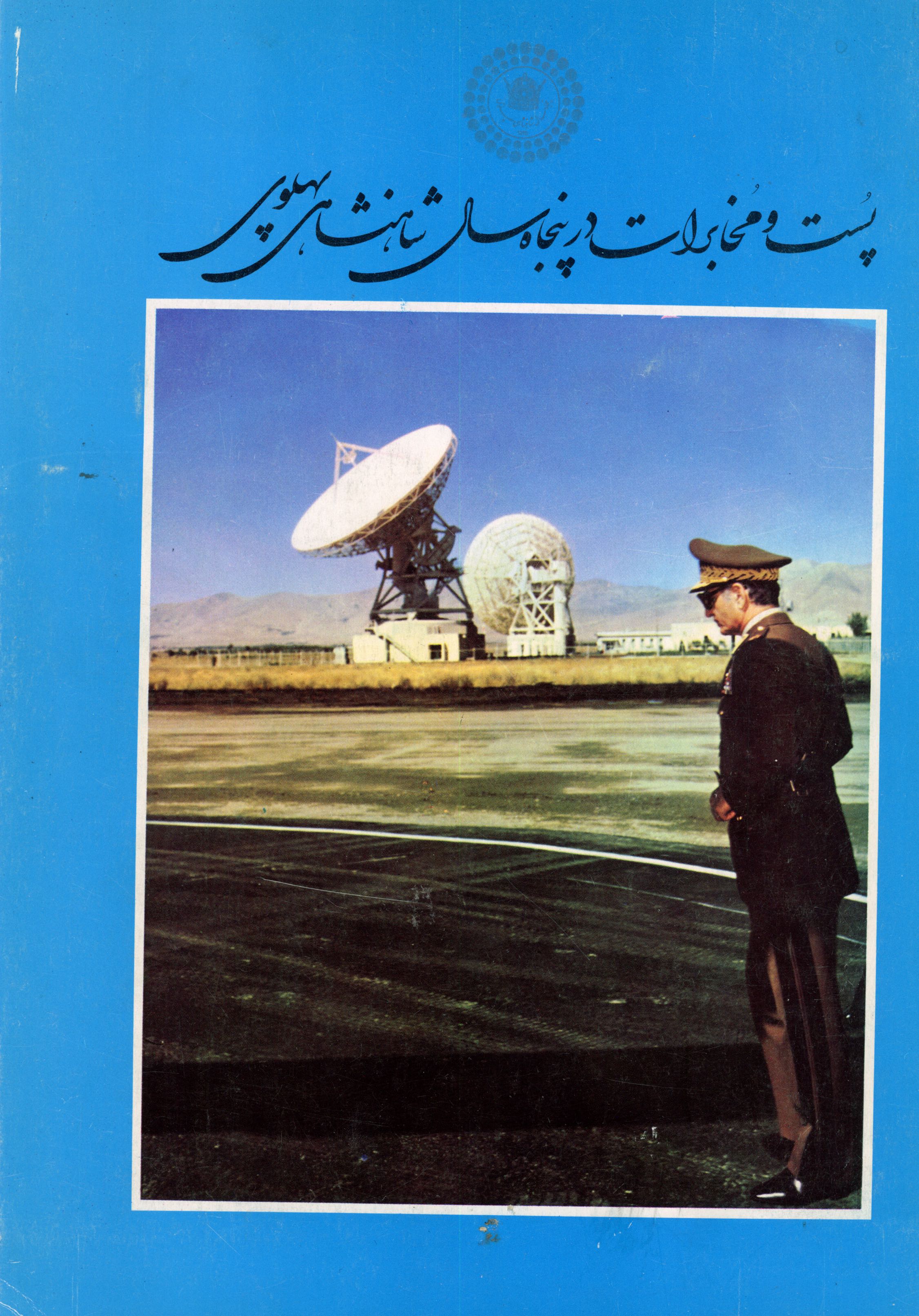
In contemporary US and Israeli operations—not least of all those coordinated throughout their genocide of Gaza—satellites, sensors, and networked command infrastructures directly link detection to strike, thereby closing the gap between seeing and acting.3 Military doctrine still requires identification of targets, estimation of civilian harm, and legal review, while officials continue to cite these procedures as evidence of control.4 The shift lies in throughput. Systems such as the Pentagon’s Maven ingest large datasets, generate target lists, assign coordinates, and rank them for action within a single interface, allowing thousands of strikes to be planned and executed within days.5
Public justification has adjusted accordingly. At the outset of the 2026 campaign, Secretary of Defense Pete Hegseth rejected “politically correct wars” and stated that civilian casualties would accompany operations conducted at this scale.6 Defense firms developing these systems frame their work in terms of securing Western dominance through technical force.7 The operational logic follows a familiar industry maxim: Deploy systems rapidly, accept the deaths that occur as a result of their use, and address responsibility after the fact through investigation and/or denial.
The strike on a primary school in Minab on February 28, 2026, which killed more than 170 people, most of them children, demonstrates the horror of this acceleration. The site had been part of an IRGC compound years earlier and remained in targeting records, even as it had functioned as a civilian school in the years since.
Investigations indicate that this designation moved forward within a system that processes large volumes of targets at high speed, drawing on data that had not been fully updated to reflect changes on the ground.8 The language of precision persists, even as the system that produces it expands the scale and frequency of violence, and as those subjected to that violence are rendered less legible as civilian life within the terms used to justify it. In the slipstream of realtime, delays are disasters for civilians and the spaces they occupy.
Then there is the matter of televisual infrastructure, designed to convert actions into maps, clips, and claims that circulate through broadcast channels and digital platforms within minutes of their unfolding. The onslaught of news from the front lines is, today, unprecedented. And yet, the breadth and immediacy of such information have arguably not served to make war any more reprehensible. On the contrary, these territorial and perceptual realtimes collate a narrative in which targets of imperial violence are rendered fully visible and yet are stripped of political and human complexity: persons become points, governments become regimes, populations become problems to be resolved through immediate and violent action.9 This all makes for a battlefield that should be known and intervened upon without delay.10
This temporal modality extends beyond the theater of war. It grows from a longer imperial project to govern across distances through electronic relays, where action is mandated via cables, satellites, and servers with minimal latency.11 Coercive, economic, administrative, and cultural power—long recognized as core techniques of empire—operates in a realtime that rejects any oversight in its unchecked hurtle toward total domination.12 Militaries track and strike through networked sensors. Financial systems shift capital across markets in seconds. Logistics infrastructures move fuel and weapons along continuously updated routes, while all manner of communication platforms circulate and regurgitate images and objectives at scale.
Authority depends on this ability to direct force, capital, and information in rapid sequence. Its objective is to neutralize the gravity of the present moment, to defy the possibility of contending with tragedy by stifling it with the speed that is realtime warfare. Such is the nature of a form of combat that barrels ahead with maximum temporal and spatial fidelity, disappearing the present in its wake.
Realtime warfare communicates, decides, and resolves events within the same moment. Iranians insist that neither politics nor life itself moves at this speed. We demonstrate that to resist such warfare is to interrupt it, to slow, misdirect, and overwhelm the systems that claim to manage it.
For distant audiences, war arrives as image and update. For us, for me, it begins with a rupture in space-time, an extended lag, an excruciating wait for news.
It begins with a phone call. One that does not go through.
March 2026
It is 5:00 am in Tehran. My phone rings.
Salam, baba.
Salam, Farzin.
Khoobi?
Khoobam.
Delam baraat tang shodeh. Chera zang nazadi?
Zang zadam. Javaab nadadi.
Anyway, what’s up with you? I’m eating sahari. A bomb fell thirty meters from the house in the middle of the night. The blast shattered all the glass. It woke me up.
What are you eating for sahari? Either kebab or this chicken thing I make. Khalehs are all OK. Cousins too. I manage to call them every few days. Your cousin just had a baby—the one who took you to the tailor. I remember the second time I met C. The bright red tailored shirt from Tehran I wore. She never let me button it to my chest again.
His wife was due next week, but the doctor suggested a C-section now. He’s in shomaal now. He invited me to join them.
Why didn’t you go?
Maybe I’ll go after Ramadan. If I go now and don’t stay ten days, I’d have to break my fast. I don’t want that. And I don’t want to be away that long.
You should go!
Optical Strikes
Despite all manner of technical innovation, war continues to depend, perhaps most absolutely, on its narrativization. Institutions beat the drums of war far in advance of any armed conflict, naming events, decreeing their order, assigning and fabricating cause.13 Eventually they earn names like the “Twelve-Day War,” coined by Donald Trump and widely used to describe the confrontation with Iran in June 2025. The designation has since shifted the sequence of strikes, retaliations, and negotiation into a single, bounded episode. Seven months later, the fighting resumed, but the name had already fixed a timeline. It gave an unstable conflict the air of closure and made subsequent escalation appear as a break from an already completed event rather than its continuation.
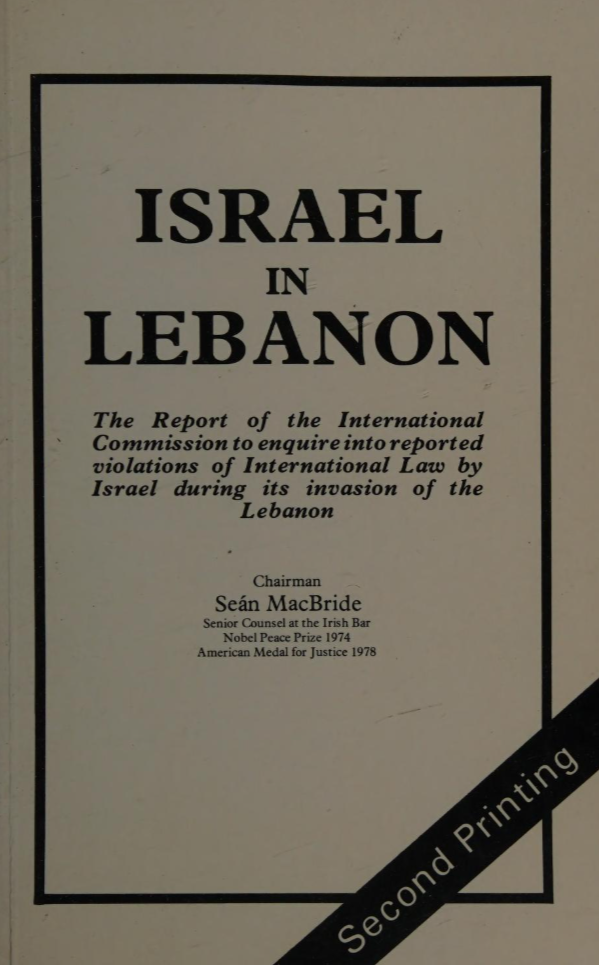
On this front, Edward Said, in “Permission to Narrate,” examined how the Palestinian experience—dispossession, exile, occupation, bombardment—has been systematically denied narrative legitimacy.14 Even when the facts are known, he argued, they are often rendered inert without a socially sanctioned narrative structure to hold and transmit them. Writing after Israel’s 1982 invasion of Lebanon, Said foregrounded the MacBride Commission’s investigation into Israeli war crimes: indiscriminate bombardment of civilian infrastructure, forced expulsions, and mass killing. The commission concluded that Israel had “no really valid reasons under international law for its invasion of Lebanon, for the manner in which it conducted hostilities, or for its actions as an occupying force.” Schools, hospitals, refugee camps—nonmilitary targets—were deliberately and systematically bombed. This is again the case over forty years later: Israel has renewed its indiscriminate bombing campaigns in Lebanon, across all kinds of civilian infrastructure, just as it targets Iran’s. In all this time, Said’s claim persists: Facts require a structure that can hold them in place, return them to public attention, and bind them to consequences over time. Absent a structure, evidence accumulates without settling into meaning.
Reading Said now is eerie. The same problem endures, though it now operates through a different technical field. The issue is not only suppression. It is distribution. Iranian voices are not absent, they are unevenly carried. The speech of those who frame Iran as a problem requiring external correction moves quickly and widely, shaping what can be said, what solutions appear reasonable, and what is impermissible. Counteraccounts exist—grounded in sovereignty, anti-intervention, or the longer history of imperial force in the region—but they are barred from traveling with comparable force.15 Institutionally mandated shadow banning, censorship, doxing, and punishment suppress the mainstream credibility, breadth, and outreach of such accounts. This uneven distribution is built into the technical systems that organize communication itself.
The Terrain of Communication
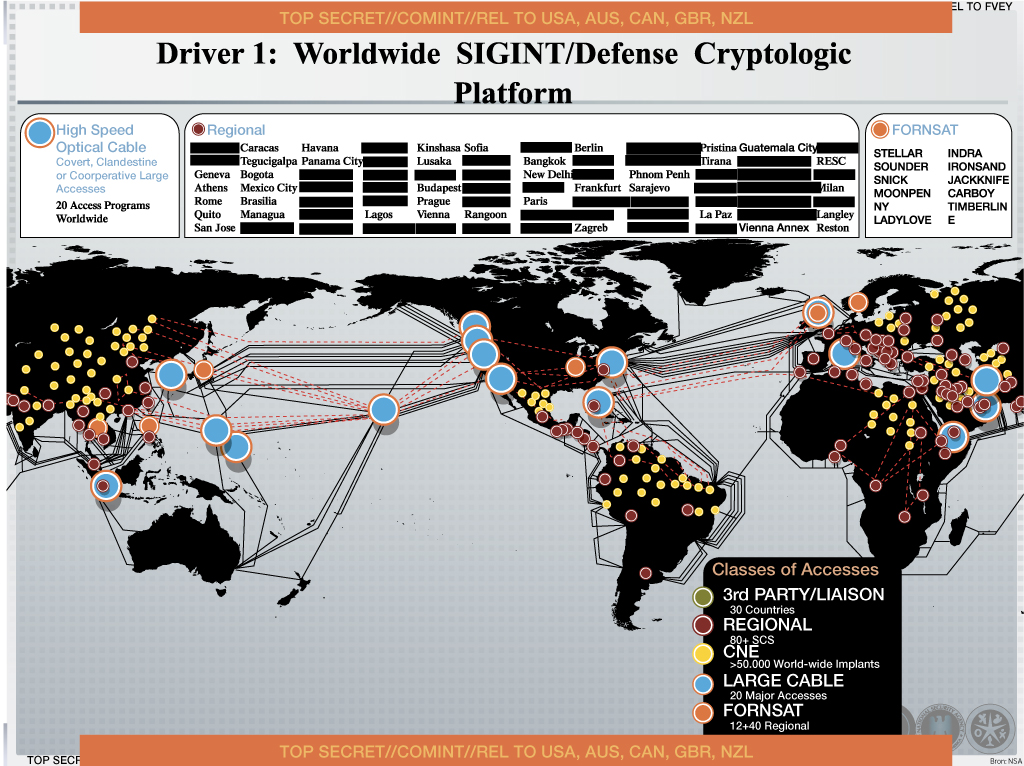
Famously, in 2013, Edward Snowden revealed that the United States had built surveillance systems operating at population scale—collecting communications data from tens of millions domestically and reaching hundreds of millions globally through bulk metadata collection, upstream interception, and platform access. This surveillance was embedded in physical infrastructure. The NSA tapped fiber-optic cables at landing stations on the Atlantic and Pacific coasts, intercepted traffic inside major switching facilities, and accessed data through telecom partners that included AT&T and Verizon. Programs such as FAIRVIEW and STORMBREW captured international communications as they passed through nodes in New York, New Jersey, Virginia, California, and Florida. PRISM provided access to data held by US-based platforms, whose server infrastructure—concentrated in data center regions in Northern Virginia, Oregon, and California—processes communications from users worldwide.
This concentration of cables, exchange points, and cloud systems routes a significant share of global traffic through US territory or firms, placing it within reach of US law and intelligence collection regardless of user location. This is a structural advantage produced through geography and infrastructure. Control operates through routing at these nodes without requiring overt interruption. Claims of digital sovereignty are constrained at this level. States that do not control these pathways operate within networks already subject to external access, and measures such as filtering or shutdowns emerge as attempts to reassert control over compromised channels. As Alexander Galloway argued more than two decades ago, the internet’s architecture diverges from its public mythology: A system presented as open relies on protocols that enable distributed control and selective interruption.16 This divergence sustains an imperial arrangement in which US-centered infrastructures present themselves as guarantors of openness while maintaining the capacity to monitor and regulate global communications. Platform companies extend this structure, embedding surveillance and behavioral modulation within everyday communication systems while preserving the claim that they remain open.17
Over the past two years, this uneven distribution has been visible in stark terms. Evidence, documentation, and testimony from Gaza have circulated continuously, even as their political force has remained limited. Human rights organizations such as Human Rights Watch and Amnesty International have documented widespread civilian harm, while journalists and researchers have reported systematic content moderation practices affecting Palestinian voices across major platforms, including removals, demotions, and account suspensions. Internal reporting has shown that platforms such as Meta have applied moderation policies unevenly, disproportionately restricting Arabic-language content during periods of conflict.18 Evidence accumulates. Yet it does not alter the conditions under which violence proceeds. International law, as Eyal Weizman reminds us, does not constrain violence so much as structure its legitimacy—embedding an economy of permissible killing within the doctrine of proportionality.19
This narrative field is also actively produced through the control and contestation of communication systems. During the January 2026 protests, and in the ongoing war, Iran’s shutdown of the internet was, and is, being widely framed in Western media as repression or concealment.20 Such accounts capture part of what a shutdown does, but isolate the act from the wider battle space in which they occur. During the protests, Iranian state television was briefly hijacked with messages calling for revolt. Days later, the CIA issued a rare Farsi-language appeal instructing Iranians how to establish secure contact.21 In the months leading up to the war, Citizen Lab identified a coordinated network of more than fifty inauthentic X accounts conducting an AI-enabled influence operation aimed at inciting unrest, with activity synchronized, in part, with Israeli military action.22 At the same time, satellite internet systems such as Starlink functioned inside Iran as an unlicensed communications layer routing data beyond domestic infrastructure, even as authorities attempted to jam their signals and later seized hundreds of terminals while alleging espionage and collaboration with external actors.23 What appears as access from one vantage point also functions as penetration from another.
In vying for communications superiority, what is first and perhaps most crucially compromised for civilians is trust. Fear of ulteriorly motivated communications swiftly erodes away social cohesion in critical ways, ushering in a climate of general doubt and mistrust that make organizing and resisting all the more arduous when attempting to navigate with certainty the terrain effectively charted by these networks—the channels through which information moves, coordination takes place, and targets are made visible. As Omid Mehrgan's recent analysis of the rendering of Tehran as a targetable space argues, “The city must first be made legible to systems that can act upon it.”24 Read alongside earlier accounts of regime-change politics, where media circulation, external messaging, and internal unrest converge to produce a crisis of legitimacy, the pattern is recognizable without collapsing distinct histories into a single script.25 The shutdown, therefore, cannot be read as either repression or protection in isolation. It operates within a contested field in which visibility, access, and verification are actively produced and controlled.
Theater of Power
This same ordering of visibility extends into the conduct of the military campaign itself. Realtime warfare on Iran unfolds through linked systems of sensing, classification, and attack designed to narrow the interval between detection and action. US and Israeli operations rely on satellites, signals intelligence, drone feeds, and command platforms that correlate data and assign significance before an image ever reaches a public screen. Programs such as Joint All-Domain Command and Control formalize this linkage across domains, seeking to move data from sensor to shooter with minimal delay. By the time a target appears, a sequence of selections has already occurred. Investigations into Israeli targeting practices in Gaza describe systems referred to as “the Gospel” or “mass assassination factories.”26 These systems draw on large datasets and machine-assisted analysis to generate target lists at scale. Júlia Nueno Guitart and others have shown how communication patterns, movement histories, and social ties are treated as indicators of militant affiliation.27 Residences, shelters, and basic infrastructure enter targeting databases through chains of inference that treat proximity and routine as signals. The category of the civilian does not disappear. It is stretched, qualified, and redefined through association. Precision does not reduce violence. It reorganizes it by expanding what can be made legible as a target.
Legal review operates within this same process. Military lawyers assess target files, estimate casualty ranges, and approve strike parameters before authorization. The language of military necessity and proportional response is applied to outputs generated by the targeting system itself. The target appears valid because technical filtering, intelligence correlation, and legal review reinforce one another within the same workflow. Realtime war consolidates these elements into a single operational frame. It reduces the interval between detection and attack, bringing sensing, classification, and execution into the same temporal register. US doctrine has described this sequence as the “kill chain,” later rebranded as the “sensor-to-shooter loop,” with success measured by the speed at which information becomes action.
Take, for example, a Hellfire missile. It travels at roughly 450 meters per second. From a few kilometers out, impact follows in roughly 10 to 25 seconds. That interval contains the time required to confirm a target, transmit data through satellite links, secure authorization, and return the firing command. The system treats the target as fixed within that span. The ground, however, does not. A person running can cover tens of meters. A car slows at an intersection. A door opens. Someone steps outside. These are ordinary conditions of urban life. The strike proceeds because the system has already stabilized the scene in advance. It holds the target in place long enough for the weapon to arrive while movement continues around it. Civilian presence is translated into expected casualties and folded into the same workflow that produces the target. Authorization follows from that calculation. The strike carries a prior decision about which lives count as part of the target environment, and which can be absorbed as damage.
A similar logic underpins what Malcom Kyeyune describes in “America’s National Security Wonderland,” where the US military no longer functions primarily to win wars but to sustain the image of American global dominance.28 His central example is the Navy’s Constellation-class frigate, a project that began with the intention to adopt a reliable European design but became mired in “concurrency”—a procurement method borrowed from software development that overlaps design, testing, and production. Though presented as innovative, concurrency has repeatedly produced cost overruns, delays, and incompatible systems. In this case, ships were built before final specifications were known. Kyeyune argues that this reflects institutional adaptation rather than failure. The Navy faces a logistical situation it cannot resolve. China’s shipbuilding capacity exceeds that of the United States by more than 200 to 1. Supply lines cannot be secured at scale, munitions cannot be replenished fast enough, and damaged vessels cannot be repaired in sufficient numbers. Under these conditions, the function of procurement shifts. The constant redesign of platforms and the promotion of speculative “game-changers” sustain the appearance of technological superiority. As Kyeyune puts it, the purpose of a system is revealed by what it does: preserves the credibility of an empire in decline.
This logic of symbolic closure helps situate prior strikes by the US in 2025 on Iranian nuclear facilities. A bunker-busting strike is publicized through official statements that emphasize technical difficulty and operational success. Iranian officials respond that key facilities were evacuated and that damage was limited. Each account moves quickly to define the event before its consequences settle. One asserts control. The other asserts endurance.
But as was evident during the war in 2025, and even more so now, the stagecraft is shifting and fraying. The immersive realism that once anchored US military spectacle gives way to a stripped-down theater of power. The presentation becomes minimal, declarative, direct. It resembles poor theater in form, though not in purpose. Where Jerzy Grotowski used austerity to provoke thought, this version reduces affect in order to assert force. The message is blunt: We strike because we can. Alignment follows not from persuasion but from cost. Violence appears as necessity rather than argument.
Iran operates within this pressure while also confronting a mediated environment in which perception shapes response. Restraint is read as weakness. Resistance is read as provocation. The conflict takes shape as a staged sequence, but it becomes real through the violence imposed on those who live within it—in Iran and across the wider field of operations, including Lebanon, Syria, Yemen, Iraq, and Palestine. What emerges is a form of warfare that attempts to govern reality through the image of continuous visibility and rapid response. Command systems track movement, process data, and model outcomes, producing the sense that political life can be managed through the same logic. Iran has repeatedly exposed the limits of that assumption. States, institutions, and populations do not move at the speed of command systems. Historical formation, class conflict, and organized resistance take shape across longer durations. Realtime systems can fix a scene long enough to strike it. They cannot determine how that strike will be remembered.
March 2026
I come home from a work trip. My flight was delayed. I missed my connection. It’s midnight. As I turn into my driveway, a beautiful song comes on the radio. My mood lifts.
I enter the house quietly and turn on the kitchen light, careful not to wake anyone up. I try to find the song, then realize I can play it through my noise-canceling headphones. I turn it up. I finish all the whiskey we have at home. I dance between the sink and the bench top. I cry.
Two hours later, I ease into bed next to my wife.
Diaspora
There is a specter haunting the contemporary Iranian diaspora: the anti-imperialist internationalist. That figure is treated with suspicion because it refuses the terms on which Iranian life is made legible within the hegemonic political imagination. In that frame, sovereignty belongs to states aligned with the US-led order. States that resist it are redescribed as regimes. Their authority is recoded as pathology. Their populations are detached from any right to collective defense. This is why the Islamic Republic’s massacres are repeatedly invoked as proof that Iran has no claim to sovereignty, while the far longer and more expansive histories of state violence that founded and sustain the United States, Israel, Britain, or France do not place their sovereignty in question. Violence, in those cases, recedes into history, law, infrastructure, and moral common sense. In Iran’s case, it remains permanently present, permanently disqualifying, permanently available for citation in support of violent intervention.
Within the diaspora, this logic appears in a set of familiar figures. The explicit interventionist, who calls for strikes in the name of liberation. The implicit interventionist, who disavows war in principle while accepting its necessity in practice. The neo-monarchist, who imagines restoration through external force. The zealot Zionist, who reads Iranian life entirely through the security of Israel. The “two-things-can-be-true-at-once-ist,” who condemns the Islamic Republic and United States alike, but whose position when played out creates cover for bombardment. The realpolitik pragmatist, who insists that power alone organizes the world and that Iran has simply miscalculated its place within it. These positions differ in tone. They share an underlying claim: Iranian sovereignty remains conditional and revocable.
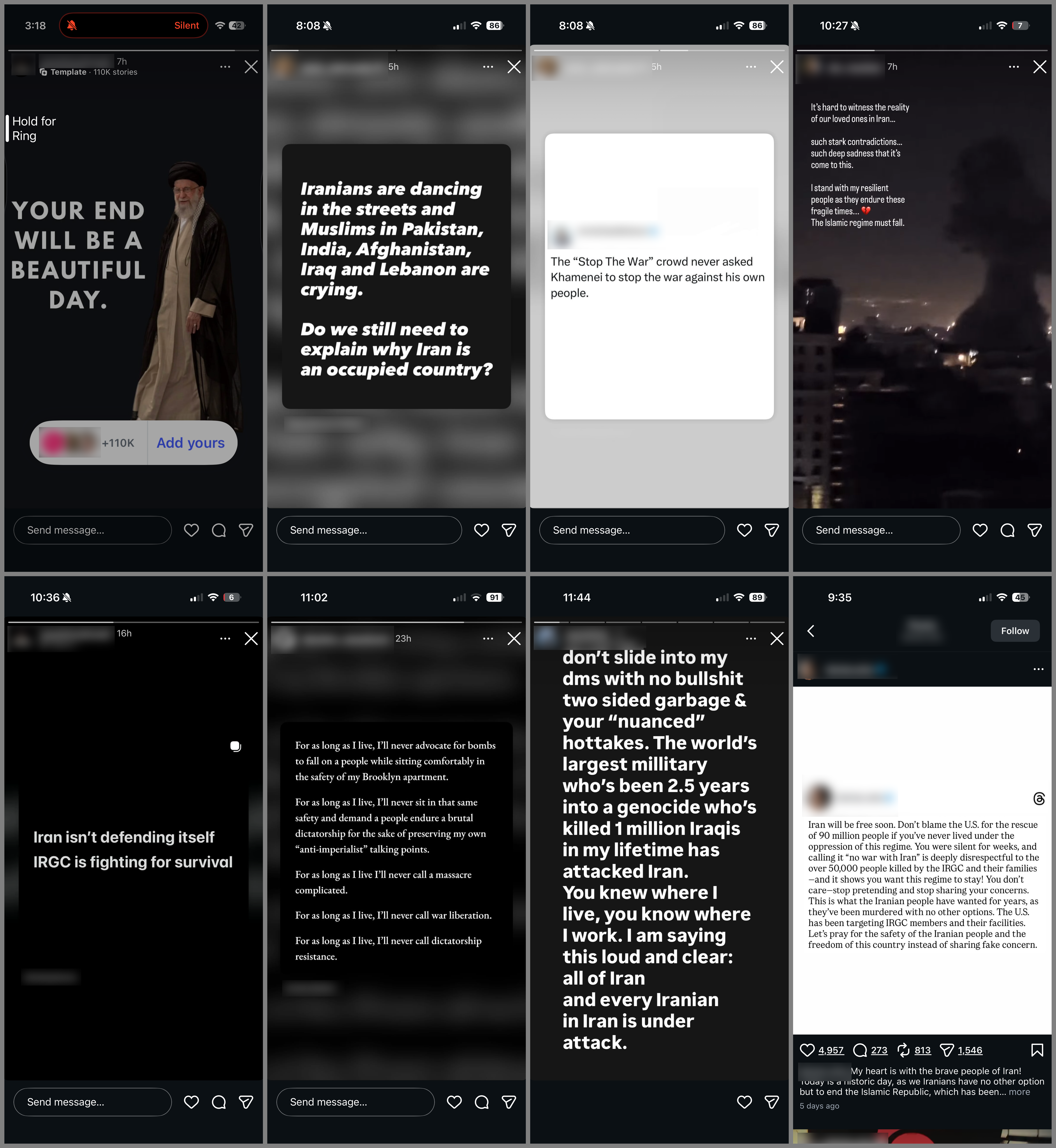
What binds them is not simply opposition to the Islamic Republic. It is a selective theory of violence. State violence inside Iran is treated as illegitimate in itself, a sufficient condition to void sovereignty. State violence exercised by the United States and Israel is treated as either a regrettable necessity or a strategic fact. The same act—killing civilians, destroying infrastructure, coercing populations—acquires different meanings depending on who carries it out. One disqualifies a state from rule. The other confirms its capacity to rule. This asymmetry extends to internationalism. Alliance with the United States, calls for sanctions, support for intervention, appeals to humanitarian rescue—these are granted the language of realism and modernity. Solidarity with Palestine, with anti-colonial struggle, with regional resistance to US and Israeli power—these are cast as ideological or irrational. Internationalism is permitted when it flows upward into the Atlantic system. It is condemned when it moves laterally across the global South.
A related problem appears in writing from the Palestinian diaspora, where distance reorganizes how people see and judge events. Ghassan Kanafani, writing from exile, addressed those outside Gaza with a demand that fixes attention on a specific site: “I won’t come to you. But you, return to us… come back to learn from Nadia’s leg what life is and what existence is worth.”29 He directs those at a distance toward a singular injury and asks them to hold their judgment there. Recent writing from Gaza carries this forward through fragments tied to particular people, places, and losses. These accounts do not assemble into a single, stable narrative. They keep attention on what has been done and on what that demands from those who witness it. The difficulty does not come from a lack of information. It comes from how it arrives. Images, posts, and reports move quickly and in large volume, pulling attention across events before it can settle. This movement weakens the link between what is seen and what one is prepared to do. The Iranian diaspora now operates within a similar field. Material circulates continuously, but it does not fix a shared ground for judgment. What remains unsettled is not only which position to take, but what one takes themselves to be responsible to when taking it.
These positions take shape within a longer history, in which imperial pressure and internal politics struggle to operate together. The 1979 revolution is often cast in simple terms—Islam against the West, sovereignty against imperialism—but those framings obscure the coalitions that made the revolution possible and the contradictions that followed. The Islamic Republic did not emerge from a unified front. It took form through the convergence of clerical networks rooted in religious life, leftist militants committed to anti-imperialist struggle, and a monarchy pursuing autonomy through oil-funded modernization.
As sociologist Valentine Moghadam noted in a seminal 1987 essay that reflects the exiled leftists’ position of the time, this convergence produced a field that was highly mobilized yet strategically uneven.30 Leftist groups drew on Guevara, Fanon, and the Algerian struggle, and many turned to armed action against banks, corporations, and military targets linked to foreign power. These actions did not build a durable political base or a clear account of the state they sought to transform. Clerical networks, by contrast, maintained presence across neighborhoods, mosques, and everyday life. When slogans converged in the streets, they did so across projects that did not share the same institutional grounding. The outcome followed from this uneven organization rather than from a single revolutionary program.
The diaspora itself is shaped by these histories. Many left Iran before or during the revolution, often tied to the monarchy or displaced by its fall. Others participated in anti−US imperialism revolutionary movements and later entered Western institutions structured by the same global order they had opposed. More recent migrants have left under conditions that select for mobility—education, capital, or asylum pathways that require legibility within Western systems. These trajectories shape how Iran is interpreted, which arguments gain traction, and which forms of political reasoning are set aside.31 They also help explain the dominance of secular frameworks and the relative absence of Islamic political thought as a field of analysis.
What is argued in the diaspora as a question of political judgment has long been organized in Iran as a question of material control. In 1976, the US Senate Foreign Relations Committee stated that the most advanced weapons sold to Iran tied the country to the United States through maintenance, training, and parts that only the supplier controlled. The report warned that, if relations broke, Washington could bring much of the military to a “virtual standstill.”32 This followed from policy set earlier in the decade. After Richard Nixon and Henry Kissinger expanded arms sales in 1972, Iran purchased large volumes of US equipment with oil revenues that Ambassador James E. Akins later described as returning to American defense firms through these contracts, while US personnel worked inside Iran to keep these systems running. The equipment carried a clear condition: it depended on a supply chain that could be slowed or cut, and it set limits on how it could be used. The rupture of 1979 and the war with Iraq exposed that condition and forced a change in direction, as Iran shifted toward systems it could build and sustain under embargo. That history carries into the present organization of US-aligned defense in the Gulf, where air defense systems, bases, and interceptor stocks rely on production and replenishment outside the states that use them, and where recent fighting has shown how quickly these systems consume munitions that are slow and expensive to replace.33 The United States produces weapons as export commodities, priced high and sustained through long contracts; Gulf states buy and operate them within that arrangement. Iran built its forces under sanction and war to meet a specific requirement: withstand attack from states that control that system. It produces missiles and drones in large numbers because it expects to use them, replace them, and keep operating without outside supply. When fighting escalates, this difference shows up directly: one side spends millions to stop each incoming strike and waits for resupply; the other sends more.
Resisting from Within
In a recent conversation, my cousin and I analyzed the current situation and agreed on nearly all points. We spoke about decades of external constraint and the way sanctions shape Iran’s political economy. We spoke about recent protests as complex events, driven by internal grievances and shaped by external interference that altered their trajectory. We acknowledged that the state killed people in the streets. We also discussed attempts to destabilize the country through financial pressure and political escalation. We agreed that, in the current war, Iran has demonstrated military development and strategic discipline that requires recognition. From that shared analysis, my cousin arrived at a different position. Watching the conflict, they described it as Barcelona playing Real Madrid. They support both teams. When one scores, they cheer. When the other scores, they cheer again. The Islamic Republic and the United States are both enemies. Their destruction, even if mutual, produces a certain satisfaction.
They can also name the source of the disconnect between their analysis and position. As a teenager in Iran, they were violently brutalized by state security forces. That experience persists. For many, this break did not emerge gradually. It took form in moments of concentrated violence. The government’s response to the January protests—whether one takes the lower or higher estimates of those killed—marked a threshold. The figures remain contested. The scale of lethal force does not. For a significant segment of reformist and liberal Iranians, this was a point of disillusionment. The expectation that the system could absorb dissent without destroying it was shaken. Positions that once held critique and continuity together began to diverge. This is the terrain on which diaspora positions now operate. Analytical clarity and affective orientation do not align. Experience of repression does not automatically produce support for intervention. It can produce rejection of the state, indifference to its survival, or, in some cases, openness to its destruction.
There are other trajectories. Behrooz Ghamari-Tabrizi, who was imprisoned and tortured as a political prisoner in Iran, has taken a different position.34 He opposes US and Israeli military action because of that experience. His argument is clear: War destroys the conditions under which political life can be organized. External intervention subordinates internal struggles to imperial priorities. Opposition to state repression and opposition to war operate together within the same analysis.
These positions unfold within the same temporal structure that organizes the war itself. Realtime systems present political change as something that can be induced through rapid intervention: a sequence of strikes, a collapse of leadership, a transition completed in days. For those watching from a distance, this appears plausible because it matches the speed at which information arrives. The opening phase of the war reinforced that expectation. The war that followed has not matched it. Political change proceeds through struggle. These processes do not move at the speed of realtime systems. The distance between how the war is seen and how it is lived shapes the gap within which diaspora interpretation takes form.
June 2025
I ring my dad. He doesn’t answer. A small fright creeps in, but an hour later, he calls me back.
He tells me his area is the one being targeted tonight. His neighbors knocked on his door and invited him to seek refuge in the basement—with them, with the cockroaches and dirt. He refused. He says the petrol lines are long and the roads out of Tehran are crowded. Even if you manage to leave, the fuel ration only gets you 20 kilometers—nowhere near the border. I think about when this started, and how much I urged him to leave then, when he still could. But I don’t say anything. He jokes that if he doesn’t answer next time, it might have been Netanyahu’s good-night. He refuses to leave. My brothers and I urge him to come to Australia, to Canada, where he has family. But he says it would feel like a betrayal—to his country, to his friends and relatives who can’t leave.
He’s also been stuck there for years. I’ve always suspected he’s where he wants to be, even if he resents the grumpy old men—within and beyond Iran—who’ve made his life hell for decades. He tells me he visited the blast site near my cousin’s house, the one that prompted him to flee over the border. He tells me that where he was having dinner last night—ten kilometers north of Tehran, maybe thinking it would be safer—was also bombed. I assume that’s why he’d been out so late. I implore him to act.
He tells me he went into the office today, took the metro home, is having kotlet for dinner. I theorize—I hope—that his refusal to choose is, in fact, a choice. That remaining in this zone of uncertainty, where he’s lingered much of his life, riding the tide of regimes and military campaigns, is his way of exerting control. That he hasn’t had all agency wrested from him, scared into hesitation, paralyzed by doubt. That he is exactly where he wants to be. And I can’t ask him to be me. I try to be pragmatic. I admonish him for being reckless. I pass the phone to my wife. I remind him of his grandchildren. He tells me he’ll call again soon.
Imperial time promises that events can be known as they happen. Waiting exposes a different structure of time, where knowledge arrives late or not at all. Resistance and justice take time.
I wait.
-
I do not address here the legality of the June 2025 and early 2026 US-Israeli attacks on Iran, which have been widely assessed as violations of the UN Charter’s prohibition on the use of force, especially Article 2(4), and as failing to satisfy Article 51’s narrow requirements for self-defense. See United Nations, “Charter of the United Nations,” arts. 2(4), 51; OHCHR statements of June 20 and 26, 2025, and March 12, 2026; Marko Milanović, EJIL: Talk!, February 28, 2026; Brian Finucane, Just Security, July 3, 2025, and March 18, 2026. For documentation of unlawful attacks, civilian harm, and incidents requiring war-crimes investigation, see Amnesty International and Human Rights Watch on the June 2025 Evin Prison strike and the March 2026 school strike. Brian Finucane, “Assessing the US Article 51 Letter for the Attack on Iran,” Just Security, July 3, 2025, link; Brian Finucane, “An Unserious Justification for an Unnecessary War: Assessing the US ‘Article 51’ Letter to U.N. on Iran War,” Just Security, March 18, 2026, link; “UN Experts Condemn Israeli Attack on Iran and Urge End to Hostilities,” OHCHR, link; “UN Experts Condemn United States Attack on Iran and Demand Permanent End to Hostilities,” OHCHR, link; “UN Experts Denounce Aggression on Iran and Lebanon, Warn of Devastating Regional Escalation,” OHCHR, link; Marko Milanovic, “The American-Israeli Strikes on Iran Are (Again) Manifestly Illegal,” EJIL: Talk!, February 28, 2026, link; “Iran: Deliberate Israeli Attack on Tehran’s Evin Prison Must Be Investigated as a War Crime,” Amnesty International, July 21, 2025, link; “Iran: Israeli Attack on Evin Prison an Apparent War Crime,” Human Rights Watch, August 14, 2025, link; “US/Israel: Investigate Iran School Attack as a War Crime,” Human Rights Watch, March 7, 2026, link. ↩
-
I use “realtime” as a single compound word to distinguish a conceptual formation from earlier technical definitions. In early computing literature, “real time” referred to systems that responded within a timeframe appropriate to external events—typically in military or industrial contexts. Later, “real-time” became a hyphenated adjective in engineering and commercial domains, describing continuous processing or streaming systems. I collapse it into “realtime” to mark a shift: from a temporal metric to a spatialized and political condition, in which latency becomes a mode of governance. See Farzin Lotfi-Jam, “Real-Time Urbanism: The Architecture of Packets, Pixels, and Neurons,” Materia Arquitectura, no. 28 (August 2025): 158–83, link. ↩
-
For analysis for recent techniques, see Ali H. Musleh, “Designing in Real-Time: An Introduction to Weapons Design in the Settler-Colonial Present of Palestine,” Design and Culture 10, no. 1 (2018): 33, link; Anthony Downey, “The Alibi of AI: Algorithmic Models of Automated Killing,” Digital War 6, no. 1 (2025): 9, link. For a longer urban history, see Farzin Lotfi-Jam, “Infrastructures of Urban Simulation: Digital Twins, Virtual Humans and Synthetic Populations,” in The Routledge Handbook of Architecture, Urban Space and Politics, vol. 1, ed. Nikolina Bobic and Farzaneh Haghighi (Routledge, 2022). ↩
-
Office of the Under Secretary of Defense for Policy, “DoD Directive 3000.09, Autonomy in Weapon Systems” (US Department of Defense, 2023), link; Office of General Counsel of Department of Defense, Department of Defense Law of War Manual (Washington, DC, 2015), link. ↩
-
Tara Copp et al., “Iranian School Was on US Target List, May Have Been Mistaken as Military Site,” Washington Post, March 11, 2026, link; David Jeans, “Exclusive: Pentagon to Adopt Palantir AI as Core US Military System, Memo Says,” Reuters, March 20, 2026, link. ↩
-
Ariana Baio, “Hegseth Says Iran Won’t Be a ‘Politically Correct’ War as He Lays Out US Objectives,” The Independent, March 2, 2026, link. ↩
-
Alexander C. Karp and Nicholas W. Zamiska, The Technological Republic: Hard Power, Soft Belief, and the Future of the West (Bodley Head, 2025); Jacob Silverman, “The Gospel According to Palantir,” Business Insider, March 17, 2026, link. ↩
-
Copp et al., “Iranian School Was on US Target List, May Have Been Mistaken as Military Site”; James Pearson et al., “Bombed Iranian Girls School Had Vivid Website and Yearslong Online Presence,” Reuters, March 12, 2026, link. ↩
-
For an account of how cybernetic and military epistemologies produce a racialized, mechanized enemy other—reducing persons to signals, coordinates, and targetable entities—see Peter Galison, “The Ontology of the Enemy: Norbert Wiener and the Cybernetic Vision,” Critical Inquiry 21, no. 1 (1994): 228–66. ↩
-
There is an extensive body of scholarship on the relations among warfare, speed, and perception. For foundational accounts, see Paul Virilio, Speed and Politics: An Essay on Dromology (Cambridge, MA: MIT Press, 1986); Paul Virilio, War and Cinema: The Logistics of Perception, vol. 32, trans. Patrick Camiller (Verso, 1989); Manuel De Landa, War in the Age of Intelligent Machines (Zone Books, 1991); and Jean Baudrillard, The Gulf War Did Not Take Place (Bloomington: Indiana University Press, 1995). ↩
-
Nicole Starosielski, The Undersea Network (Durham, NC: Duke University Press, 2015); Laleh Khalili, Sinews of War and Trade: Shipping and Capitalism in the Arabian Peninsula (London: Verso, 2020); and Lotfi-Jam, “Real-Time Urbanism.” ↩
-
See V. I. Lenin, Imperialism, the Highest Stage of Capitalism (1916); Samir Amin, Accumulation on a World Scale (New York: Monthly Review Press, 1974), and Imperialism and Unequal Development (New York: Monthly Review Press, 1977); Walter Rodney, How Europe Underdeveloped Africa (London: Bogle-L’Ouverture, 1972); Prabhat Patnaik and Utsa Patnaik, A Theory of Imperialism (New York: Columbia University Press, 2016); Mahmood Mamdani, Citizen and Subject: Contemporary Africa and the Legacy of Late Colonialism (Princeton, NJ: Princeton University Press, 1996); Frantz Fanon, The Wretched of the Earth (1961); Ngũgĩ wa Thiong’o, Decolonising the Mind: The Politics of Language in African Literature (1986); and Edward Said, Culture and Imperialism (New York: Knopf, 1993). ↩
-
Benjamin Netanyahu has been beating the drum for this war with Iran since the early 1990s, repeatedly asserting that the country was approaching nuclear weapons capability, often within a time frame of months or a few years; see, for example, his address to the United Nations General Assembly, September 27, 2012. For a detailed account of how these claims were sustained and mobilized politically, see Gareth Porter, Manufactured Crisis: The Untold Story of the Iran Nuclear Scare (Just World Books, 2014). On longer-term US strategic planning in the Middle East, see General Wesley Clark’s account of a 2001 Pentagon memorandum outlining plans to “take out seven countries in five years”—Iraq, Syria, Lebanon, Libya, Somalia, Sudan, and Iran—in “General Wesley Clark Weighs Presidential Bid,” Democracy Now!, March 2, 2007. See also National Intelligence Council, Iran: Nuclear Intentions and Capabilities, National Intelligence Estimate (NIE), November 2007, which assessed that Iran had halted its nuclear weapons program in 2003. ↩
-
Edward Said, “Permission to Narrate,” Journal of Palestine Studies 13, no. 3 (1984): 27–48, link. ↩
-
Taylor Penley, “Iranian Journalist Urges Trump to ‘Finish the Job,’ Says Iranians Fear ‘Wounded Regime,’” Fox News, March 4, 2026, link; Roya Hakakian, “The War Is Iranians’ Best Chance at Peace,” The Free Press, March 25, 2026, link; Karim Sadjadpour, “The Islamic Republic’s Predatory Contract with Its People,” The Atlantic, January 27, 2026, link; Karim Sadjadpour and Jack A. Goldstone, “Is the Iranian Regime About to Collapse?,” The Atlantic, January 10, 2026, link; Nicholas Kristof, “The ‘Arrogance of Power’ Drives War in Iran," New York Times, March 7, 2026, link; Amir Ahmadi Arian, “The Outlook Is Grim for a Freer Iran,” New York Times, February 28, 2026, link. ↩
-
Alexander R. Galloway, Protocol: How Control Exists After Decentralization (Cambridge, MA: MIT Press, 2004). ↩
-
Shoshana Zuboff, The Age of Surveillance Capitalism: The Fight for a Human Future at the New Frontier of Power (New York: PublicAffairs, 2019). ↩
-
Human Rights Watch, “Israel/Palestine: Devastating Civilian Toll as Parties Flout Legal Obligations,” October 9, 2023; Amnesty International, “Damning Evidence of War Crimes as Israeli Attacks Wipe Out Entire Families in Gaza,” October 20, 2023; Human Rights Watch, “Meta’s Broken Promises: Systemic Censorship of Palestine Content on Instagram and Facebook,” December 21, 2023; 7amleh, “Briefing on the Palestinian Digital Rights Situation Since October 7th, 2023,” November 1, 2023; 7amleh, Hashtag Palestine 2023, November 15, 2023. ↩
-
Eyal Weizman, The Least of All Possible Evils: A Short History of Humanitarian Violence (London: Verso, 2017). ↩
-
“Iran: Internet Shutdown Violates Rights, Escalates Risks to Civilians: Authorities Should Restore Full Connectivity; Ensure Civilian Protection,” Human Rights Watch, March 6, 2026, link. ↩
-
“Iran to Consider Lifting Internet Ban; State TV Hacked," Reuters, January 19, 2026, link. ↩
-
“We Say You Want a Revolution: PRISONBREAK—An AI-Enabled Influence Operation Aimed at Overthrowing the Iranian Regime,” Citizen Lab, n.d., link. ↩
-
Erin Hale, “Is Starlink Helping Iranians Break Internet Blackout, and How Does It Work?,” Al Jazeera, January 14, 2026, link; Supantha Mukherjee, Cassell Bryan-Low, and Parisa Hafezi, “Iranians Tap Musk’s Starlink to Skirt Internet Blackout, Sources Say,” Reuters, January 13, 2026, link; Indranil Ghosh, “Iran’s Internet Shutdown Crippled Starlink,” Rest of World, January 13, 2026, link; “Iran’s Ministry of Intelligence Says It Seized Hundreds of Starlink Terminals,” March 17, 2026; “NetBlocks Says Iran Blackout Enters Day 16 as Arrests Target Starlink Users,” Iran International, March 15, 2026. ↩
-
Omid Mehrgan, “Rendering Tehran Bombardable,” Parapraxis, link. ↩
-
Michael Parenti, “Article: Ukraine and Regime Change,” Michael Parenti Political Archive, September 2014, link. ↩
-
Yuval Abraham,“‘A Mass Assassination Factory’: Inside Israel’s Calculated Bombing of Gaza,” +972 Magazine, November 30, 2023, link. ↩
-
Julia Nueno Guitart, “The Target Factory,” Verso Blog, September 30, 2024, link. ↩
-
Malcom Kyeyune, “America’s National Security Wonderland,” American Affairs 9, no. 1 (Spring 2025), link. ↩
-
Alia Al‐Sabi and Amany Khalifa, “Passage: Rehearsals in Linguistic Returns,” Journal for the Anthropology of North America 27, no. 2 (2024): 31–39, link. ↩
-
Val Moghadam, “Socialism or Anti-Imperialism? The Left and Revolution in Iran,” New Left Review, no. I/166 (November–December 1987): 5–28. ↩
-
I migrated with my family from Iran to Australia near the end of the Iran–Iraq War. I reflect on this trajectory and the state technologies that enabled it in my short film My Domestic Routines, Architectural League of New York, June 3, 2022, link. ↩
-
United States et al., US Military Sales to Iran: A Staff Report to the Subcommittee on Foreign Assistance of the Committee on Foreign Relations, United States Senate (US Govt. Print. Off., 1976), link. 52; Cavanegh discusses a related, earlier passage from the same Senate staff report and drew my attention to that source. James Cavanegh, “Iran: US Policy and the Shah,” Multinational Monitor, 1980, link. ↩
-
Recent operations have drawn down US interceptor stocks at a pace that exceeds production. During the June 2025 war, US forces fired roughly 150 THAAD interceptors—about a quarter of the total inventory of 534—alongside significant use of SM-3 and Patriot systems. Unit costs remain high (THAAD: c. $12–15 million; Patriot PAC-3: c. $3–4 million), while production is limited (c. 96 THAAD and several hundred Patriot interceptors annually, with expansion planned but slow). At current use rates, stockpiles can be depleted within weeks, while replacement takes years due to manufacturing constraints and delivery gaps extending into 2027. By contrast, Iranian one-way attack drones are commonly estimated at $10,000–$50,000 per unit, producing a persistent cost and volume imbalance in air defense engagements. Analysts describe this as an attritional dynamic in which expensive interceptors are expended faster than they can be replaced, exposing the limits of a defense system dependent on centralized production and global allocation. See Wes Rumbaugh, The Depleting Missile Defense Interceptor Inventory, December 5, 2025, link; Max Bergmann et al., Europe Needs an ASAP Program for Air Defense, March 23, 2026, link; Riley Ceder, “‘Race of Attrition’: US Military’s Finite Interceptor Stockpile Is Being Tested,” Military Times, March 6, 2026, link. ↩
-
“Iranian American Scholars Denounce US–Israeli Attack, Warn Regime Change Efforts Will Backfire,” Democracy Now!, March 2, 2026, link. ↩
Farzin Lotfi-Jam is an Assistant Professor of Architecture at Cornell University, where he directs the Realtime Urbanism Lab. The lab focuses on the use of spatial media and technologies in urban research, particularly the impact of digitalization and realtime data on urban environments. He also leads Farzin Farzin, a design studio operating at the intersection of architecture, computation, and media. His current book project, Realtime: Computing Southwest Asian and North American Urbanism, 1858-Now, traces how realtime technologies—from colonial telegraphs to digital twins—have operated as tools of imperial control shaping urban life.