
What does a doorbell see? Over the last decade, as sensors and software have merged with the hardware of the household, doorbell cameras have transformed the front door, porch, building facade, and the app-networked neighborhood into a zone of continuous surveillance. Extending beyond an electrical buzzer, smart doorbells—“smart” because of their Wi-Fi-connected cocktail of recording and data analytics features—communicate the presence of visitors or potential “threats” to your phone in real time. In this sense, their smartness is a form of “platform seeing.”1 The term, used by Adrian MacKenzie and Anna Munster, describes the smartphone camera as not only an imaging device but also an ensemble of massive image flows and operations distributed across hardware and computational systems—where the human operator is only one part.2 Marketed in terms of connectivity and convenience, smartness is a digital-physical bundle of sensor operations that offers a “platform-ready” mode of imaging —one in which “seeing is performed by a multitude of human and computational agents.”3 This platform seeing simultaneously cuts off “the ability to see across, look at, or step back and observe” the broader apparatus of data extraction and manipulation. In other words: While it markets the possibility of omnipotent vision, platform seeing is opaque and designed to be inscrutable to the end user—for “the platform itself clears visuality of such ‘oversight.’”4 With something like ten million active Ring doorbells across the country (as of 2023), Amazon’s titan platform-seeing, hearing, and sensing ensemble is a distributed panopticon tethered to its private cloud.5
Platform (over)seeing
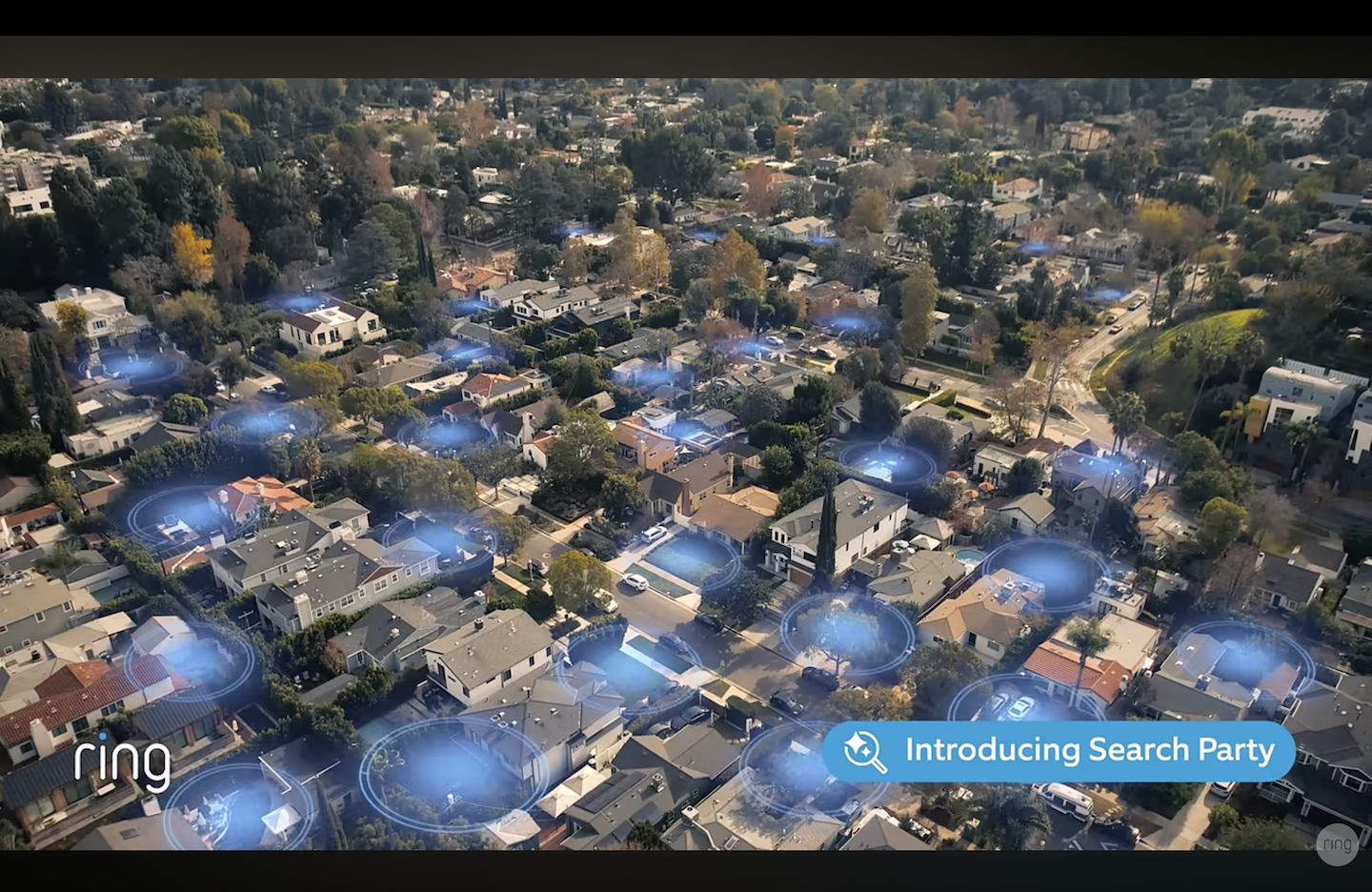
What does a platformed doorbell oversee? A single Amazon Ring doorbell camera now monitors the home with built-in 4K video, color night vision, knock detection, motion detection, sound detection, package detection, facial recognition, automated voice assistance, automated pet search parties, a first-responder SOS feature, and even a direct line to a Virtual Security Guard—all packaged into a palm-sized device and its corresponding app, Neighbors.6 Of these features, one has gone particularly viral: enter the 2026 Super Bowl ad backlash. Amazon Ring’s 30-second prime-time commercial sparked particular outrage for announcing Search Party, the platform’s ability to track down lost pets with AI by automatically soliciting and scouring footage from a mesh of outdoor cameras across the neighborhood to find “a match.”7 The ad cuts rapidly from a text search bar to a single home to a drone’s-eye view of an entire neighborhood covered in ambient hotspots, revealing that each home camera is but one node in an extensive mesh. The Super Bowl ad was swiftly decried by viewers as “creepy,” “dystopian,” and a harbinger of AI-powered mass surveillance and individual tracking, prompting some users to publicly deactivate their devices and cancel subscriptions. Even the budget doorbell competitor Wyze—itself founded by ex–Amazon employees—mocked Search Party with its own opportunistic ad, “Definitely Only for Dogs.”8 Whether by comment, post, report, or meme, the outcry over Search Party underscored a concrete and widespread worry: that the doorbell could be actively enlisted in police searches and surveillance.
Given how entrenched AI-enabled facial recognition and racial profiling are across the surveillance industrial complex, this concern is not abstract—it is alarmingly real. In October 2025, Amazon Ring announced a partnership with the cloud-based surveillance company Flock Safety. Flock has become a dominant player in the US’s automated license-plate reader industry since its launch in 2017, and is used by more than 5,000 local law enforcement agencies across forty-nine states for AI-powered policing.9 Installed on roads, highways, and police vehicles, Flock uses machine learning to detect license plates in security camera and video footage. It can also conduct nuanced Vehicle Fingerprint® searches for specific vehicle make, color, car damage, or modifications, even “resident or non-resident vehicle” status—“no plate required.”10 This is similar to Amazon’s AI pet-recognition model, which has been pretrained on “tens of thousands of dog videos so it can recognize different breeds, sizes, fur patterns, body features, unique marks, shape, and color,” enabling it to not only identify a dog, but your dog.11
Flock is an instructive case in platform policing: an extension of platform seeing in which an aggregated ensemble of images not only predefines what there is to see but also profiles and informs on who is being seen, at the individual level. Even before the Ring backlash, Flock’s footage had been found to be not only intensive—capturing the time and location of every passing car for potential future police investigations—12 but also extensive—its National Lookup Tool sharing individuals’ data with 4,800 law enforcement agencies across the country.13 Platform seeing is therefore not a closed network; data collected by law enforcement in one jurisdiction crosses spatial and legal borders, sometimes as many as seven million times in a twelve-month period.14 AI-trained policing systems are designed to remember bias and predict crime: The NAACP Legal Defense Fund has warned that predictive policing tools premised on biased data, such as historical crime data, will retain and reflect that bias, exacerbating discriminatory policing practices.15 Discourses of safety and security—invoked to facilitate predictive policing—are always underwritten by particular logics of incursion that produce harm.
Flock has been used by the Johnson County Sheriff’s Office to track a Texas woman in an abortion investigation; Flock has exposed pedestrian-tracking public camera feeds to the open internet in cities as far apart as Bakersfield, California, Brookhaven, Georgia, and Cedar Rapids, Iowa; Flock has had its data accessed by US Customs and Border Protection (CBP) without proper authorization via the “back door” of at least ten Washington state police departments, and via the “front door” of at least eight Washington state law enforcement agencies.16 A Ring-Flock partnership would have further allowed an array of agencies to access Ring customers’ private doorbell video streams via the innocently named feature “Community Requests,” including biometric samples like facial recognition.17 The collusion of surveillance companies and their contractors further diffuses and blurs accountability across the panoptic ensemble. It shifts the burden of accountability onto the user. Participation is always voluntary—or is it? Who polices the peephole—the homeowner, neighbor, AI model, police officer, or border patrol agent? After the Super Bowl backlash, Amazon Ring promptly canceled its partnership with Flock Safety, citing resource and time constraints. Yet Community Requests “remain[s] a core feature of Ring’s mission,” and continues to be marketed in moralistic terms: Would you “want to help, or simply ignore” your community?18
Selling Surveillance
The platform-seeing, hearing, and sensing ensemble extends its data extraction frontier with every hardware and software update. Its surveillance ambitions are, however, masked by its neatly designed user interface. Ring’s app, being the literal touchpoint between a user and their physical equipment, produces a false sense of individual security, privacy, and control through live alerts and visible feeds. It attempts to quell privacy concerns at the superficial level of user experience. As Ruha Benjamin so succinctly puts it: “Users get used.”19
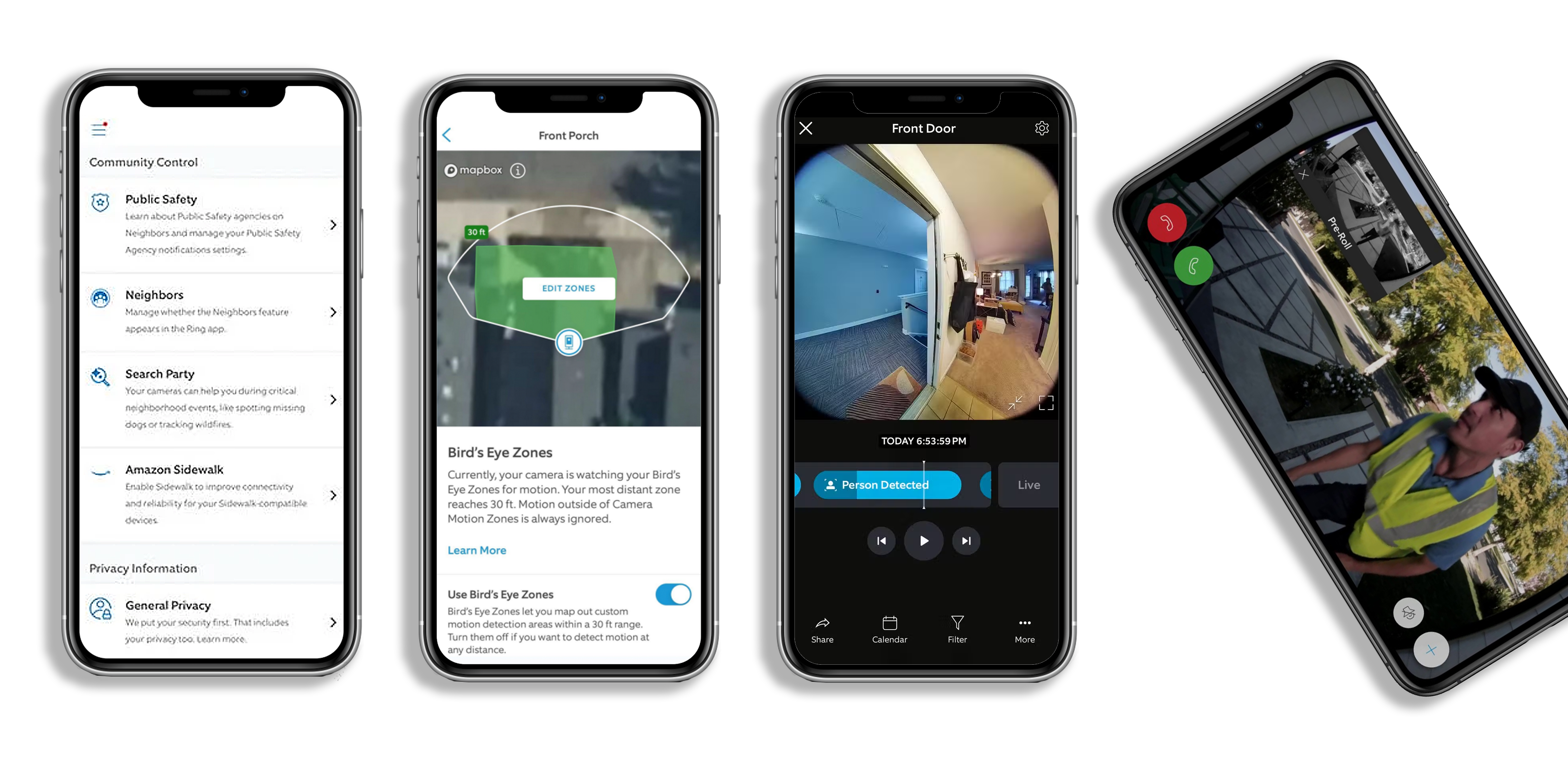
On the Ring app, users can calibrate the sensor’s physical range, orientation, and sensitivity through interactive graphics and sliders—for example, by adjusting a view cone over a satellite image of their property. Under Privacy Settings and Community Control, there are options to turn off Search Party; to opt out of receiving Community Requests from local police; even to block out customized camera angles (i.e., establish “Privacy Zones”) to prevent it from recording neighboring properties. But the app’s interactivity ultimately amounts to “simulated visibility”—a veneer of individual choice papering over deeper algorithmic subjugation.20 Its view controls do not disclose the true range and scope of its dragnet across millions of homes. Its Search Party and Community Requests are opt-in by default. Its Privacy Zones have failed to prevent the recording of audio.21 Even more insidious is Amazon Sidewalk (quietly released in 2020), a low-bandwidth, long-range mesh network that extends cloud connectivity from a few hundred feet to a half mile.22 In short, Amazon interlinks nodes across a neighborhood such that devices stay online and become even more trackable, even when the user’s own internet is off or out of range.23 From security cameras to Echo speakers, doorbells and smart locks and lights and car alarms, the Internet of Things communicates, and whispers back to Ring. Signals stretch beyond sidewalks: Amazon boasts that its mesh network “covers approximately 95 percent of the country.”24 Bent on eliminating all interruptions to platform seeing, the app’s marketing slogan takes on an ominous tone: “Ring – Always Home.”25
In 2020, Amazon Ring introduced Pre-Roll, a preemptive feature that “can begin recording video a few seconds prior to motion detection or a doorbell press,” allowing users to see not just the motion event but what triggered it.26 How is a camera triggered to record before a sensor is activated? Preemptive imaging is now prevalent in smartphones such as the Google Pixel. Thanks to the automated processing of a 15-frame image stream, “When you tap the ‘take a photo’ button, the photo has actually already been taken”—even edited by the platform.27 In the case of Pre-Roll, the camera is constantly buffering four to six seconds’ worth of low-resolution, low–frame rate video that is stored on the local device, overwriting itself automatically. When a motion event is triggered, it stitches the previous four to six seconds to the live full-resolution recording. This anticipatory recording is sold as giving the user “the full context” and providing “peace of mind” that one’s home is “always being monitored.”28 Amazon has also invested in a literal view from above: its Bird’s Eye View uses radar-based 3D motion detection to track a visitor’s path on a map “even if they leave the camera’s field of view before you begin a live stream.”29 While not predictive like its other AI features, Amazon marketing plays clairvoyant: “See who’s there. Even before you receive an alert.”30
Can you photograph the future? If photography is “a practice of making time,” Joanna Zylinska reminds us that “we also make the world by making images of it… over and over again.”31 Past, present, and future are mutually imbricated. As one Reddit user intuited: Even when nothing has been detected, “the camera is always watching.”32 The panoptic ensemble enframes the body in the present, entraining every past gesture and appearance only to render it data for the future.
Can you hear the past of the future? “Do you hear the surveillance camera whisper,” Jackie Wang asks in Carceral Capitalism, “your body is not your body, your body is a point on a grid?”33 This grid abstracts and extracts from bodies through computation, well beyond visual means. Ring hears your conversation from 20 feet away. Sensors are fitted with two-way talk and noise cancellation, attuning recordings not just to ambient noises but to voices. Cameras whisper back, in human voices: Numerous Ring camera users have reported chilling experiences of hackers who audiovisually accessed their home and tormented them or their children directly, “without ever having to set foot inside.”34 Ring also channels voice-activated home assistants: “Alexa+ Greetings transforms Alexa into a smart doorbell attendant—able to manage deliveries, send away solicitors and provide instructions.”35 Thao Phan writes that Amazon Alexa and Echo present not only a gendered servile voice but also an “aesthetics of whiteness” that attempts to “appeal to a more ‘universal’ subjecthood” while conveniently “avoid[ing] both the discomfort associated with racialized servitude as well as any confrontations with the historical consequences of slavery, colonialism, global capitalism, or white supremacy.”36 For Phan, it is in this white-coded voice—one that “escapes identification and explicit racialization” and is thus constituted as a neutral norm, and that is programmed without wants, needs, opinions, personal backgrounds, or “homes of their own”—that “the nineteenth-century American fantasy of a servile class that is without race and without history is fulfilled.”37
Lenses, mirrors, fields of view
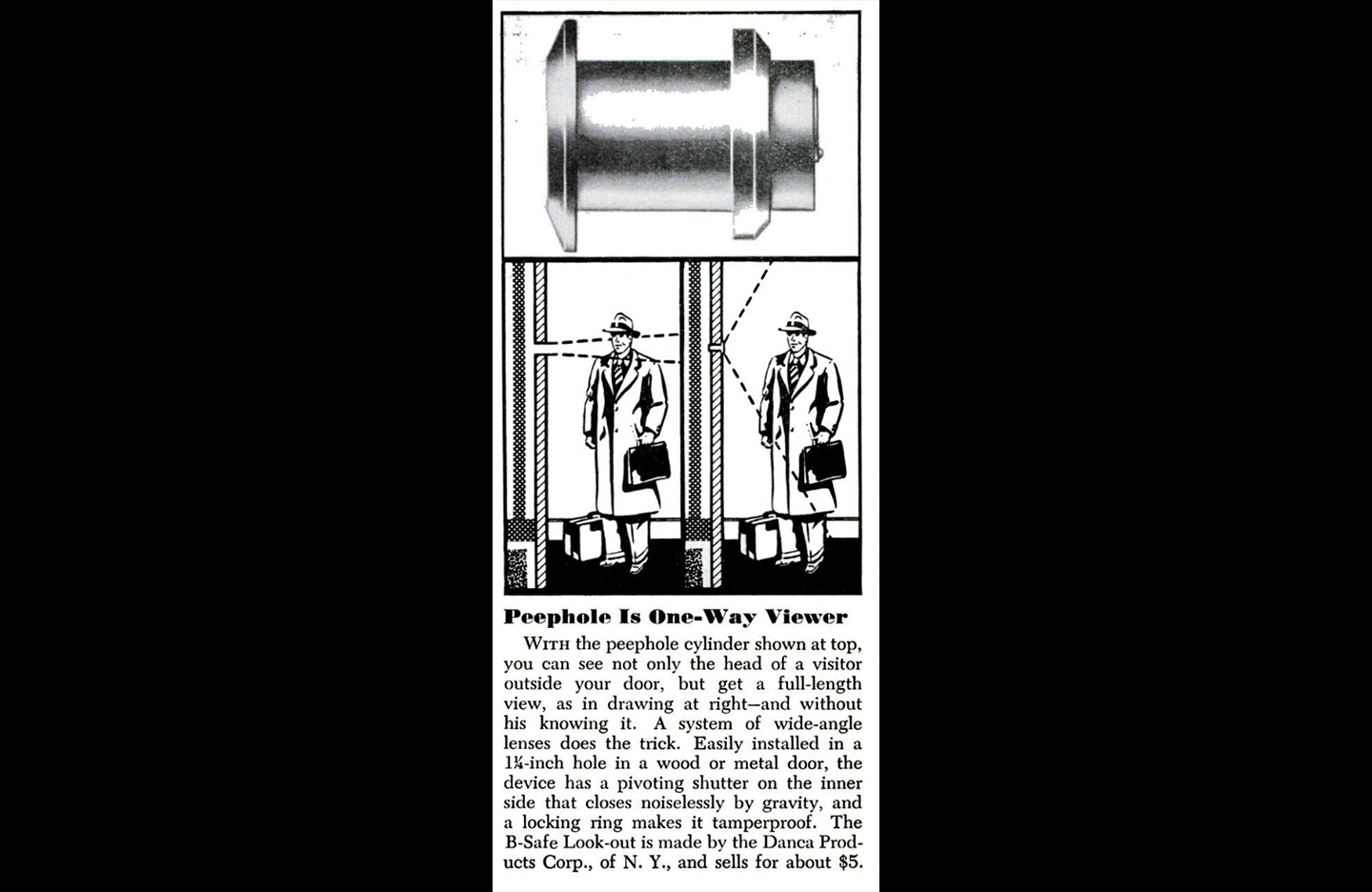
If “policing has always been technical,” McKenzie Wark posits, how have its technics changed?38 The design of doorbell vision has been honed over centuries of private homeownership to achieve a view as wide, as full-length, and as surreptitious as possible. Featured in a 1950 issue of Popular Science was the B-Safe Look-out, a “system of wide-angle lenses” embedded in a suburban front door with a silent shutter such that the anxious homeowner “can see not only the head of a visitor outside your door, but get a full-length view... without his knowing it.”39
If B-Safe mediated postwar suburban anxieties about the unknown intruder, earlier one-way viewers enabled a culture of casual surveillance. In the eighteenth century, the gossip mirror emerged in the coastal towns of Sweden and Finland, at a time when international maritime trade and greater regional mobility had heightened local “feelings of insecurity.”40 Discreetly mounted on the upper-floor windows of wealthy households, three-angled mirrors framed the street and its newly “mobile casual workforce” as both suspicious and fodder for gossip.41 In the Netherlands, similar devices, called spionnetjes (“little spies”), were used “to inspect people who ring the bell” from the second floor, often from a “comfortable chair” placed at the viewing end.42 These mechanical “busybody mirrors” were soon brought to American households; they can still be found protruding from the sills of colonial-era homes in Philadelphia and Virginia. In an 1881 issue of The Philadelphia Inquirer, the contraption was advertised to let residents see “any one on the front doorstep without raising the window or Being SEEN.”43 Whether mechanical or electronic, through-the-door monitoring has never been only about enhancing one’s visual range, but also about cultivating the expectation of a one-way gaze, or panopticon, that gives the impression that someone could be watching on the other end.
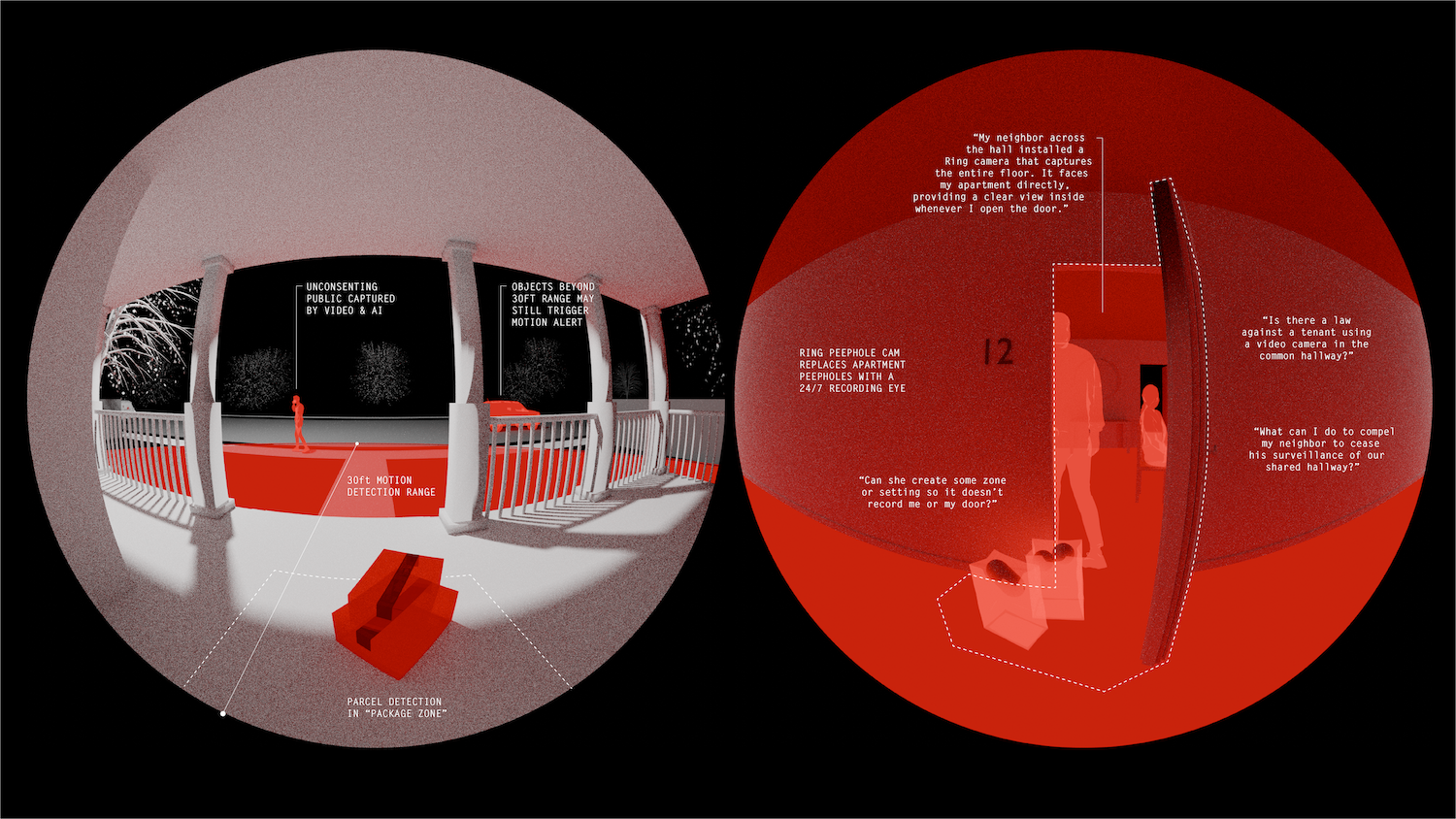
In 2021, amid the COVID-19 pandemic, as tech companies looked to capitalize on the heightened reliance on home delivery services, Amazon introduced a new battery doorbell model that replaced the standard 16:9 aspect ratio with a 1:1, 150°-by-150° field of view, “for seeing the whole porch.”44 Released alongside Package Alerts—a feature that notifies users when a delivery arrives on the doorstep—the distorted “head-to-toe” view was designed to capture people and packages in the same frame. In advertisements for the Ring (and other home security products cashing in on pandemic-fueled delivery fever), smiling delivery workers stand behind overtly foregrounded packages, framed by a fisheye lens as their bodies demonstrate the full length of the display.
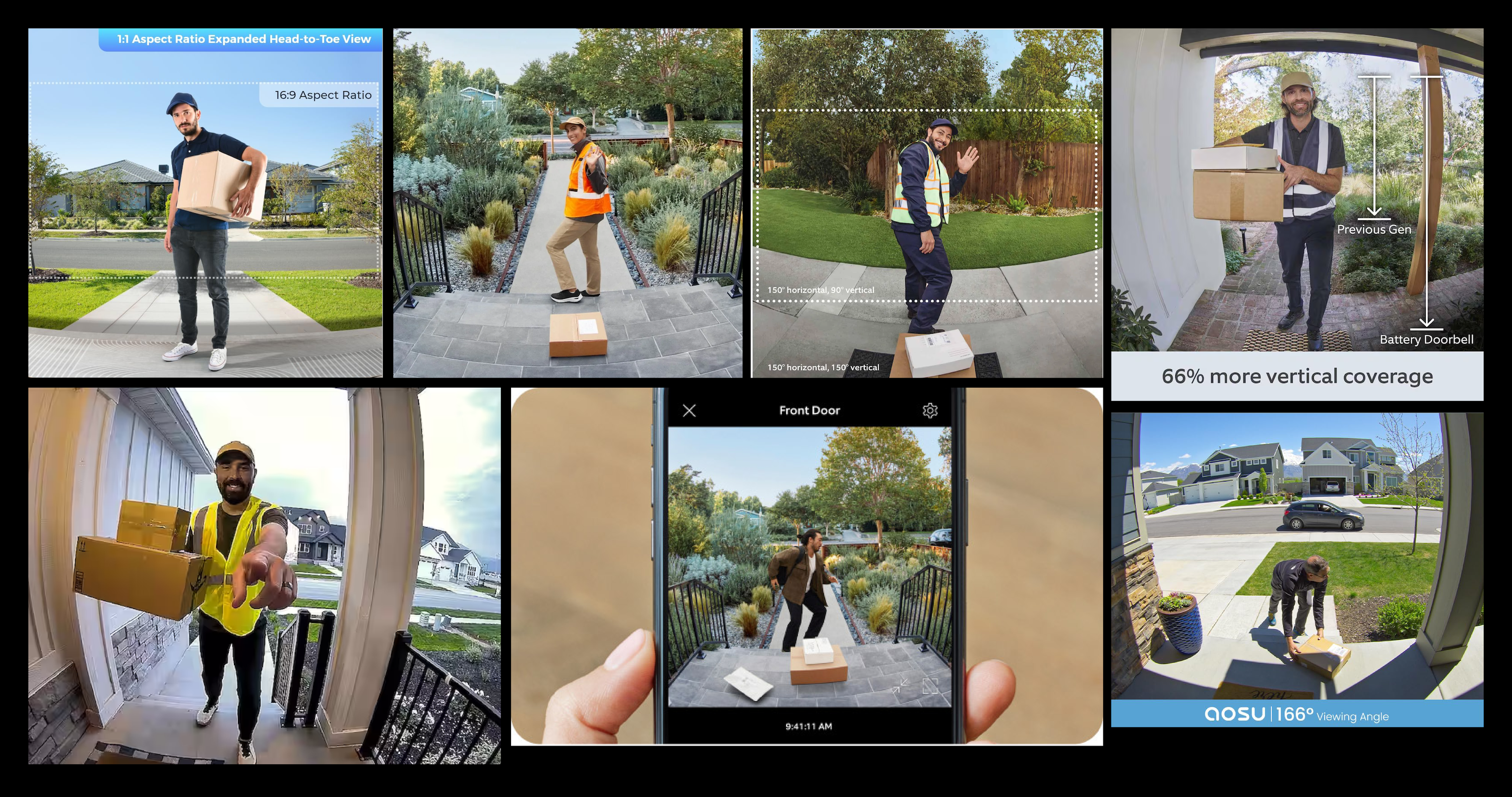
These innocuous marketing gestures hide the power asymmetries between camera and gig worker. Interviewing Ring owners and Amazon employees in 2022, Aiha Nguyen and Eve Zelickson found that home monitoring doubles as workplace monitoring, “in the name of safety or package security.”45 The doorstep, they write, is not only the threshold of on-demand consumer fulfillment but also a physically demanding workplace for millions of underpaid delivery workers. Amazon profits by “turning everyday people into bosses and police.”46 Homeowners are transformed into remote supervisors and micromanagers, ready to penalize the worker at every turn, pressuring drivers to deliver as fast as possible—and to do so with an Amazon smile. In a dystopian twist, the camera has even been used to shame hurried drivers on social media and coerce them to perform; viral TikToks show customers demanding that their driver “do a dance before he delivers my package.”47
Doorbell vision overlaps with the spatial logics of the suburban front yard, a space known to architects and planners as the “setback.” In pre–twentieth century American developments, setbacks were initially introduced to preserve the visual appeal of a picturesque “rural atmosphere” and later to comply with new sanitation laws in urban centers that required minimum distances between buildings.48 By the early twentieth century, setbacks had established a legal building line between private and public property, regulated first under the power of eminent domain and later through zoning.49 In reality, however, the legal zone between porch and property line is not so clear-cut; thus today’s courier is forced to negotiate this public-private interface at personal risk of trespassing. Delivery drivers report being placed in unsafe conditions via contradictory customer requests, such as being asked to walk through gates marked “do not enter” or to deliver to the back porch of a home—only to have the homeowner pull a gun on them.50 The deeper the setback, the more dangerous the work becomes. On a subreddit for Amazon DSP (delivery service partner) drivers, workers express a shared mistrust of the “long driveway” on rural routes, fearing the need to leave their vehicle, damage to the van or private property, extended delivery routes, or encounters with aggressive pets (or owners).51 Each of these outcomes ultimately penalizes and endangers the worker—the most precarious node in the system. Amazon’s head-to-toe view regulates the bodies of predominantly Black and Latine workers, monitoring their every move and demeanor on the job under the threat of termination or, in Amazon-speak, “deactivation.”52
Seeing like private property
The extra-wide visual and sonic field of smart doorbells, paired with the possibility of always-on live recording, has spatial implications for the home—and for neighborly relations. With a motion range of up to 30 feet, the Ring regime casts a watchful eye well beyond the front door or porch, extending into the public street and sidewalk.53 In multifamily dwellings, where doors are in close proximity, this expanded visual field spills into other adjacent private and shared spaces. In a 2023 post on Reddit titled “Apartment complex doors face one another, 6 feet apart,” a frustrated user, LadySandry, seeks advice: “How do I prevent my neighbor from tracking my comings and goings and recording video and audio of me and my guests?… I dislike the idea of there being footage of the inside of my apartment if my door is opened… She literally installed the thing on her door facing mine.”54
It is in these small moments of neighbor-on-neighbor friction—collisions between competing privacy claims—that beliefs about the inalienable right to private homeownership in America surface. Rather than encouraging LadySandry to communicate with her neighbor about transforming their shared space into a privately monitored zone, Reddit users have conceded that “you cannot control where someone chooses to place their camera to protect their property.”55 Recommendations ranged from asking the offending neighbor to “mount it on the door jamb” and “set up a privacy zone around your door” that masks motion detection, to proposing elaborate spatial workarounds—such as installing a freestanding room divider “with enough room for your door to open”—to the most unhelpful suggestions: “move somewhere else and hope your next neighbor doesn’t get a camera”; “get one yourself to record her.”56 As home security is tightly coupled with American homeownership, its recording technologies are normalized as inevitable—so much so that it has become easier to imagine the end of neighborly relations than the end of surveillance.
Bernhard Siegert writes about the door itself as a media technology precisely because it separates an outside from an inside.57 In the United States, the doorway of a private home legally “delineat[es] the Fourth Amendment threshold.” It is an architectural boundary of juridical significance. Simply put, the Fourth Amendment establishes one’s right to be protected from unreasonable searches, seizures, and arrests without a warrant, and ensures a “reasonable expectation of privacy” in one’s home.58 It has been used to dispute warrantless searches of physical homes as well as private electronic data.59 Whether a door is open or closed can make all the difference in averting warrantless entry by police.60 But through the smart doorbell, the door itself becomes a de facto surveillance and reporting node—even if it remains closed.
For one, the physical door turns into a sensor. Designed to replace peepholes in apartment doors with a multisensing probe, every Ring Peephole Cam comes with Knock Detection, a feature that measures vibrations with a built-in accelerometer, and triggers a mobile notification and live recording.61 Yet the knock itself has been deemed a threat to the single-family home. In a survey of some 850,000 Los Angeles posts on the Neighbors app between 2016 and 2020, MIT researchers found a generalized suspicion of “strangers knocking on doors”; this mundane activity was the second-most frequent topic on the app, after parcel theft.62 “Who is this guy and why does he knock on the door instead of ringing the doorbell? Seems shady to me,” posts one wary Neighbor, attaching a high-resolution fisheye screenshot of what researchers later deemed completely innocuous. The researchers concluded that Ring’s Neighbors app fuels a rampant culture of suspicion (often directed toward people of color) and “participatory mass surveillance,” particularly in white, propertied enclaves.63
The act of ringing, knocking, or otherwise addressing a stranger’s door is significantly more dangerous for people of color than for white homeowners. Ringing a bell for fun, or knocking on the wrong door by accident, has resulted in disproportionate and often deadly violence against people of color across the US. In the fall of 2025 alone, an eleven-year-old boy was fatally shot in the back by a military veteran for playing “ding dong ditch” in a Houston neighborhood, while in Whitestown, Indiana, a Guatemalan housecleaner was killed after she rang the wrong doorbell.64 In 2023, a Black high school student in Kansas City was shot while trying to pick up his younger siblings from the wrong address, prompting then–vice president Kamala Harris to announce on X: “Let’s be clear: No child should ever live in fear of being shot for ringing the wrong doorbell.”65 Yet this shoot-first, ask-later violence is often not only tolerated but partly shielded under self-defense laws. The home is legally rendered a private fortress through the common-law Castle Doctrine, an “affirmative [defense] for individuals charged with criminal homicide” while defending their property.66 Additionally, stand-your-ground laws exist in at least thirty-one US states, including Texas and Indiana, removing the common-law duty to retreat before resorting to deadly force.67 Across the United States, quantitative research has found that “expanding people’s right to use deadly force has not reduced crime on average”—in some states, such as Florida, it is associated with increases in homicides.68
As Ring vision enables the militarized coverage of public space, self-defense laws such as stand-your-ground reinforce the asymmetry of one-way viewing, effectively inviting homeowners to draw a gun before even opening their door. In a speculative future where Ring systems are fully integrated into a surveillance state, smart doorbell technology would abet the shooting of strangers and reinforce the castle doctrine as far as the doorbell could see. This future already runs rife in #selfdefense forums: in “Castle Doctrine: What you NEED to know to NOT go to prison,” a YouTube video commenter emphasizes that “there is no gray area when it comes to my home. Other places maybe, but my home there is NO doubt about when I would have a right to shoot.”69
Despite the appearance of objectivity, the enforcement of such laws reproduces racial bias in practice. In a 2021 study of self-defense claims in Florida, such “claims under stand-your-ground law were more often denied when victims were White, especially when claimants were racial minorities.”70 The enactment of castle rights, then, clearly depends on the color of your skin, or your visa status. This year, as we have seen with increasing frequency, Immigration and Customs Enforcement (ICE) and border patrol agents have used brute force to enter the homes, cars, and private spaces of immigrants (and US citizens) without presenting judicial warrants. To be clear, knocking before entering is a legal requirement for federal agents with a valid warrant. In practice, however, this requirement has been eroded over the past decade through the expansion of “no-knock warrants” and, more recently, “warrantless home abduction.”71 This needs no reminder in an era of mass deportation and surveillance, where so many undocumented immigrants, protesting citizens, and students advocating for Palestinian freedom—Mahmoud Khalil, Mohsen Mahdawi, Leqaa Kordia, Ranjani Srinivasan, Yunseo Chung, and others—have been ensnared by the disciplinary dragnet.
Shattering Doorbell Vision
James C. Scott’s “seeing like a state” has become shorthand for governmentality through the modernist project of legibility.72 Marion Fourcade and Kieran Healy have adopted “seeing like a market” to describe how markets regard consumers as data—subjects to be classified, aggregated, and extracted.73 To see like a doorbell is to see like a state and a market simultaneously. This neoliberal confluence of state policing and private profit is not novel, but characterizes an already-dystopian society in which ICE pays millions of dollars in immigrant-tracking services to “bounty hunter” surveillance firms, expediting and closing the loop between “hunting and imprisoning” immigrants.74
And yet, technological resistance is still conceivable. The recent backlash to Ring’s Super Bowl ad on social media and Amazon’s subsequent canceling of its partnership with Flock shows that these surveillance infrastructures are neither fixed nor inevitable, but socially contestable: consumers can still challenge their default settings through reputational damage.75 In January 2026, as the Trump administration’s violent immigration raids in Minnesota entered their second month of aggression, calls to opt out of Ring vision altogether mounted across social media. “Smash your Ring doorbells,” urged TikTok influencer Guy Christensen to his 3.5 million followers, encouraging users to opt out of the Amazon–Flock–police surveillance nexus.76 “Your Ring camera is an ICE agent,” wrote an activist-researcher from Michigan named Kathryn Brewster.77 Even though Flock denies giving ICE “direct access” to its data, audit logs reveal that federal agencies have asked local police to conduct Flock searches on their behalf.78 The American Civil Liberties Union has also reported the use and abuse of Flock vision by state agencies, warning in no uncertain terms: “Build it (an authoritarian tracking infrastructure) and they (expanded uses) will come.”79
Calls to shatter the system of doorbell vision reemerged soon after Minneapolis resident Renee Good was killed point-blank in her car by an ICE agent, days before ICE agents beat, shot, and killed Alex Pretti, another resident of Minneapolis. After witnessing ICE agents detain a man waiting for the bus in front of his home, Garrett Guntly began installing cameras on the houses of trusted and willing neighbors in his Minneapolis neighborhood to help monitor ICE activity in their neighborhood and share information with rapid response groups.80 Rather than driving them apart, the local network of twenty cameras brought neighbors together; by February 2026, Guntly and his neighbors had “worked together to interrupt around a dozen immigrant arrests.”81 This work is not done in isolation, nor surreptitiously, but in community—along with large-scale community organizing efforts such as volunteer ICE observations at school pickups and immigrant-owned restaurants. As state violence against everyday residents persists with little accountability, neighbors have turned to one another to help keep their communities safe.
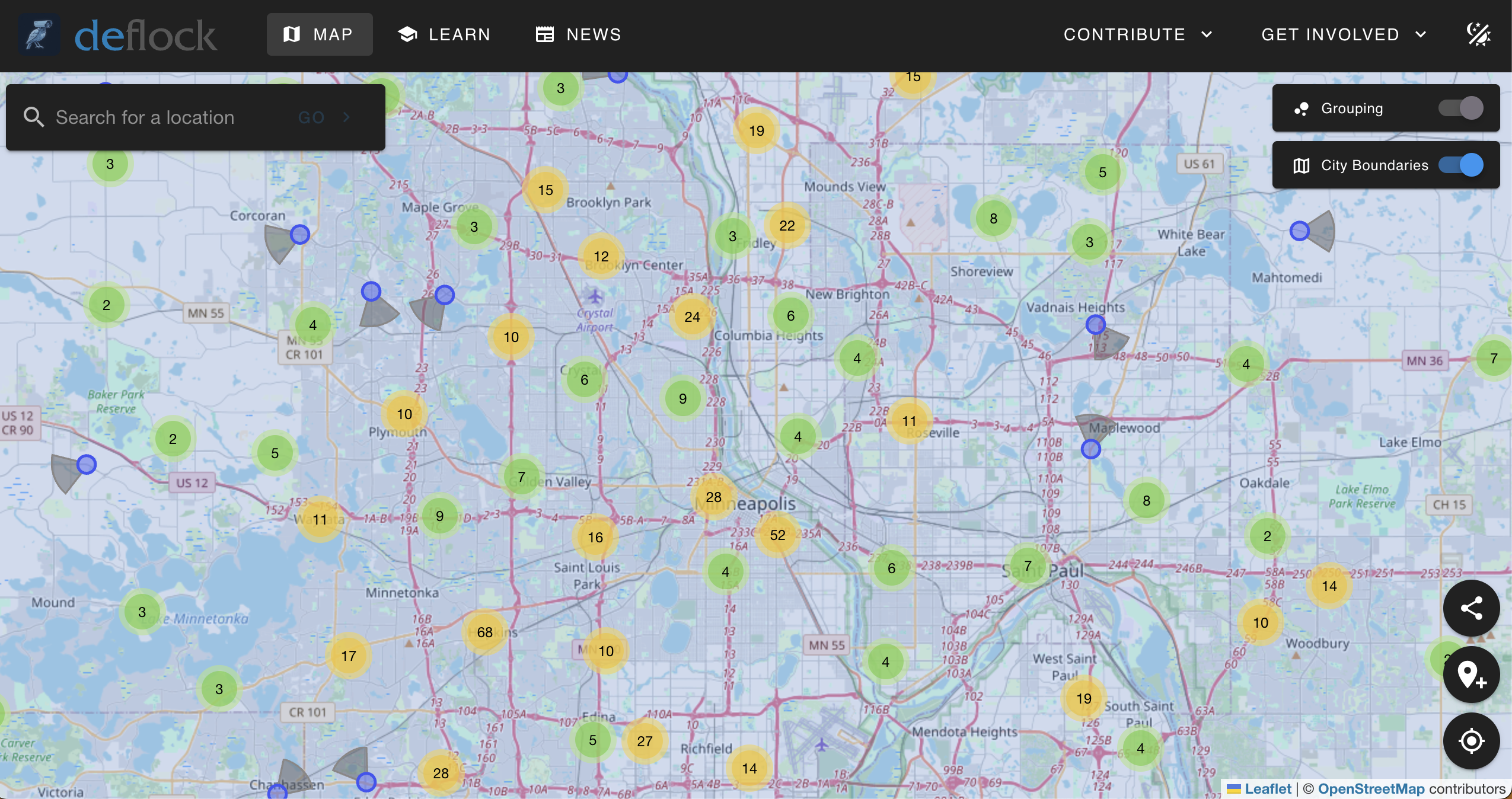
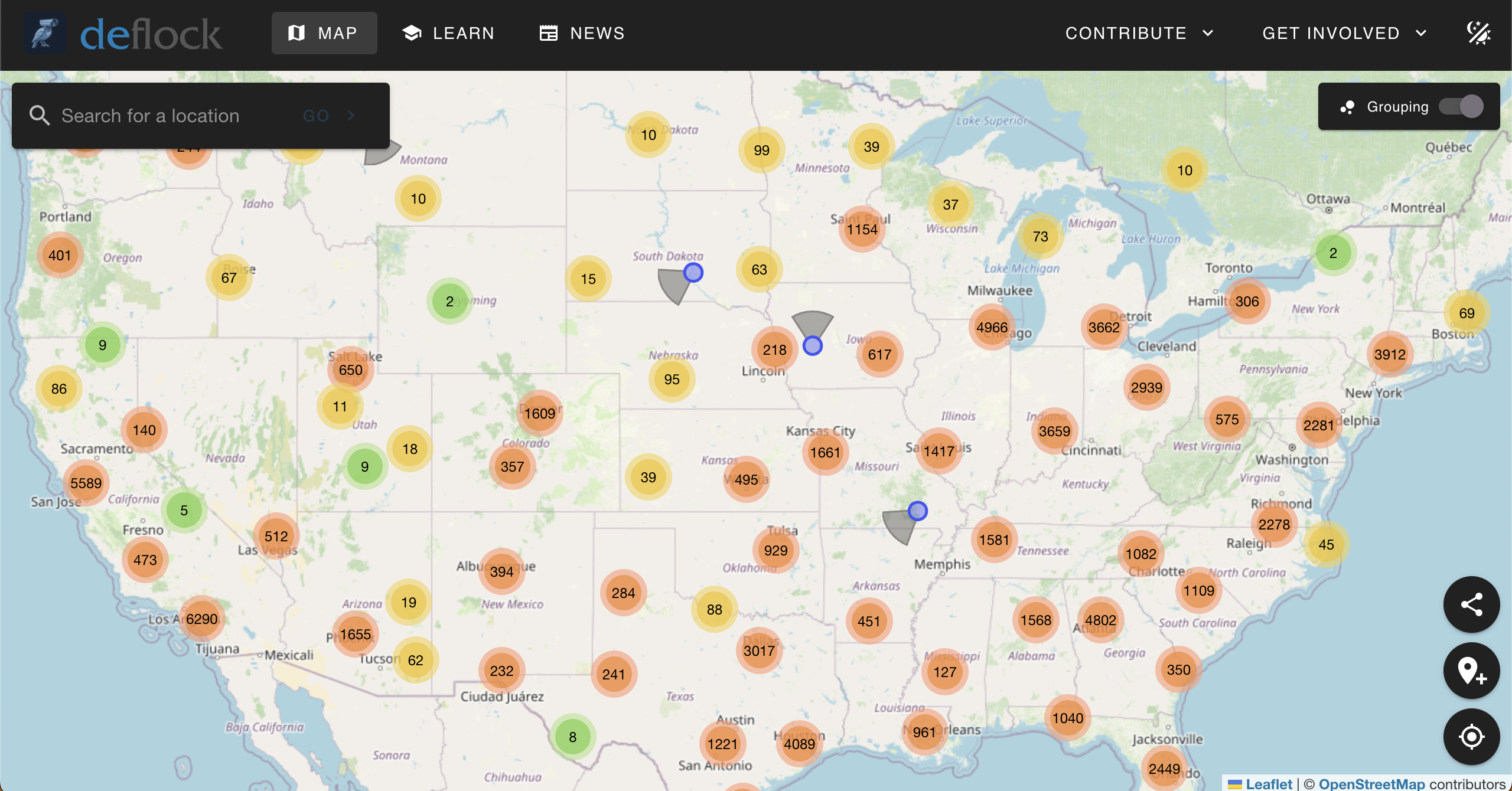
Inflamed by oppressive police presence and civilian deaths, the anti-surveillance momentum has also pressured city leaders to dismantle automated license-plate readers. At the time of writing, at least thirty localities—including the liberal college towns of Cambridge, Massachusetts, Eugene, Oregon, and Santa Cruz, California—have deactivated their Flock cameras or canceled their contracts with the company.82 The Colorado-based activist Will Freeman keeps track of the trackers on DeFlock.org, a website that has crowdsourced locations (and camera orientations) of more than 76,000 license-plate readers nationwide. Predictably, Flock’s CEO, Garrett Langley, has vilified DeFlock.org as “terroristic” and has claimed that it was Flock and the police that were under attack.83 Such accusations are frequently wielded against social movements working to dismantle oppression and the status quo.84 Flock has also threatened the creator of HaveIBeenFlocked.com—an interactive website that revealed the failure of police departments to redact Flock audit logs of license-plate searches—for inadvertently leaking the details of millions of surveillance targets to the public.85 While the platform-seeing panopticon prefers to present itself as an impervious one-way mirror, deflecting culpability and rendering itself inscrutable, its sheen has worn off. These fractures continue to be widened through the many actions of activists, journalists, and organizers. The rejection of a carceral society and the turn toward other forms of sensorial relation and neighborly solidarity is, against all odds, possible.
“But do we not sense it all around us? Do we not feel through our sensoria that something is off?” Wang writes. “Does passing CCTV cameras mutate your psyche?”86 The most transparent grade of glass, when curved and coded in such a political arrangement, becomes an opaque one-way viewer. Its unblinking image differentiates and distorts those standing on both sides of the door into asymmetrical power relations and figures in opposition: boss/worker, neighbor/stranger, victim/criminal. These mirror-walls extend from Minneapolis to Palestine, from police platforms and camera companies to the closed, QR-coded gates of academic institutions. While the slippery surfaces of smartness may not be easy to grasp, they reflect the same exclusionary tactics of oppression that persist in profiling, segregating, and denying certain bodies, communities, and entire polities the right to life. Wang presses on:
What I wanted to understand was the everyday incursion of policing into our lives and how technology regulates us, sometimes without our knowing. I wanted to attend to the intrusive-unseen against the backdrop of dystopic cinematic projections of what policing could become. Because the future of law enforcement is now.87
Mass surveillance is not a distant dystopia—it has arrived on the front porch. Off-the-shelf police-whispering smart doorbells and cameras like the Amazon Ring precisely embody the intrusive-unseen of everyday control. Packaged in a benign, servile automated voice, this technology entrains the seeing and hearing of whiteness in every home. The future of law enforcement is now; it goes for as low as $49.99 at Home Depot.88 For Ring, this future is not so much speculative as it is carefully designed. Since the Search Party backlash, a leaked employee email from Ring’s founder and CEO, Jamie Siminoff, revealed that Search Party was never really about finding lost dogs, but a milestone in “one of the most important pieces of tech and innovation to truly unlock the impact of [Ring’s] mission. You can now see a future where we are able to zero out crime in neighborhoods.”89 As the surveillance industry doubles down on predictive policing, algorithmic search parties would sweep neighborhoods for the mere presumption of crime and further legitimize the use of deadly force. In this dystopia, homeowners become an arm of the police, and every stranger (and neighbor), a potential threat.
-
Adrian MacKenzie and Anna Munster, “Platform Seeing: Image Ensembles and Their Invisualities,” Theory, Culture & Society 36, no. 5 (2019): 3–22, link. ↩
-
When you look through a smart camera, you are not only seeing an image but interacting with image operations that conjoin “pixel, device, and hardware architecture.” MacKenzie and Munster, “Platform Seeing.” ↩
-
MacKenzie and Munster, “Platform Seeing.” ↩
-
MacKenzie and Munster, “Platform Seeing.” ↩
-
Alfred Ng, “The Privacy Loophole in Your Doorbell,” Politico, March 7, 2023, link. ↩
-
Older Ring doorbell models, or users without Premium subscriptions, do not have access to all features. The above-described list of features (particularly AI-enabled ones) is for the 2025 Ring model. Ng, “The Privacy Loophole in Your Doorbell.” ↩
-
The Super Bowl ad aired on February 8, 2026. Ring, “Search Party from Ring: Be a Hero in Your Neighborhood,” YouTube, February 2, 2026, link. ↩
-
Tyler Lacoma, “We Learned How to Share Info About ICE and Police Raids on Apps Like Ring Neighbors,” CNET, February 26, 2026, link. ↩
-
“While Flock Safety’s claim to be the US’s “largest public-private safety network” may sound hyperbolic, critics, tech researchers, and nonprofits who have covered its business model and products for years have found Flock to be building an expansive “authoritarian tracking infrastructure.” See Jay Stanley, “Flock’s Aggressive Expansions Go Far Beyond Simple Driver Surveillance,” ACLU, August 18, 2025, link. ↩
-
In addition to Vehicle Fingerprint®, Flock FreeForm™ invites police departments to query “billions of monthly plate reads” across Flock’s nationwide license plate reader database. Flock Safety, link. ↩
-
X post by Andy Jassy, @ajassy, February 8, 2026, link. Andy Jassy is the current president and CEO of Amazon. ↩
-
Take, for example, one of the numerous lawsuits Flock is embroiled in: In Norfolk, Virginia, a retired veteran found that his location had been logged 526 times in four months across 176 Flock cameras. He is a plaintiff in Schmidt v. City of Norfolk, a lawsuit arguing that Flock’s automated license-plate readers in Norfolk are unconstitutional and violate the Fourth Amendment right to be protected against unreasonable searches. Kevin Collier, “Police Cameras Tracked One Driver 526 Times in Four Months, Lawsuit Says,” NBC News, September 18, 2025, link. ↩
-
Jay Stanley, “Flock Can Share Driver-Surveillance Data Even When Police Departments Opt Out, and Other Flock Developments,” ACLU, October 24, 2025, link; and Flock Safety, “The Power of a Connected Network: Coast-to-Coast Reach,” link. ↩
-
Stanley, “Flock Can Share Driver-Surveillance Data.” ↩
-
“Artificial Intelligence in Predictive Policing Issue Brief,” NAACP, link. ↩
-
“Leaving the Door Wide Open: Flock Surveillance Systems Expose Washington Data to Immigration Enforcement,” Center for Human Rights, University of Washington, October 21, 2025, link and link. Here, “front door” access refers to the “direct sharing of data through a 1:1 relationship with another network” while “back door” access refers to “access to networks without explicit authorization by the network owner.” ↩
-
Scharon Harding, “Ring Cameras Are About to Get Increasingly Chummy with Law Enforcement,” Ars Technica, October 17, 2025, link. ↩
-
“Ring and Flock Cancel Partnership,” Ring blog, February 12, 2026, link; and “Community Requests,” Ring Help, link. ↩
-
Benjamin continues: “We are more like the unwitting constituents who, by clicking submit, have authorized tech giants to represent our interests.” See Ruha Benjamin, “Introduction: The New Jim Code,” in Race After Technology (Polity Press, 2019), 1–48, 14. ↩
-
Wendy Hui Kyong Chun, “On Software, or the Persistence of Visual Knowledge,” Grey Room 18 (Winter 2004): 40. ↩
-
In 2021, a British court found a Ring user to have breached UK data protection laws when his camera recorded audio of his neighbor’s home even if Privacy Zones were on. Jane Wakefield, “Neighbour Wins Privacy Row over Smart Doorbell and Cameras,” BBC, October 14, 2021, link. ↩
-
“The free network is built on top of the millions of Echo smart speakers and Ring devices Amazon has sold, essentially using them like miniature cell towers to connect low-power devices like pet trackers, smart lights, door locks, and more to the internet.” Daniel Wroclawski, “Pros and Cons of Amazon’s Sidewalk Network. Plus, How to Opt Out,” Consumer Reports, June 10, 2021, updated March 29, 2023, link. ↩
-
Like other invasive features, Sidewalk is automatically enabled and benignly sold as a solution to better locating things when they are lost outside your home’s internet range, or keeping equipment powered “when your Wi-Fi cuts out.” Amazon Sidewalk, link. ↩
-
An interactive GIS map of Amazon Sidewalk coverage across Mexico, Canada, and the US can be found here. ↩
-
Joanna Zylinska, “Can You Photograph the Future?” in The Perception Machine: Our Photographic Future Between the Eye and AI (Cambridge, MA: MIT Press, 2023), 150. See also Thomas Germain, “Your Phone Edits All Your Photos with AI – Is It Changing Your View of Reality?” BBC, February 4, 2026, link. ↩
-
Kyle Wiggers, “Ring’s Video Doorbell 3 Plus Can Be Set to Always Record,” VB, March 11, 2020, link. ↩
-
Ring, “Use Bird’s Eye View to See Your Visitor’s Paths,” link. ↩
-
Ring, “Ring Introduces a Breakthrough in Battery-Powered Video Doorbells: Pre-Roll,” March 11, 2020, link. ↩
-
Zylinska, “Can You Photograph the Future?” 161. ↩
-
Ring’s persistent short-term memory is indicated by a blue light on the device, which may mislead users to believe that other models without the blue light are somehow not constantly recording. Ring, “24/7 Recording,” link; and Whocaresaboutyourcar, “Pre-Roll: How does it know when to do it?” Reddit post on r/Ring, 2023, link. ↩
-
Jackie Wang, Carceral Capitalism (Los Angeles: Semiotext(e), 2018), 257. ↩
-
Mark Hanrahan, “Ring Security Camera Hacks See Homeowners Subjected to Racial Abuse, Ransom Demands,” ABC News, December 12, 2019, link. ↩
-
Amazon Staff, “Ring Introduces Its First-Ever 4K Cameras and AI Feature That Helps Find Lost Pets,” Amazon News, September 30, 2025. ↩
-
Thao Phan, “Amazon Echo and the Aesthetics of Whiteness,” Catalyst: Feminism, Theory, Technoscience 5, no. 1 (2019): 1–39. ↩
-
Phan, “Amazon Echo and the Aesthetics of Whiteness.” ↩
-
Wark invites us to trace how domestic space is differentiated, homogenized, and policed by the algorithms of techno-governance. McKenzie Wark, “Prisoners of the Algorithm: On Jackie Wang,” Verso, September 4, 2020, link. ↩
-
“Peephole Is One-Way Viewer,” Popular Science, July 1950, 153. Emphasis added. ↩
-
Timo Ylimaunu et al., “Street Mirrors, Surveillance, and Urban Communities in Early Modern Finland,” Journal of Material Culture 19, no. 2 (May 2014): 145–167. ↩
-
Ylimaunu et al., “Street Mirrors, Surveillance, and Urban Communities,” 153. ↩
-
Ylimaunu et al., “Street Mirrors, Surveillance, and Urban Communities,” 152. ↩
-
Quote from an 1881 advertisement in The Philadelphia Inquirer. Jim Murphy, “Philadelphia Busybodies,” Real Philly History with Jim Murphy (blog), March 22, 2025, link. ↩
-
Jennifer Pattison Tuohy, “Ring Video Doorbells Are Finally Getting Package Alerts,” The Verge, September 28, 2021, link. ↩
-
Aiha Nguyen and Eve Zelickson, “At the Digital Doorstep: How Customers Use Doorbell Cameras to Manage Delivery Workers,” Data & Society, October 2022, 23, link. ↩
-
Andrew Paul, “Ring Camera Surveillance Puts New Pressure on Amazon Gig Workers,” Popular Science, October 20, 2022, link. ↩
-
Amanda Hess, “Dance, I Said—Dance! And Leave the Package on the Porch,” New York Times, June 22, 2023, link. ↩
-
Chenhao Zhu and Eran Ben-Joseph, “Shaping Suburbia: The One-and-a-Half-Century Evolution of Setback Regulations in American Neighbourhood Development,” Journal of Urban Design (2026): 1–27. ↩
-
Zhu and Ben-Joseph, “Shaping Suburbia,” 3. ↩
-
“Amazon Flex Drivers’ Safety Concerns with Back Porch Deliveries,” Facebook thread, November 24, 2024, link. ↩
-
“Long driveways,” heystephanator, Reddit post on r/AmazonDSPDrivers, March 14, 2024, link. ↩
-
See Karl Marx, “The Origins of Capitalism,” in Capital I (1867), 926, and Lawyers for Civil Rights, “Black and Latino Drivers File Discrimination Class Action Against Amazon,” Lawyers for Civil Rights, link. ↩
-
Ring, “Using Motion Detection,” link; see also Justine Morris, “Surveillance by Amazon: The Warrant Requirement, Tech Exceptionalism, and Ring Security, Boston University Journal of Science & Technology Law 27, no. 237 (2021): 237–269, link. ↩
-
LadySandry, “Apartment complex doors face one another, 6 feet apart,” Reddit post on r/Ring, 2023, link. ↩
-
LadySandry, “Apartment complex doors.” ↩
-
LadySandry, “Apartment complex doors.” ↩
-
“Doors and door sills are not only formal attributes of Western architecture, they are also architectural media that function as cultural techniques because they operate the primordial difference of architecture—that between inside and outside. At the same time they reflect this difference and thereby establish a system comprised of opening and closing operations.” Bernhard Siegert, “Door Logic, or the Materiality of the Symbolic: From Cultural Techniques to Cybernetic Machines,” in Cultural Techniques: Grids, Filters, Doors, and Other Articulations of the Real (New York: Fordham University Press, 2015), 192–206. ↩
-
Irus Braverman, “Rights of Passage: On Doors, Technology, and the Fourth Amendment,” Law, Culture and the Humanities 12, no. 3 (2014): 669–692. ↩
-
Doorbell vision flagrantly breaches both physical and digital searches. “Fourth Amendment,” Electronic Privacy Information Center, link. ↩
-
Braverman, “Rights of Passage,” 669–692. This paper “highlights how various door configurations affect the level of constitutional protections granted to those situated on the inside of the door and the important role of vision for establishing legal expectations of privacy.” The author suggests “that we might be witnessing the twilight of the ‘physical door’ era and the beginning of a ‘virtual door’ era in Fourth Amendment jurisprudence.” Emphasis added. ↩
-
Ring’s Neighbors app, a social platform for the Ring neighborhood watch, is distinct from the Ring app, which is used to manage one’s surveillance devices. See Dan Calacci, Jeffrey J. Shen, and Alex Pentland, “The Cop in Your Neighbor’s Doorbell: Amazon Ring and the Spread of Participatory Mass Surveillance,” Proceedings of the ACM on Human-Computer Interaction 6, issue CSCW2 (November 2022): 1–47, link. ↩
-
Calacci et al., “The Cop in Your Neighbor’s Doorbell.” ↩
-
Adam Zuvanich, “Houston Man Charged with Murder in Shooting Death of 11-Year-Old Boy Who Was Playing ‘Ding Dong Ditch,’” Houston Public Media, September 2, 2025, link, and “US Cleaning Woman Shot Dead After Arriving at Wrong Home,” BBC, November 8, 2025, link. ↩
-
Becky Sullivan and Jaclyn Diaz, “After Days of Outrage over the Shooting of a Black Teen, Official Charge the Gunman,” NPR, April 17, 2023, link. ↩
-
Mark Randall and Hendrik DeBoer, “The Castle Doctrine and Stand-Your-Ground Law,” Connecticut General Assembly, Office of Legislative Research, April 24, 2012, link. ↩
-
“Self-Defense and ‘Stand Your Ground,’” National Conference of State Legislatures, September 23, 2025, link. ↩
-
Alexa R. Yakubovich et al., “Effects of Laws Expanding Civilian Rights to Use Deadly Force in Self-Defense on Violence and Crime: A Systematic Review,” American Journal of Public Health 111, no. 4 (April 2021): e1–e14, link. ↩
-
Comment by @davidguymon1673, in “Castle Doctrine: What you NEED to know to NOT go to prison,” YouTube video by Tom Grieve, July 13, 2022, link. ↩
-
Yakubovich et al., “Effects of Laws Expanding Civilian Rights to Use Deadly Force.” ↩
-
John Aloysius Cogan Jr. and Miguel F. P. de Figueiredo, “Warrantless Home Abductions by ICE Are a Recipe for Wild West Shootouts,” Los Angeles Times, October 21, 2025, link. ↩
-
James C. Scott, Seeing Like a State: How Certain Schemes to Improve the Human Condition Have Failed (New Haven, CT: Yale University Press, 1998). ↩
-
Marion Fourcade and Kieran Healy, “Seeing Like a Market,” Socio-Economic Review 15, no. 1 (January 2017): 9–29, link. ↩
-
One of ICE’s “bounty hunters” is a subsidiary of prison giant GEO Group, which perversely profits from both ends of the carceral pipeline. See Sam Biddle, “10 Companies Have Already Made $1 Million as ICE Bounty Hunters. We Found Them,” The Intercept, December 23, 2025, link. ↩
-
Kevin Collier, “Amazon No Longer Working with Controversial Police Tech Company After Backlash over Ring Doorbell Super Bowl Ad,” NBC News, February 12, 2026, link. ↩
-
While this post has since been removed, see Joe Wilkins, “Activists Say Ring Cameras Are Being Used by ICE,” Futurism, January 21, 2026, link. ↩
-
Jason Koebler and Joseph Cox, “ICE Taps into Nationwide AI-Enabled Camera Network, Data Shows,” 404 Media, May 27, 2025, link. ↩
-
Jay Stanley, “Flock’s Aggressive Expansions Go Far Beyond Simple Driver Surveillance,” ACLU, August 18, 2025, link. ↩
-
By January 2026, “neighborhood group chats dedicated to tracking ICE movements regularly reach capacity at 1,000 members.” See Madison McVan, “In the Twin Cities, ICE Resistance Goes Mainstream,” Minnesota Reformer, January 21, 2026, link. ↩
-
Unlike Ring’s cloud-based storage system, powered by Amazon Web Services, Guntly’s subverted neighborhood-watch camera network is backed up by local hard drives, keeping sensitive data offline and inaccessible to training AI. Madison McVan, “How One Minneapolis Man Is Helping Neighbors Surveil ICE Back,” Minnesota Reformer, February 11, 2026, link. ↩
-
Jude Joffe-Block, “Why Some Cities Are Ditching Their Flock License Plate Readers,” All Things Considered, NPR, February 19, 2026, link. ↩
-
Joffe-Block, “Why Some Cities Are Ditching Their Flock License Plate Readers.” See also Have I Been Flocked?, link. ↩
-
For example, see Angela Dewan, “Trump Is Calling Protesters Who Disagree with Him Terrorists. That Puts Him in the Company of the World’s Autocrats,” CNN, July 26, 2020, link. ↩
-
Jason Koebler, “Police Unmask Millions of Surveillance Targets Because of Flock Redaction Error,” 404 Media, January 13, 2026, link. ↩
-
Wang, Carceral Capitalism, 139. ↩
-
Wang, Carceral Capitalism, 139. ↩
-
The bar for consumer peephole policing is so glaringly low that even Meta’s Ray-Ban augmented-reality glasses operate as a portable live-recording studio that can be modded by third parties to remove its courtesy recording-on light. See Joseph Cox and Jason Koebler, “A $60 Mod to Meta’s Ray-Bans Disables Its Privacy-Protecting Recording Light,” 404 Media, October 23, 2025, link. ↩
-
Jason Koebler, “Leaked Email Suggests Ring Plans to Expand ‘Search Party’ Surveillance Beyond Dogs,” 404 Media, February 18, 2026, link. ↩
Amelyn Ng is an architect, researcher, and Assistant Professor at Columbia GSAPP. She is a co-founder of Friends Making Work, a design collective in New York City. Working across exhibitions, publications, and media experiments, her work troubles the default settings of architectural representation and seeks alternate narratives to the status quo of building.