
I met members of the Borderlands Relief Collective (BRC) at a queer punk house in Tijuana’s Zona Central, blocks from the US–Mexico border.1 Tijuana is in mutation; raw-edged rebar cages jut out of cement construction, and shuttered complexes promise high-rise living next to rascuache shacks made from its scraps. The city‘s postmodern potential in the 1980s quickly disintegrated against a backdrop of bureaucratic corruption and narco-capital.2 Tijuana rubs shoulders with sunburnt San Diego3 and only the raw sewage from the Tijuana River Watershed4 runs smoothly across state lines. Corridors steam with corridos and food, mixing piss and imported goods from China. Endriago5 subjects run parallel with tourists. Smog from the colonies of maquiladoras6 settles, refracting the beautiful peninsula light, bouncing off the infinite traffic from cars sputtering against themselves.
The house is an abandoned five-story building across from the wax museum Museo de Cera de Tijuana.7 Dubbed “Enclave Caracol,” it hosts hard-core anarchist collectives8 that crawled into (or emerged out of) the rubble of post-NAFTA economic abandonment and embraced waves of migration and transfeminist practices to establish nonhierarchal mutual aid. I was there presenting a video game at a workshop9 centered around youth policing. We settled in a multipurpose room that was mirrored and painted acid green. It was sparsely filled with the cushioned odor of bread from the jobs skill training downstairs. We sat in a circle and ate soy burritos.
The BRC is an autonomous group that distributes humanitarian aid in the San Ysidro Mountains that surround the Tijuana–San Diego metropolitan area. They operate within a network of coconspirators who support migrants, refugees, and asylum seekers pushed ever deeper into the steep terrain of Otay Mountain that swallows life and dignity; tactics central to Customs and Border Protection’s (CBP) 1994 policy of Prevention Through Deterrence.10 The scope of BRC’s work has expanded to document the rise of technologies that surveil migratory routes across Kumeyaay land. After looking through zines, as you share in places like Enclave Caracol, members offered to take me along on one of their hikes a few months later.
The Mountain
Dawn broke over the border wall in shards as we rode in between two fences up sinuous Otay Mountain roads. The barely there sunshine, a rhythm. It yanked itself between the railing of the walls with a strobe effect. It reminded me of structural film,11 where the screen flashes so intensely, it’s physical. Squinting hard against the flicker, we could barely see as we wound up the mountain. The landscape had impairment12 built into it, the physical sensation of being there rife with hostility. We paused at a clearing. The landscape was scorched orange, heat sweeping the viewshed against faded denim skies. The vantage point opened over the 800-acre detention supersite on the Otay Mesa. It houses the for-profit Otay Mesa Detention Center, run by CoreCivic,13 as well as the California State Richard J. Donovan Correctional Facility, the county George Bailey Detention Facility, and the East Mesa Juvenile Detention/Reentry Facility. Despite the density of carceral infrastructure, the US side of the border was relatively bare. By contrast, the architectural consumption and maquiladora sprawl of the Mexican side consumed the landscape. There was life right up to the edge. The view was gross in its beauty, heavenly in the way things you can’t touch are. Zooming out from the vista and in toward our boots, the terrain beneath our feet was grain brown and craggy, with deep gashes left from bulldozers and quarry trucks that moved exploded bedrock in the distance. Construction of the double border wall was still underway. Contractors continued their work, indifferent to us passing through.
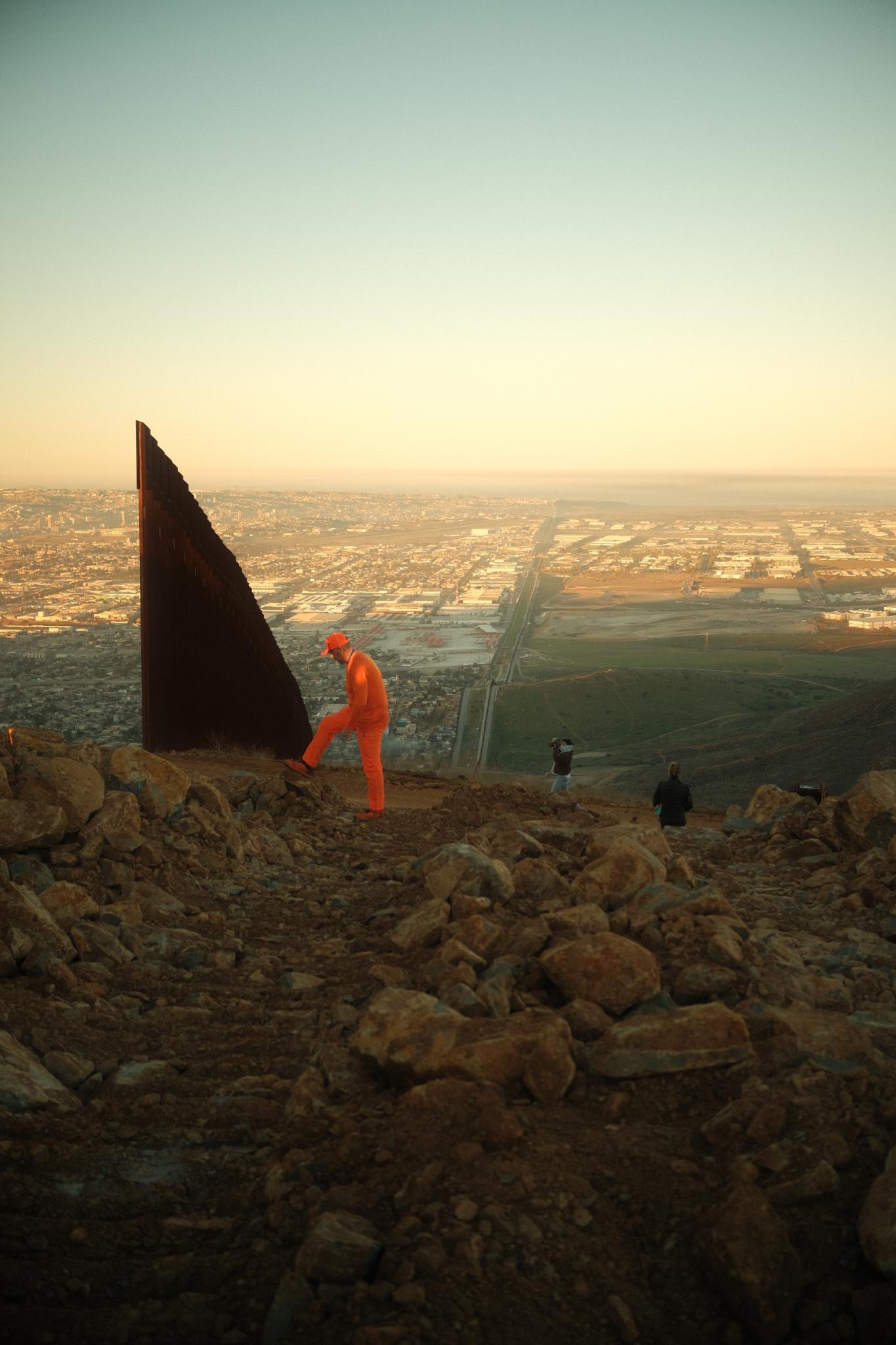
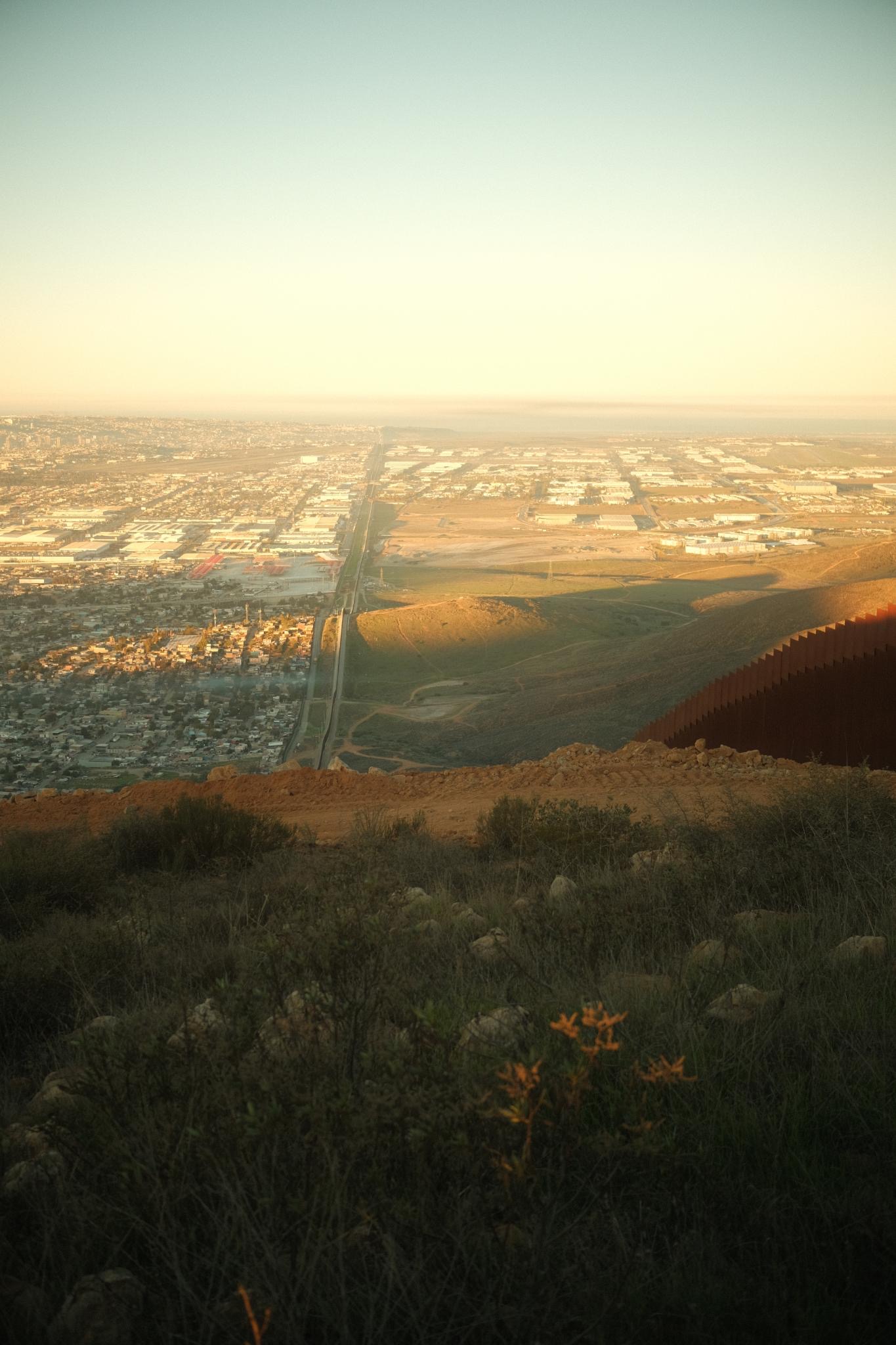
We continued together in a hefty SUV, voices vibrating under unfinished roads, past tower-mounted surveillance systems.14 They sprout up inside coastal sage and cypress forests15 as signatures of the Department of Homeland Security’s (DHS) Integrated Fixed Tower program (IFT).16 IFT matrices heavily blanket the San Diego border region, where Otay Mountain is located. Though the program was initiated in 2018, whispers of what would become the “virtual border” boomerang from the Vietnam War. The McNamara Line, between North and South Vietnam, used a distributed sensor network17—the first real-time surveillance program utilizing an electronic fence, controlled remotely from an air-conditioned command center in Thailand. Ground sensors that looked like bombs with antennae were dropped from OP-2E Neptune aircraft and their transmission towers were tested to monitor Viet Cong supply routes along the Ho Chi Minh Trail.18 That technology was copy-pasted at the Chula Vista sector of the US–Mexico border in the early 1970s as the “War on Drugs” gained intensity.
Today, the virtual border consists largely of steel towers with multisensor system crowns.19 The cluster of sensors and lenses detects movement and orients imaging devices to its source. The sensors then respond to inputs from their environments, churn out mountainous scraps of data, and autonomously organize them into images at a remote facility where a CBP agent identifies (purported) threats.20 Threat is an infinite alarm bell, it’s vibration superimposed on the borderlands in the aftermath of 9/11 and the blank-check battle against an always-enemy.21 The wired network of towers is one material in a constellation of autonomous surveillance technologies and discursive and symbolic methods of computer-generated imaging. These devices fabricate a vantage point—a long view granted through prosthetic architecture. As a force amplifier, they extend the working capacity beyond what a CBP agent can perform within the wet capacity of the human body. The guard’s watchtower has been replaced with sensors, radar, LiDAR thermal imaging, and machine learning that scans the sweeping horizon.
Beacons
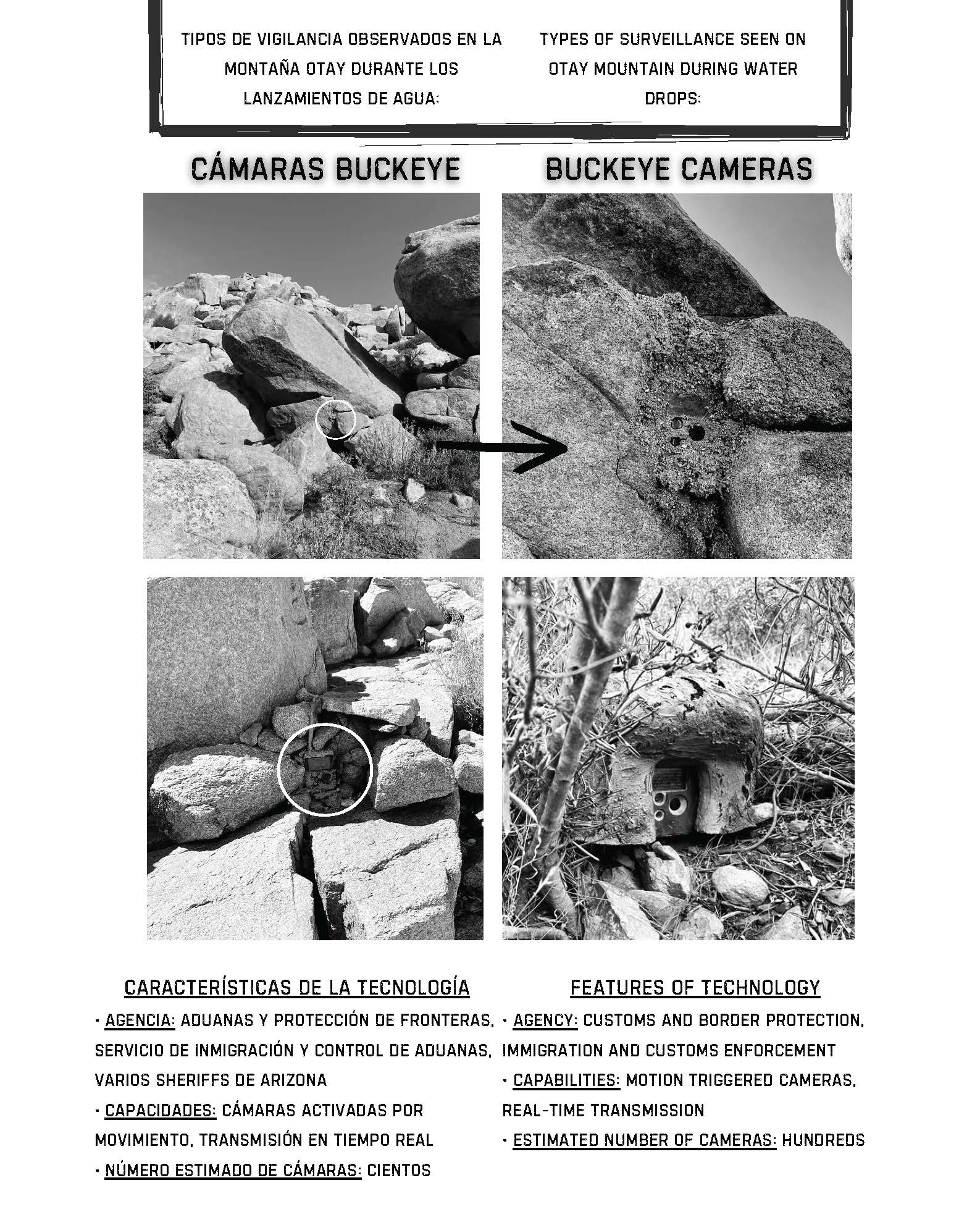
In the back of the BRC truck, one hiker recounted an instance where they found a Buckeye Cam pointed at their piles of water bottles, which were scrawled with encouraging messages, and the acid-colored Gatorades and MREs.22 In recent years, CBP installed cameras at frequent aid drop sites. Buckeye Cams, made by Athens Technical Specialists, are off-grid radio frequency camera systems, often tucked into lucrative government contracts as “networkable trail cameras.” The camera was tucked deep inside the crevices of a fabricated sedentary formation and spackled with soil to disappear into the brush. When the hikers noticed the intrusion, they moved the provisions—but within an hour CBP agents rolled up on the group with threats to arrest them for “tampering with evidence.”23 Aid transfigures into evidence in CBP’s reterritorialization of Otay Mountain.
The manipulation of aid into grounds for apprehension is a frequent tactic across these borderlands. The first tower we approached that day was a “rescue beacon,” positioned closer to recreational hiking grounds than to irregular migration routes. The beacons are a CBP project aiming to account for the ever-rising death count due to draconian deterrence policies; they offer avenues for migrating people in crisis to call for aid by pushing the beacon’s button and alerting the authorities, who ostensibly respond in good faith.
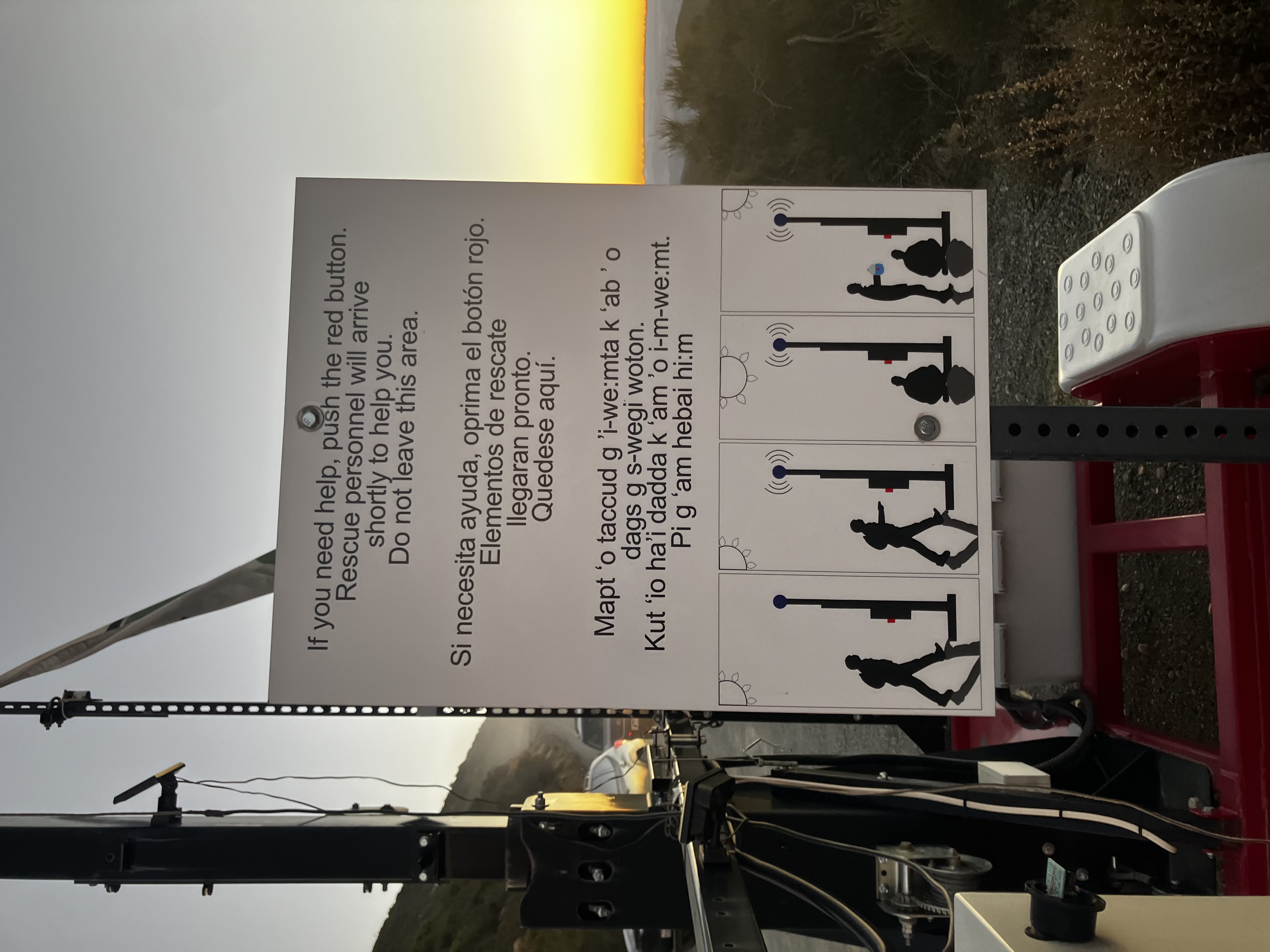
The towers are equipped with a signal system and instructions in three languages (English, Spanish, and Tohono O’odham—the region’s Indigenous language). As analyzed by Tara Plath:
[The beacons are] couched in the rhetoric of aid and humanitarianism by Border Patrol and the media, the rescue beacons operate as a supplemental technology of the border regime, within a system of ceaseless “‘crisis’ management” in a scenario characterized by the US government and media as a “border out of control.” This human rights catastrophe, which has claimed the lives of untold thousands, is the result of the implementation of 1994’s Southwest Border Strategy, a pivotal shift in border enforcement that expanded personnel and infrastructure in cities along the Southwest border.24
As the driver of our car pulls off the road over cracking gravel to provide us a better look, he points to, what he calls, the “arrest-me towers.” In line with Plath, we can understand the beacons as a “symbol and as an object [that] is intended to communicate a message to those within its viewshed and is operationalized across cautious registers including the visual, political and legal.”25
Symbolically, both rescue beacons and surveillance towers are determined reminders of this vicious reorganization of the land. This, in the cache along with passports, visas, residency papers (or, sans papiers26) and warrants that funnel immigration into bureaucratic paper pushing and the theft of time27 and agency. Biometric passports fortify themselves with polycarbonate data pages and iris scanners blink softly at airports. The feigned importance of travel documents and stopgaps such as ports and checkpoints reconstruct relationships to land and mobility in the service of what Lisa Lowe calls an “Anglo-American settler imperial imaginary.”28
The sink hole of “undocumentedness” is the application of il/legality onto subjecthood outside the colonial imagination. DHS’s expanded Systematic Alien Verification for Entitlements (SAVE) program is used as both a citizenship verification tool and a voter suppression tactic. When implemented, it forces immigrants to self-report to US Citizenship and Immigration Services (USCIS). Their data is shared not only with Immigration and Customs Enforcement (ICE) to aid and expedite apprehension, detention, and deportation but is furnished to election officials. According to Chioma Chukwu, Executive Director of American Oversight:
When voter rolls are cross-checked against immigration databases that are not designed to determine voting eligibility, errors are inevitable—and eligible voters can be wrongly flagged or removed. That raises serious concerns about voter suppression ahead of the 2026 elections.29
These are pointed steps toward the establishment of a nationwide citizen/voter eligibility database through the scraping of information kept by federal agencies. The towers are a passage, and their viewshed reproduces data collection and analytics.
Speculative Vision
The etymology of speculation comes from the Latin specula: watchtower, a vantage point, a soaring eye. Speculation is a form of clairvoyance that is integral to the capitalist machine both as prediction of economic potential and ideological drive. As Marina Vishmidt unpacks:
Financial speculation, which thinks of itself as “wealth-creating” or “market-making” doesn’t actually create anything but more of itself—it has no horizon besides an indefinite replication of the future as the present, thus predicated on enclosing the future as a temporality and as a resource.30
Imagine the virtual border as speculation, as towers multiplied. Its reproduction is enabled by an economy that not only propagates a diffuse existential threat emerging from the US–Mexico border but circulates that threat directly as capital. By crafting immigration policy as a stopgap for the intuitive flow of migrating populations, infrastructure must be built to contend with these excesses of information while also functioning as a barrier against external inoculation.31 Vast amounts of capital move through government contracts to fund mutating technologies, monitor the border, and manage the data that is off-gassed. Speculation is a form of infinite self-replication. The future’s enclosure is the domain of the psychic, the cybernetic.32 The future’s enclosure is an impossible watchtower.33
In all its parts, the virtual border is not surveillance but speculative vision. Speculative vision is a dense architecture of designed environments, algorithmic policing, and globalized tracking and citizenship-making that can coordinate and predict movements of colonized populations (migrating and otherwise) for apprehension and labor extraction in an effort to propagate itself. Operating under the cover of “national security,” it generates more targets through global immigration policies and economic sanctions. This is amplified by eroding access to amnesty and deployment of ICE agents away from the immediacy of the US–Mexico boundary and into cities across the country, into every airport, coastline, and metropolitan area; a diffuse, ever-shifting borderlands. The border is virtual because it exists not only in the actual and bloody perimeters of the nation-state but extends deeply, diffusely into the landscape. Speculative vision’s genesis is flexible paranoia that becomes deployable when convenient to those with the most to gain from its contracts and testing. This vision of course includes detention centers and various sites of carceral capture as economic and architectural foundations of the American settler colonial imagination. Dylan Rodriguez notes:
Mass incarceration” evidences an ideological formation that shapes the language and policy of the contemporary (abortively “post-racial”) racist state while expanding the conceptual and political scope of a punitive and racist approach to policing, criminalization, and human capture.34
As oracle, speculative vision anticipates criminality and ensures that the built environment of the virtual border responds. Psychic anticipation churns alongside dangerous terrain, and subsequent detention.
Clairvoyance
Clairvoyance, we may presume, exists within the realm of the metaphysical or paranormal;35 it is not lodged in materials of surveillance and capture. But how else would you describe a pursuit of endless sight at impossible distances? Delusion? Paranoia? Anduril Industries, an American “defense” tech company, markets “persistent autonomous awareness across land, sea, and air”36 as its foundational asset. This constant state of awareness addresses both diffuse infiltration that is speculatively looming and a presence that soothes deep anxiety. Annihilation37 consumes the technocrat class and absorbs the workers within the matrices of border technology. Total vision across thousands of square miles of arid landscape is unachievable through the bodies of conventional CBP agents alone, so it’s outsourced to entities that can provide it. This holds transhuman desire and anti-labor automation dreams—ideologies that preoccupy defense contractors and political stakeholders alike. To evidence this and indulge in similar paranoia, let’s dig into the Stargate Project.
Conducted in aging barracks at Fort Meade in Florida, Stargate was a classified US Army unit established in 1977 by the Defense Intelligence Agency and the Stanford Research Institute as the American response to a Soviet parapsychology unit.38 The unit was tasked with exploring the possibility of exploiting extrasensory perception (ESP) for military intelligence applications. The phenomenon of interest was a subset of clairvoyance: remote viewing (RV). RV is “the attempt to sense unknown information about a distant and unseen subject”39 through the acceptance of conceptual data and images through meditative techniques that train the viewers to rid their minds of “noise,” or extraneous environment input, and open themselves up as channels.
In a remote viewing, “[The viewer] is asked to visualize a place, location, or object being viewed by a ‘beacon’ or sender. A judge then examines the viewer’s report and determines if this report matches the target or, alternatively, a set of decoys.”40 By 1995, the program had conducted several hundred intelligence collection projects involving thousands of remote viewing sessions, to some notable success.41 Though it was eventually transferred to CIA jurisdiction and subsequently defunded after an audit by the American Institutes for Research, it wasn’t ended because RV did not produce measurable results. Rather, it was concluded, “even though a statistically significant effect has been observed in the laboratory, it remains unclear whether the existence of a paranormal phenomenon, remote viewing, has been demonstrated.”42 Though entrenched in doubt, it is not difficult to draw a line between this fantasy of clairvoyant sight and the technocratic desire to erase unknowability through the management of data flows. After all, Palantir, the defense contractor tasked with building a database of the US’s citizenship data, is named after a collection of all-seeing stones.43
Noise
Sonic disruption sets my pace alongside the Borderlands Relief Collective team on this excursion. Following fenced roads, the hikers and I came upon another mobile surveillance tower. I had to squint because this one was similar to the suite of steel and solar panels nearby, except sprouted from the bed of a white Ford pickup, camouflage-patterned mesh hardly obscuring its wheels.44 Most notable when hiking around the various towers was the sound emanating from the machines themselves. These towers operate on solar power but have backup generators that hum like a hive of a million bees, a hungry drone. Their vibration is haptic, waveforms stretching like a rubber band across the mountain range connecting to the hum of data centers a few miles away, boasting seamless data connectivity from San Diego, California, to Baja, Mexico.45 Inside, active-duty army personnel were sleeping, the noise machine of the towers a soundtrack to their dreams.
What is noise to a tower? Noise is a random variation of excess information that appears in images and data sets. Noise is food for computational systems being fed extraneous data points and cloudy data to teach them to sharpen their gaze. It can appear as grain that obscures a face in a photograph and irrelevant or erroneous data points that deviate from the expected pattern when training algorithms. In surveillance systems installed on territorialized borders, movement registers as a signal before resolution clears. Data needs to be cleaned and immobilized well before anyone is apprehended. Migrating people, coyotes, cars, anything that moves… produces noisy data in need of interpretation, and discipline.
Hito Steyerl asks, “What are the social and political algorithms that clear noise from information?” and her answer is more politics. At the border, citizenship is assigned through the collection of de-noised images that mark a subject as an intruder.46 This is the plane where disciplinary techniques of nationalist identity get to play out with the help of algorithmic translation. Steyerl further writes:
If one wants to not take someone else seriously, or to limit their rights and status, one pretends their speech is just noise, garbled groaning, or crying, and that they themselves must be devoid of reason and therefore exempt from being subject, let alone holders of rights. In other words, this politics rests on an act of conscious decoding—separating “noise” from “information,” “speech” from “groan”... and from there neatly stacking the results into vertical class hierarchies.47
The virtual border is a generator of images churning within the dense patchwork of automated surveillance devices. Noise is cleared away to make images generated through the vast net of surveillance infrastructure. The Otay Mountain region along the US–Mexico border is a primary ground for carceral applications of autonomous surveillance technologies and discursive and symbolic methods of computer-generated imaging that make noise from those systems, make noise from the land. As artist Oraib Toukan writes, “The mathematician and pedagogue Munir Fasheh often refers to turbeh, meaning soil, to describe forms of knowledge and consciousness that stem from the grain of the earth. Just like turbeh, the grain of every image—its noise—contains knowledge beyond what the image itself represents.”48
Computational Images
I am careful to mark the images49 collected within these machines as bypassing the human. They are built by real people according to necropolitical codes. But can we apply the logic of photography to towering image generators? Maybe. Photography relies on optics, which is to say, the body. The techniques used to generate the images at the border are not removed from the body; the body they see is networked and pieced together algorithmically. Writes Roland Barthes, “The photographic representation always leads the corpus I need back to the body I see,”50 meaning—sight within speculative vision is leading back to the photographic representation. It is the gas that powers the system. But their mode of production is much different from that of the point-and-shoot camera.
Among these towers, image-making takes the form of description rather than optical. The system constitutes an infrastructural corpus of data where machine-learning models describe the temperature of bodies moving covertly in the dead of night, sensors feed stimuli from the landscape and then, finally comes the image. The resulting image is computational. Computational photography uses algorithms to generate images, by piecing the information harvested from the field through pattern recognition established through extensive machine training. It is coded with the algorithmic, which is to say, these images are imbued with bias and are wholly political. They use internal ethics systems to duplicate the desires of the state: supernatural total vision in service to the creation of deportable subjects. Patrolling at this scale is made possible through computational power. This necessitates new and better-networked digital infrastructure, through the establishment of hyperscale data centers51 as support because there is an unrelenting desire for apprehension. These processes’ dependence on computation links them to raw material resources, all of which place the images into a vast supply chain. Alongside and within these images, we are more in the realm of rare earth minerals and the toxic steam of the data centers than any photography darkroom.
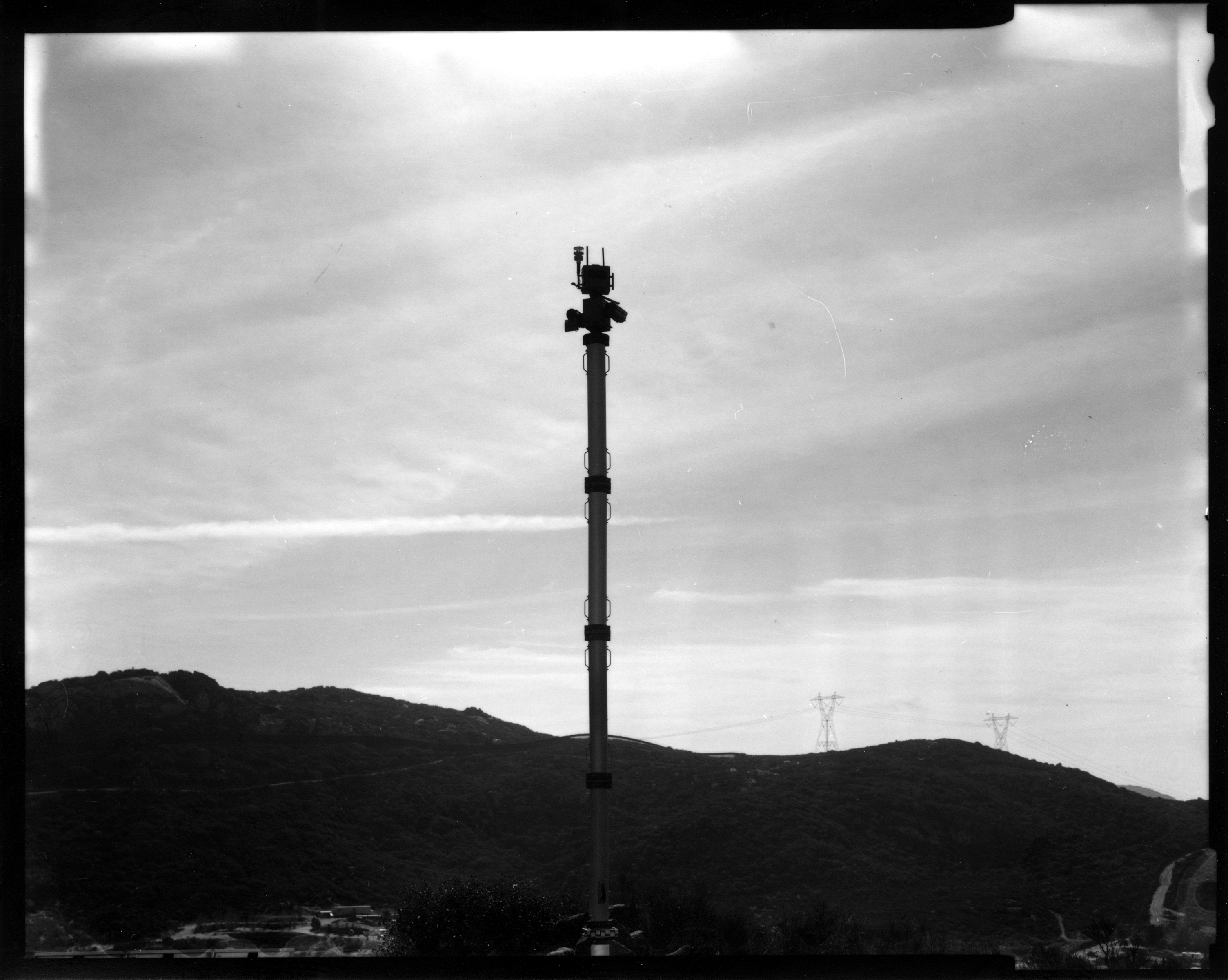
In his photo series “Self Portrait (2024–ongoing),” D. A. Gonzales hikes to Autonomous Surveillance Towers (AST) guided by the Electronic Frontier Foundation’s comprehensive map.52 He takes photographs of the towers using a large-format film camera and prints them using darkroom techniques. This analog approach registers the towers within canons of landscape photography that are foundational to colonial imaginations of land, ownership, and destiny. He marks the “complex historical bind between historic photographic technology and its afterlives in ongoing construction of the nation-state.”53 The enduring image, though, is not what lives in the gallery but the untouchable images of his and others’ lives operationalized within this hyper-surveillance system’s consciousness. Alongside his photographs are the artist’s Freedom of Information Act (FOIA) requests seeking his image back from the towers. His requests and appeals were denied. The interplay between the request of his image and the portrait of a machine that sees back acts as an obsidian mirror, with the image collected by the machine never amounting to a photographic depiction but rather fugitive and residing in the untouchable symbol of bottomless reflection. What the work demands is a recognition of data capture as it restages the endlessness of American bureaucracy into an archive.
Kill You in Real Life
Back on the mountain, the sun fills the sky, illuminating our faces, illuminating the machinery. About 100 yards from the mobile tower was an Anduril-branded AST, a unit in their “Sentry” system for “autonomous awareness.”54 It was overwhelming in scale. The murky beige components hardly obscure the harsh transformer parts against the arid hills.
Anduril’s founder and ex-virtual reality executive, Palmer Luckey, wants to turn “allied warfighters into invincible technomancers who wield the power of autonomous systems.”55 His lust for science fiction and fantasy-infused security is not a stretch. DHS has hired science fiction writers; “Anduril” is ripped directly from Lord of the Rings.56 Luckey is the designer and cofounder of the Oculus Rift headset. He sold the company to Facebook for $2 billion in 2014 and was subsequently fired after public donations to allies of the first Trump presidential campaign. After this hiccup, he pivoted into autonomous weapons manufacturing, cofounding Anduril Industries in 2017, a start-up based in Costa Mesa, California, that specializes in government contract acquisition and automation. In his office, he displays a headset he manufactured, inspired by NerveGear from the anime Sword Art Online. In a blog post titled “If You Die in the Game, You Die in Real Life,” he writes,
It houses three explosive charge modules I usually use for a different project, tying them to a narrow-band photosensor that can detect when the screen flashes red at a specific frequency, making game-over integration on the part of the developer very easy. When an appropriate game-over screen is displayed, the charges fire, instantly destroying the brain of the user. This isn’t a perfect system, of course. I have plans for an anti-tamper mechanism that, like the NerveGear, will make it impossible to remove or destroy the headset.57
Luckey’s first contract with CBP was signed in 2019, around the same time as a surge in deaths in these borderlands. At the time of this writing, Anduril has deployed over 400 ASTs, covering about 30 percent (1,200 kilometer linear coverage) of the US southern land border.
Interface
When it was first conceived, Anduril’s proprietary operating system, “Lattice,” was meant to be accessed through a virtual reality headset.58 From one of the many promotional PDFs circulated by the company:
[Lattice is] an open operating system for Defense that delivers autonomy to the toughest missions. It enables operators to understand, decide, and act with machine speed, unparalleled confidence, and military grade security by turning data into information, information to understanding, understanding to decisions and decisions to actions across tactical and strategic operations.59
The interface makes data legible to humans. This legibility is organized by algorithms designed to assign animacy or aliveness to the data gathered; that is to say, it organizes hierarchies of humanness against signals for a coyote or a car. Heat sensors could pick up anything with blood, but what blood makes a target?
Lattice offers CBP agents a conceptual space to determine citizenship status through images.60 High-contrast and noisy infrared pictures are pieced together from an unknowable quantity of abstract information, marked simply as “person” on the dashboard; tiny figures with defaulted ghostly white skin appear on a full-color GPS map. The interface parses identifiers of race, movement, land, and labor through a web of reproductive actors that compute legality.
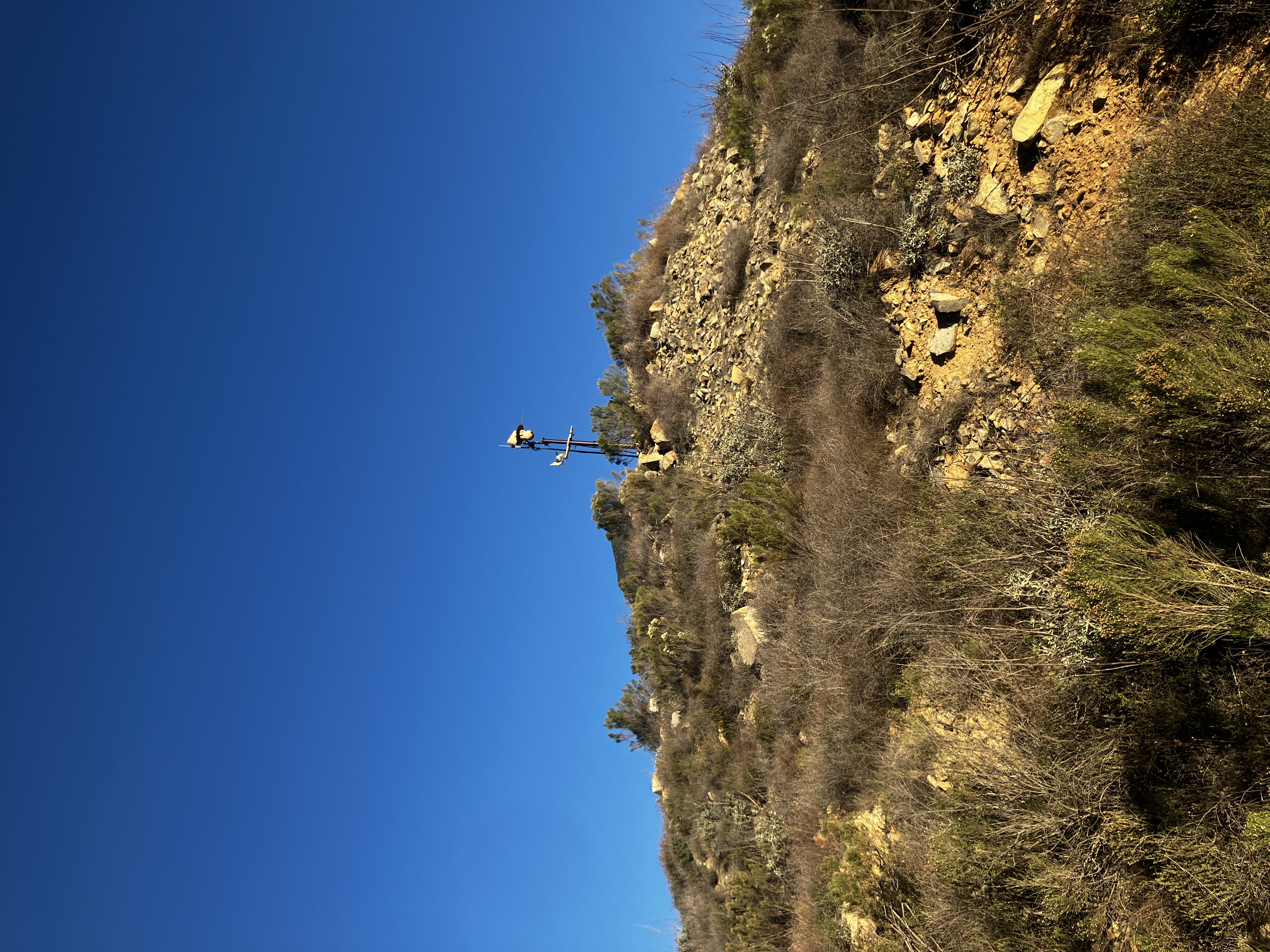
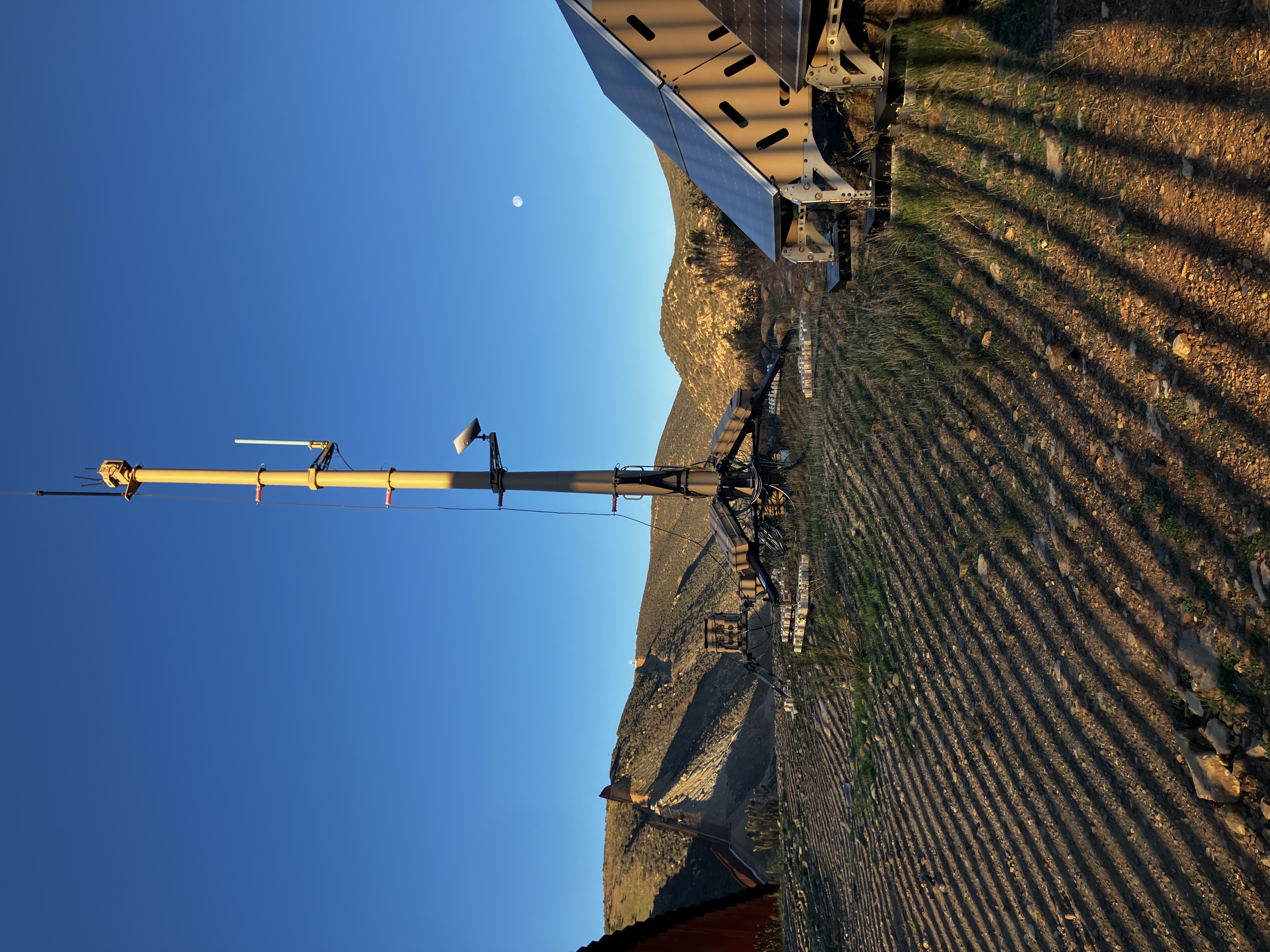
The specific configuration of apprehension at the US–Mexico border is one that historically used labor as its primary filter for racial inclusion and imposed “illegality” through the capacity for people’s labor to be organized (disciplined) and extracted. Undocumented migrations (irregular passage) can be framed as labor migrations. From 1925 to 1940, the US Border Patrol operated under the Department of Labor.61 As Hannah Black writes:
The colonial and the racial don’t just organize surplus, they also organize the interior of labor, and this remains the case whether a particular racialized or colonized population is deployed as labor or not. Of course, we all know now, this is what a border is.62
The border patrol agent, the migrant, the Otay Mountain Range, the Lattice programmer… are all parts of an amalgamation of target-makers and data repositories that reestablishes the idea of homeland as organized for the settlement of the white, legal subject.
Lattice is embedded in Sentry ASTs and meshes them to legacy infrastructure by networking signals previously connected via phone or radio using artificial intelligence. But the interface is different from the familiar cinematic devices of film and television that telecast images on screens. It offers DHS personnel telepresence, or “the feeling of being present at a remote location by means of real-time telecommunications devices”;63 it gives agents the ability to touch what cannot touch them back. Captured populations from within its viewshed embark on an alternative passage through sensors and electro-optical imaging.
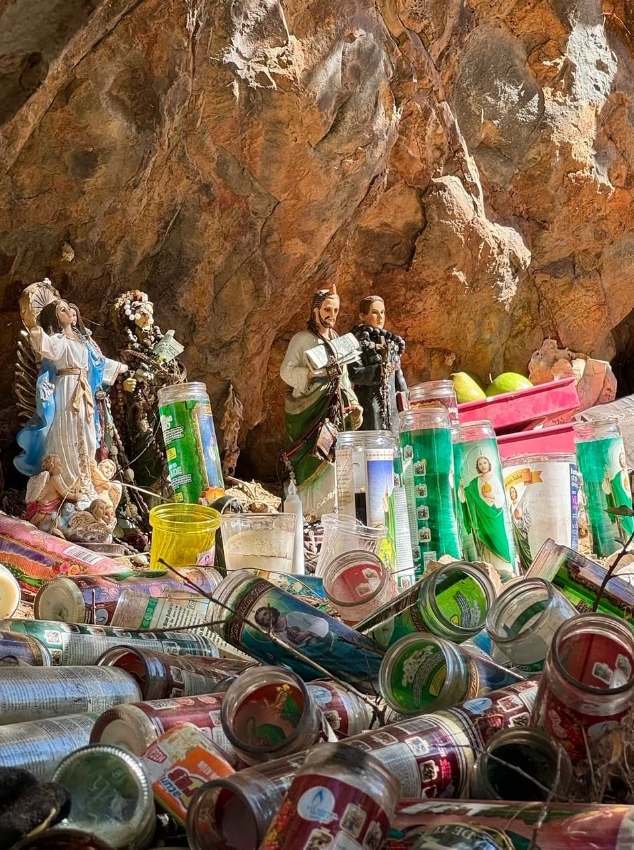
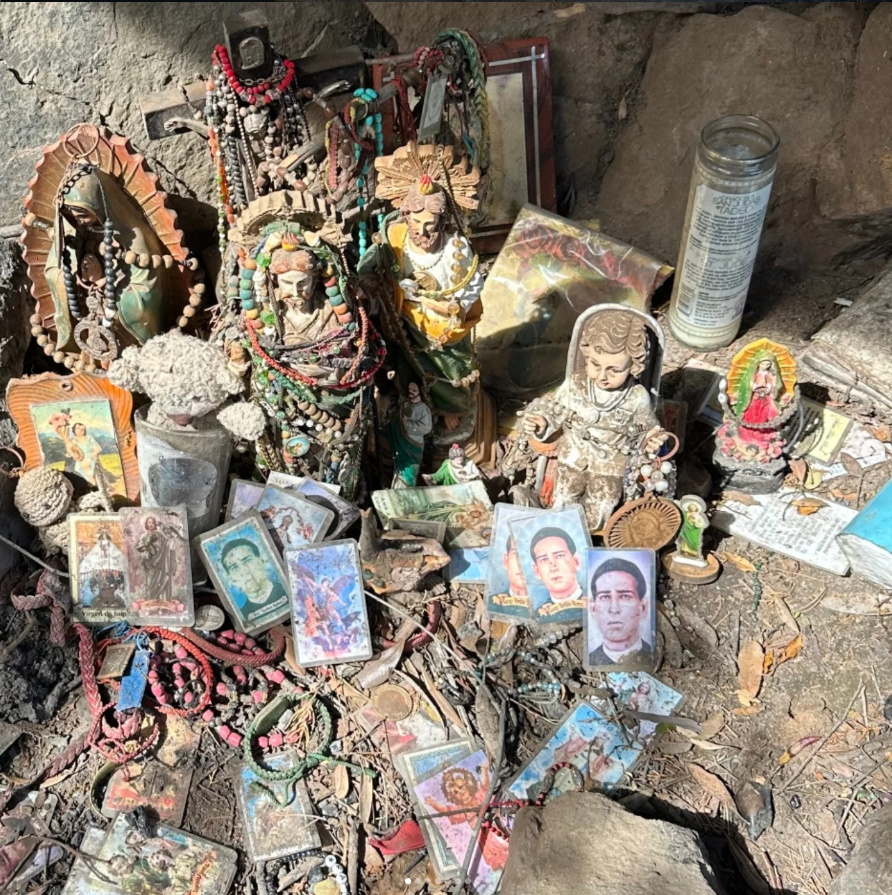
We finished our ride, winding hard and fast down the mountain. The truck whips past blue-tinged vistas of quarry rock and yellow grass so fine it blurs. I spoke to two hikers in the truck, trying to hold my shaky recorder on my knee, scraping their voices, crunchy noise, and other breath in the desert. The mountain is sacred Kumeyaay ancestral territory. One hiker spoke of the lifeworld that had been annihilated from Otay Mountain—by the border wall’s palimpsestic ecocide, and spiritually through the magnitude of migrants’ deaths. The BRC accounts and attends it. They participate in search and rescue operations, place grave markers, and conduct funerals. An unspoken part of the BRC’s mission is death doula work—performing the spiritual and reproductive labor that maintains the dignity of migrants through funeral rites and shrine-making as well as distributing aid for those still alive. Migrating people deserve the cover of noise through the machinations of violence and its blanket of static in the mountain. The BRC performs one last rite. In unison they say the deceased person’s name three times, letting it reverberate through the valleys.
-
The Tijuana–San Diego borderland is the busiest land crossing in the Western Hemisphere. ↩
-
Hailed as a laboratory of postmodernity by anthropologists like Néstor García Canclini in the 1990s, this framing reified the fantasy of Tijuana as a bordertown with boundless cultural contact and absurd hybridity, leaving out the cartel-fueled violence that has continued to decimate the region. Canclini characterized the city using the concept of “urbantransnationalism,” arguing that the culture of Tijuana orients itself toward (or rather “up” to) the United States and, as a result, has developed an identity distinct from the rest of Mexico. However, upon revisiting the city in 2000, he reframed the region as “a laboratory of the social and political disintegration of Mexico as a consequence of a calculated ungovernability.” See Josh Kun and Fiamma Montezemolo, eds., Tijuana Dreaming: Life and Art at the Global Border (Duke University Press, 2012), 95. ↩
-
San Diego is home to more than 100,000 active-duty military personnel (split between the US Navy and Marine Corps). ↩
-
Untreated wastewater from Mexico flows into Southern California. The US Environmental Protection Agency committed $300 million in the United States–Mexico–Canada Agreement (USMCA) to mitigate the pollution and restore the area’s potential for tourism. See “Tijuana River Watershed Provisions in US–Mexico–Canada Agreement (USMA),” EPA, link. ↩
-
A reference to Sayak Valencia’s book Gore Capitalism (2010), the endriago subject is “a new creature, an amalgam of economic entrepreneur, political entrepreneur and violence specialist.” It functions as the ultimate actor in the terrorscape of Tijuana because they traverse the deadly field of cartel violence to find economic subjectivity. Sayak Valencia, Gore Capitalism, trans. John Pluecker (Semiotext(e), 2018). ↩
-
Maquilladoras are factories that operate at or near the US–Mexico border. The entire system is predicated on exporting goods, mostly to the US. Raw materials are imported duty- and tariff-free, and, coupled with low-cost Mexican labor, these factories have emerged as sites of labor exploitation, ecological violence, and quasi–special economic zones. ↩
-
The museum showcases the local logic of global neoliberal horror: Whoopi Goldberg from the 1992 movie Sister Act sits alongside Mexican colonial-era presidents, next to US Democratic presidents, next to El Chavo del Ocho, next to a Mexican ritual heart-sacrifice scene, next to Marilyn Monroe, and so on… you get the picture. The result is a total cultural collapse between the US media machine and the Mexican imaginary, which steals and recasts these figures, thus reflecting Tijuana’s taste for imported symbols. ↩
-
Enclave Caracol permanently hosts Tijuana Comida No Bombas, who offer hundreds of free vegan meals weekly. It serves as an event center for a rotating group of activists and artists and runs a vegetarian café. It responds to the direct needs of the migrant community by offering free access to technology and clean drinking water as well as cultural needs—such as offering Haitian dance classes. ↩
-
I was invited by Homegrown, a collective of educators and researchers who work to dismantle adult supremacy and empower youth in the San Diego region and beyond. For more, see: link. ↩
-
Borderlands Relief Collective, Borderlands Relief Collective Mission Statement, link. ↩
-
My favorite example of structural filmmaking is Carolyn Lazard’s Red (2021). The film is made by the artist covering their phone camera with their finger and then lifting it to reveal a red, glowing flicker. The video installation produces a warm, fleshy glow. It produces color-field gradients in that glowing orange of a finger held beneath a flashlight. The most important part for me is the strobe warning, which embeds accessibility into the foundation of the film. Lazard works through disability in ways that situate the body in relation to metrics of pain and the racialized attitudes that accompany it. The Flicker (1966) by Tony Conrad was arguably the first film to use this technique. He begins his film with a warning message about the optic injury that may occur from watching the film. I make these parallels because of the landscape of optic violence at the border. It might not have been intentional, but as someone who experiences seizures, this layer of harm was unexpected. ↩
-
See Jasbir Puar, The Right to Maim: Debility, Capacity, Disability (Duke University Press, 2017). ↩
-
In 2025, CoreCivic expected to make $300 million from ICE contracts. The company reported total revenue of $538 million in the second quarter, up 9.8 percent from 2024, with net income of $38.5 million. ↩
-
Among the four we encountered, the largest was an integrated fixed tower (IFT) manufactured by Elbit Systems, a global manufacturer responsible for designing the apartheid architecture inside Gaza and across Palestine. This tower is the largest and most imposing, sitting at the highest point of the immediate landscape. A makeshift gravesite is cradled within its barbed wire perimeter. I won’t go into this more deeply but instead direct you to Caitlin Blanchfield and Nina Valerie Kolowratnik, “‘Persistent Surveillance’: Militarized Infrastructure on the Tohono O’odham Nation,” Avery Review, no. 40 (May 2019), link. ↩
-
The word “Otay” derives from the Kumeyaay language; some say “otai” = “brushy” + “etaay” = “big.” ↩
-
As stated on the US Customs and Border Protection website, “The IFT system provides detection and identification of items of interest enabling Border Patrol agents to more efficiently and effectively respond to border incursions.” The items of interest are migrating populations. ↩
-
Matt Novak, “How the Vietnam War Brought High-Tech Border Surveillance to America,” Paleofuture, September 24, 2015, link. ↩
-
The film Bugging the Battlefield, produced by the Department of Defense in 1969, shows the scope of the project. The sensors were dropped into the field like bombs from an aircraft or were installed by hand. The scope of the film is primarily infographic, using banal staged scenes to document the technological scope of the operation, undoubtedly to combat widespread critique of a very unpopular war. What appeals to me most about the film is the interspersed animation. Hand-drawn and rudimentary, the only animated subject is the data. It moves in radial paths up and outward, overlaid on flat green jungle scenes; the rendering is the same shade as the camouflage that patterns the sensor itself. ↩
-
They are commissioned by the Department of Homeland Security, and while their manufacturers and functions vary, the systems operate in similar ways. ↩
-
US Customs and Border Protection, “CBP’s Autonomous Surveillance Towers Declared a Program of Record Along the Southwest Border,” CBP Newsroom, July 2, 2020, link. ↩
-
The Department of Homeland Security was established as a “response” to the events of 9/11. For more, see “The Department of Homeland Security,” link. ↩
-
We also saw one embedded in a traffic sign on our way up, pointed backward to catch car license plates. While the tracking of and reporting on these proliferating technologies is a difficult cat-and-mouse game, see Electronic Frontier Foundation, “Border Surveillance Technology,” link. ↩
-
The BRC has pro bono lawyers on call during their excursions. That day, as hikers started to motion to call for legal representation, CBP agents backed off. The threat of arrest itself was a fear tactic. ↩
-
Tara Plath, “An Elusive Viewshed: An Investigation of United States’ Border Patrol Rescue Beacons in Arizona’s Western Desert,” Plot(s) 7, no. 2 (2020), link. ↩
-
Plath, “An Elusive Viewshed.” ↩
-
The tactics and technologies, of course, piece into global carceral regimes; we can connect the agency, and lack thereof, of people on the move from Otay Mountain to the Mediterranean Basin and beyond. See, for example, Mogniss H. Abdallah, “The Sans-Papiers Movement in France,” The Funambulist, December 12, 2023, link. ↩
-
For more, see Shahram Khosravi, “Stolen Time,” Radical Philosophy 203 (December 2018): 38–41. ↩
-
Lisa Lowe, The Intimacies of Four Continents (Duke University Press, 2015). ↩
-
American Oversight, “American Oversight Sues ICE and DOJ for Records on Sensitive Voter Data Collection and Sharing,” March 10, 2026, link. ↩
-
Andreas Petrossiants, “Spaces of Speculation: Movement Politics in the Infrastructure,” interview with Marina Vishmidt, Historical Materialism, November 14, 2020, link. ↩
-
In January 2025, the “Protecting the American People Against Invasion” Executive Order mandated an alien registration requirement, stipulating that every immigrant over the age of fourteen must register with US Citizenship and Immigration Services (USCIS). This puts communities at risk by forcing their inclusion in databases that manipulate voting and representation. It further provides information that may be used for detention and deportation. The White House, “Protecting the American People Against Invasion,” Presidential Action, January 20, 2025, link. ↩
-
See also Ivan Chaar Lopez, The Cybernetic Border: Drones, Technology, and Intrusion (Duke University Press, 2024). ↩
-
I want to frame the following analysis by emphasizing Marina Vishmidt’s insistence on the negative aspects of speculation. Her adherence to Theodor Adorno's negative dialectics is useful here because it holds space for the impossibility of resolution within the struggle against capture by larger systems of control. Especially when the subject matter is heavily inflected by science fiction, she encourages analysis that moves away from utopian possibilities of speculation, instead foregrounding labor as an antidote to the exceptional speculative sphere of cultural production. ↩
-
Dylan Rodríguez, “Carceral Architectures of Policing: From 'Mass Incarceration' to Domestic Warfare," in Paths to Prison: On the Architectures of Carcerality, ed. Isabelle Kirkham-Lewitt (Columbia Books on Architecture and the City, 2021), link. ↩
-
Take the Mayan priest Chilam Balam, who predicted the coming of the Spanish Inquisition. In his prophecy, bearded men would descend on the Yucatán and introduce a new religion. Though he had thought that it was indicating the arrival of Quetzalcoatl, the feathered serpent deity who is the creator of humanity, the presence of the Spanish at the predicted time made Balam the greatest oracle in Mayan history. ↩
-
Let’s look to PayPal and Palantir cofounder Peter Thiel, who has a preoccupation with death and a fear of aging. He says that technology can overcome death and invests heavily in antiaging protocols. He has often aligned himself with transhumanism. Conversely, he has gone as far as advocate for the end of humanity in favor of a technologically enmeshed species. I’d also suggest a skim of headlines covering Thiel’s March15–18, 2026, lectures in Rome. For example, see James Imam, “Peter Thiel Labelled a Heretic by Vatican Aide over Antichrist Talks,” The Times, March 16, 2026, link. ↩
-
US Central Intelligence Agency, “STAR GATE Project: An Overview” (Central Intelligence Agency, 1995), link. ↩
-
Jan Dirk Blom, A Dictionary of Hallucinations (Springer, 2009), 451. ↩
-
Michael D. Mumford, Andrew M. Rose, and David A. Goslin, An Evaluation of Remote Viewing: Research and Applications (American Institutes for Research, September 29, 1995), link. ↩
-
Federation of American Scientists, "STAR GATE [Controlled Remote Viewing]," Intelligence Resource Program, link. ↩
-
Mumford, Rose, and Goslin, An Evaluation of Remote Viewing. ↩
-
Sheera Frenkel and Aaron Krolik, “Trump Taps Palantir to Compile Data on Americans,” New York Times, May 30, 2025, link. ↩
-
I walked up to the tower, choosing to leave my large camera behind. I wanted to get a closer look at the mobile setup because I hadn’t come across it in my research previously. It was stationed on a large hill, a three-minute walk away from where the hikers were preparing for the trail. As I approached, I saw large sandbags littering the ground and tangles of wires that led to the truck. It looked slightly lived in, with water jugs stacked near the tires and a tarp draped over the window to create a makeshift shade. I got spooked and turned around. I squatted to pee, thinking that it might be a good idea to have an excuse to be up there. As I stood up, I found an armed active-duty soldier looking at me. He was young and Latino and clutched his gun as he asked if I was crossing. I said, “No, I’m with the hikers,” with my hands up. He let me go, and I counted my privilege. The experience lingers, and I feel how much my assimilation has blanketed and insulated my own passage through this speculative vision. In the 1970s, my paternal grandmother, Ana Martinez Saucedo, was pregnant with my youngest aunt. She traveled from the northern Mexican state of San Luis Potosí to cross Otay Mountain. She was apprehended and ended up in Tijuana, from where she crossed along the beach months later. ↩
-
This essay and my own understandings of computational photography and noise are indebted to Hito Steyerl’s book Duty Free. I hope to extend the location of her research and make more noise among her signal. See Hito Steyerl, Duty Free Art: Art in the Age of Planetary Civil War (Verso, 2017). ↩
-
Steyerl, Duty Free Art, 37. ↩
-
Vijay Masharani, “Oraib Toukan: ‘Cruel Images’ and the Blind Spots of Hypervisibility,” Artforum, April 20, 2022, link. ↩
-
Noise is also a common vehicle for virtual image-making, both computer-generated and imagined. Take Perlin noise, an algorithmic pattern that provides realistic texturing by scattering light and darkness in 3D modeling software. It was created by Ken Perlin in 1982 while he was working on the movie Tron, which subsequently received an Academy Award for technical achievement. Designers use noise for representation by applying and manipulating the pattern to generate randomized terrain, give pores to skin, fluffiness to clouds, and waves to the ocean: a whole world simulated in noise. Perlin worked at Mathematical Applications Group (MAGI), a subsidiary of United Nuclear Corporation. MAGI repurposed radiation modeling data from uranium processing for the US Navy’s nuclear propulsion into ray-tracing techniques that enabled flash and chrome effects. Ray tracing simulates the path of light as it bounces across surfaces, calculating reflection, refraction, and shadow, transforming raw calculation from nuclear power into luminous realism. For more, see “Perlin Noise: A Procedural Generation Algorithm,” Raouf’s Blog, link. ↩
-
Roland Barthes, Camera Lucida, trans. Richard Howard (Vintage Classics, 1993). ↩
-
Anduril Industries, “Anduril Building Arsenal-1 Hyperscale Manufacturing Facility in Ohio,” Anduril, January 15, 2025, link. ↩
-
Electronic Frontier Foundation, "Border Surveillance Map," US–Mexico Border Surveillance Data, link. ↩
-
D. A. Gonzales, “Survey of the Virtual Border (Self-Portrait),” link. ↩
-
Curiously, the program to expedite passage across the US–Mexico border is called “SENTRI.” It’s a visa program that encodes biometrics into cars of verified citizens, who often hold dual passports, and allows for quick(“er”) passage across the San Ysidro and Juarez border crossings. See US Customs and Border Protection, “Secure Electronic Network for Travelers Rapid Inspection,” link. ↩
-
Palmer Luckey, “Turning Soldiers into Superheroes,” The Blog of Palmer Luckey, February 11, 2025, link. ↩
-
Jim Dawson, “Science Fiction Writers Bring Creativity to DHS,” Physics Today, August 1, 2007, link. ↩
-
Palmer Luckey, “If You Die in the Game, You Die in Real Life,” The Blog of Palmer Luckey, November 6, 2022, link. ↩
-
Tom Simonite, “Behind Anduril's Effort to Create an Operating System for War,” Wired, October 8, 2020, link. ↩
-
When reporting on surveillance networks used by CBP agents in the Sonoran Desert, reporter Gaby del Valles found that after image collection and force deployment, “The agents on the ground would get more details: names, ages, nationalities. After that, the specifics would matter a little. If the hikers were carrying drugs, they’d be prosecuted. If they had been deported before, they could be charged with illegal reentry. But if this was their first time—if they were crossing the border for work or to reunite with family on the other side or because they were in danger in their country—they’d likely be sent back to Mexico, regardless of where they had come from.” Gaby del Valles, “The Most Surveilled Place in America,” The Verge, August 8, 2022, link. ↩
-
Nicholas P. De Genova, “Migrant ‘Illegality’ and Deportability in Everyday Life,” Annual Review of Anthropology 31 (2002): 442. ↩
-
Hannah Black, “Like Knives in a Block,” Nordic Journal of Aesthetics 34, no. 70 (2025): 29. ↩
-
Kris Paulsen, Here/There: Telepresence, Touch, and Art at the Interface (MIT Press, 2017). ↩
Cielo Saucedo (1993, Whittier, CA) lives and works in Los Angeles. Their work encompasses writing, computer-generated imagery, sculpture, and machine vision. They received their BFA from the School of the Art Institute Chicago in 2020, and their MFA from UCLA in 2024. They were an Eyebeam Democracy Fellow (2024). Recent exhibitions of their work include presentations at the Coaxial Art Center (2025), the Armory, Pasadena for Getty PST (2024), François Ghebaly, Los Angeles (2024), Honor Fraser, Los Angeles (2024), and MexiCali Biennale, the Cheech at the Riverside Museum (2023). They have given panels and lectures at NYU, UPenn, the Whitney Independent Study Program, Emily Carr University, Indiana State University, and the Sandberg Instituut, among other institutions. They are moving through.